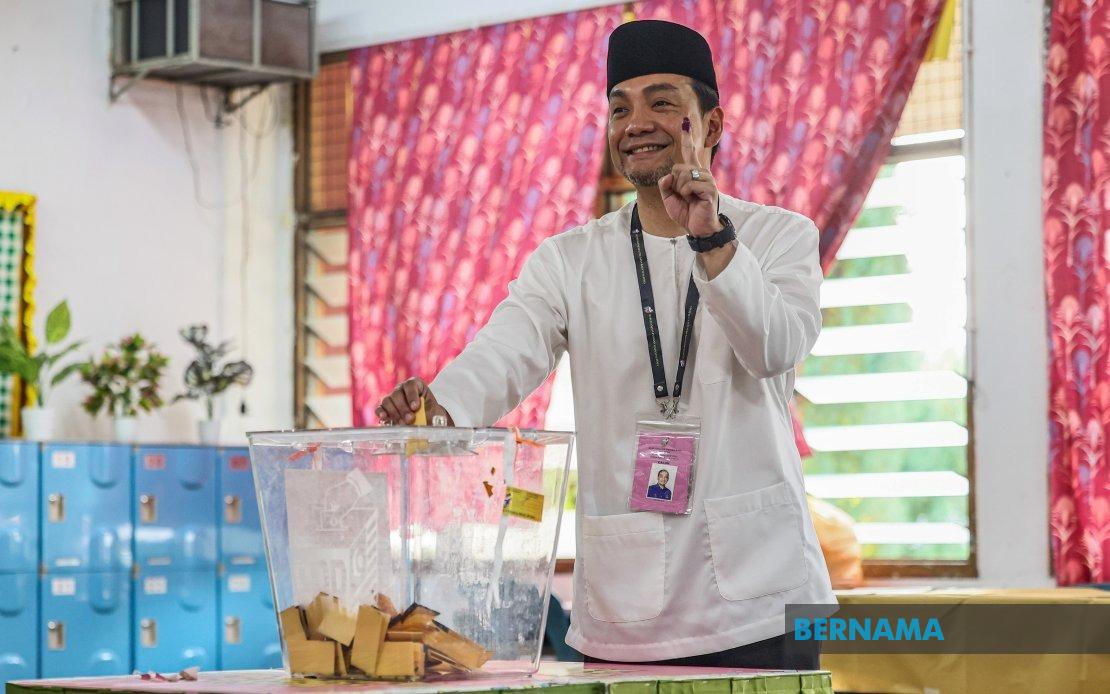
Johor Menteri Besar Datuk Onn Hafiz Ghazi voted in the 16th Johor state election on July 11, arriving at Sekolah Kebangsaan Simpang Renggam in the morning. The seasoned politician, who chairs the Johor branch of Barisan Nasional, made his way to Stream 4 at 8.33 am to exercise his democratic right in what represents a closely watched contest reflecting broader political dynamics across the state.
Before casting his ballot, Onn Hafiz engaged with constituents gathered at the polling centre, demonstrating the traditional retail politics that remains central to Malaysian electoral campaigns. His interactions with other voters at the school reflected efforts to maintain grassroots engagement even as voting commenced, a strategy designed to reinforce BN's ground presence during what many observers viewed as a critical test of the coalition's standing in one of Malaysia's most politically significant states.
The Menteri Besar faces a direct contest against Nur Hafiz Roslan of Pakatan Harapan in his electoral battle. This straight fight encapsulates the broader two-coalition struggle that has defined Malaysian politics since the 2018 general election, with BN seeking to consolidate its recovery and PH attempting to maintain influence in key state contests. The outcome carries implications beyond Johor's boundaries, potentially signalling voter sentiment toward each bloc's governance record and policy platforms.
Following his vote, Onn Hafiz called upon the electorate to participate actively in the election process, emphasizing the importance of early turnout. His public remarks underscored the responsibility voters bear in determining electoral outcomes and ensuring that polling operations proceed without disruption. Such appeals represent standard messaging by candidates attempting to frame participation as a civic duty while potentially benefiting from higher overall voter engagement.
Elsewhere in the electoral landscape, Puteri Wangsa constituted a significantly more crowded field. Dr Maszlee Malik, the Pakatan Harapan nominee and former education minister, cast his vote at SJK (C) Tuan Poon in Simpang Renggam at 8.58 am. His candidacy drew substantial attention given his ministerial background and profile within PH's leadership circles, making the outcome in this constituency a bellwether for the coalition's performance among educated urban and semi-urban voters.
The five-way contest in Puteri Wangsa reflected Malaysia's increasingly fragmented electoral marketplace, particularly in seats with diverse voter demographics. Maszlee faced competition from Rashifa Aljunied representing MUDA, a newer political force attempting to carve space between the traditional coalitions through appeals to younger and reform-minded voters. Teow Chia Ling carried the BN standard, while Parti Bersama Malaysia's Nicholas Paul Vincent and independent candidate Wang Wee Siong completed the field, each representing different political perspectives and constituencies.
The participation of multiple candidates across constituencies underscored how Johor's electoral landscape had evolved beyond straightforward two-way contests. The emergence of parties like MUDA and splinter coalitions reflects voter fragmentation driven by dissatisfaction with established political models, economic concerns, and generational shifts in political preferences. For Malaysian observers monitoring state politics, the distribution of votes across these diverse candidates provides insights into whether voters are gravitating toward alternative political narratives or consolidating around traditional blocs.
For the Menteri Besar's reelection effort specifically, securing a second term would represent validation of his administrative approach and BN's broader state-level strategy. Since assuming office, Onn Hafiz has positioned himself as focused on development and administrative efficiency, messaging designed to appeal to voters concerned with practical governance outcomes rather than ideological positioning. A successful reelection would strengthen his hand in managing Johor's internal BN dynamics and potentially enhance his influence within the coalition's national structures.
The timing and conduct of the July 11 election reflected Malaysia's established electoral procedures, with polling centres opening early to accommodate working voters and those with other commitments. The morning voting hours saw steady participation, with candidates from various parties and their supporters observing proceedings at polling stations. This standard operational approach masked the substantive political stakes underlying the election, which carried ramifications for state government formation, coalition positioning, and the direction of Johor's development agenda over the subsequent legislative term.
For Southeast Asian observers and Malaysia-watchers internationally, Johor elections remain significant barometers of domestic political health. As Malaysia's most developed state and a crucial BN stronghold historically, electoral outcomes there signal whether the ruling coalition maintains adequate support among diverse voter groups including Malay-Muslim majorities, Chinese minority communities, and growing urban professional classes. The election's results would therefore influence assessments of political stability and coalition viability across Malaysia's federal system.
The voting process itself proceeded within Malaysia's established institutional framework, overseen by the Election Commission and conducted according to constitutional provisions governing state legislative elections. Each voter's participation, from Onn Hafiz to the broader electorate across numerous constituencies, represented an exercise of rights enshrined in the Federal Constitution. The mechanics of voting and vote counting, while procedurally routine, ultimately determine whether incumbent governments retain power or face political transition, making each election cycle consequential for governance and policy continuity or change.

