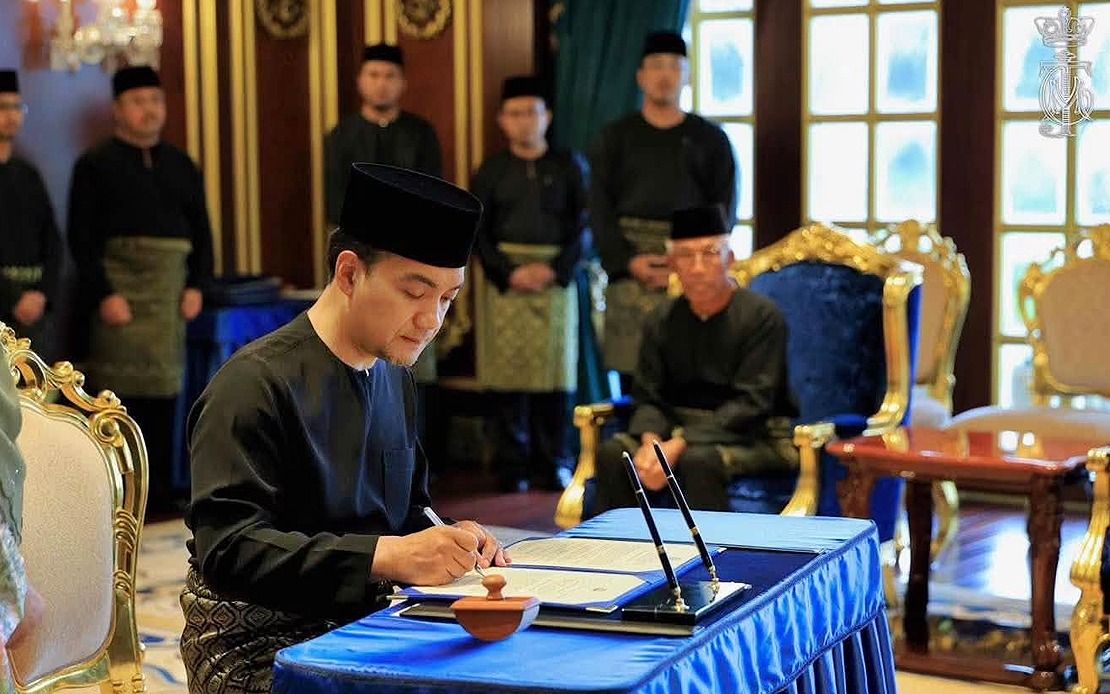
Datuk Onn Hafiz Ghazi steps into his second term as Johor Menteri Besar with a reinforced political mandate and the weight of one of Malaysia's most recognizable surnames. The 48-year-old state leader inherited the reins following Barisan Nasional's overwhelming performance in the 16th Johor state election, where the coalition captured 48 of 56 available seats—a significant improvement from the 40 seats it secured just two years earlier in the 2022 contest. This expanded parliamentary majority provides him with considerably greater room to manoeuvre his development agenda and reshape the state's economic trajectory over the coming years.
Onn Hafiz's ascent represents a continuation of political dominance by his family, whose fingerprints are etched across critical junctures of Malaysian governance. He is the great-grandson of Datuk Onn Jaafar, the visionary who established UMNO and served as Johor's seventh Menteri Besar during the colonial and early post-independence periods. More immediately, he is the grandson of Tun Hussein Onn, who guided Malaysia through its third premiership during the crucial 1976-1981 period. This genealogy places him squarely within the country's political establishment, though it also invites scrutiny about whether leadership positions are being consolidated within dynastic networks rather than opening opportunities to fresh talent within the broader party machinery.
Having initially assumed office on March 15, 2022, following Barisan Nasional's recovery in that year's state election, Onn Hafiz had roughly four years to establish his administrative footprint and demonstrate his capacity for governance. This period allowed him to move beyond the conceptual phase and begin implementation of concrete projects. His team took the oath before the Regent of Johor, Tunku Mahkota Ismail, at Istana Bukit Serene, formally cementing the electoral result into constitutional authority and enabling the state administration to proceed with its mandate.
The path to his current position reveals a deliberate career trajectory that blended private-sector discipline with political ambition. Born on March 2, 1978, Onn Hafiz completed his secondary education at the Royal Military College, an institution historically associated with Malaysia's leadership class, before pursuing a degree in accounting from the University of Hertfordshire in Britain. The choice to study accounting and then join PricewaterhouseCoopers between 2001 and 2004 suggests a deliberate cultivation of technical expertise in financial management and corporate governance—skills he would later market as essential to state administration.
Following his audit and consulting background, Onn Hafiz transitioned through corporate directorships and chief executive roles between 2005 and 2013, including positions at Chin Well Holdings Berhad and KMB Sdn Bhd. This corporate pedigree has become a defining characteristic of his public persona, often highlighted by supporters as evidence that he brings private-sector efficiency and results-oriented thinking to government bureaucracy. In an era when Malaysian politics frequently grapples with perceptions of inefficiency and patronage, such credentials hold considerable appeal, particularly among younger voters and the urban middle class who view corporate management practices as superior to traditional political administration.
Onn Hafiz formalised his entry into politics during the 2012-2018 period, serving as an UMNO Youth executive council member and heading the Sembrong division's youth wing. He simultaneously worked as political secretary to the defence minister, a role that provided him insider access to federal political machinery and demonstrated his reliability to senior party figures. When the 14th General Election occurred in 2018, he successfully contested the Layang-Layang federal seat, securing a parliamentary foothold that would prove valuable during subsequent state-level negotiations. Appointment as chairman of the Johor Tourism, Youth and Sports Committee between 2019 and 2022 kept him visible and allowed him to build alliances across the state administration.
The pivotal moment came in 2022 when Onn Hafiz won the Machap state assembly seat and, in the negotiations that followed Barisan Nasional's state-level recovery, was selected as the 19th Johor Menteri Besar, replacing Datuk Hasni Mohammad. This transition reflected both his status as a fresh-faced UMNO representative and calculations within Barisan Nasional leadership about generational renewal. His appointment also signalled a deliberate pivot toward technocratic governance, moving away from figures perceived as traditional patronage administrators toward someone marketed as having modern business acumen.
Once in office, Onn Hafiz unveiled the "Maju Johor 2030" development blueprint, positioning Johor as an economic powerhouse through investment attraction and diversified growth. This strategic framework reflects the broader post-pandemic reality that Malaysian states must actively compete for both foreign and domestic capital, moving beyond resource extraction or low-value manufacturing toward higher-technology industries and services. For Johor specifically, such positioning carries particular weight given its proximity to Singapore, its historical role as a manufacturing hub, and its potential as a gateway for investors seeking alternatives to Thailand or Vietnam.
Within UMNO's internal hierarchy, Onn Hafiz has consolidated support through his role as chairman of the Johor UMNO Liaison Committee and chief of the Simpang Renggam division since 2023, building upon his earlier service as that division's deputy chief. Such positions are not ceremonial; they represent real influence over party nominations, resource allocation, and internal deliberations about candidate selection for future elections. His success in accumulating these party posts alongside his state executive role demonstrates that he has avoided the isolation sometimes faced by state-level leaders who lack strong federal connections.
The substantially expanded Barisan Nasional majority achieved in yesterday's election reshapes the political landscape considerably. With 48 seats out of 56, Onn Hafiz faces minimal risk of defections or coalition instability—circumstances that plagued previous Johor administrations when majorities were razor-thin and government stability hung upon the loyalty of individual assemblymen. This breathing room permits him to think longer-term, undertake investments with multi-year payoff periods, and resist the constant pressure to distribute patronage simply to maintain coalition discipline. The strategic question now centres on whether he will leverage this advantage to implement genuine structural reforms or revert to conventional development patterns.
For regional observers, Onn Hafiz's continued dominance carries implications for Malaysia's broader political trajectory. His rise represents both institutional continuity—the persistence of established families within power structures—and generational transition, as younger figures with corporate backgrounds gradually reshape UMNO's self-conception. His emphasis on economic development and investment attraction mirrors priorities articulated at the federal level, suggesting potential alignment between state and national agendas. However, questions remain about whether dynastic leadership can truly innovate or whether institutional patterns will perpetuate themselves regardless of the individuals temporarily occupying high office.
As Onn Hafiz commences his second term with substantially greater legislative support, the test will involve translating the "Maju Johor 2030" agenda from slogan into tangible economic outcomes. Johor's workforce, infrastructure networks, and investment environment will require sustained attention over the coming years. The expanded mandate provides political capital to undertake difficult decisions—relocating administrative resources, prioritising infrastructure zones, potentially imposing unpopular regulations to attract higher-quality investment. Whether he deploys this advantage for structural transformation or conventional spending will shape not merely Johor's future but also signal what contemporary UMNO-led governance looks like when freed from the constant anxiety of coalitional collapse.

