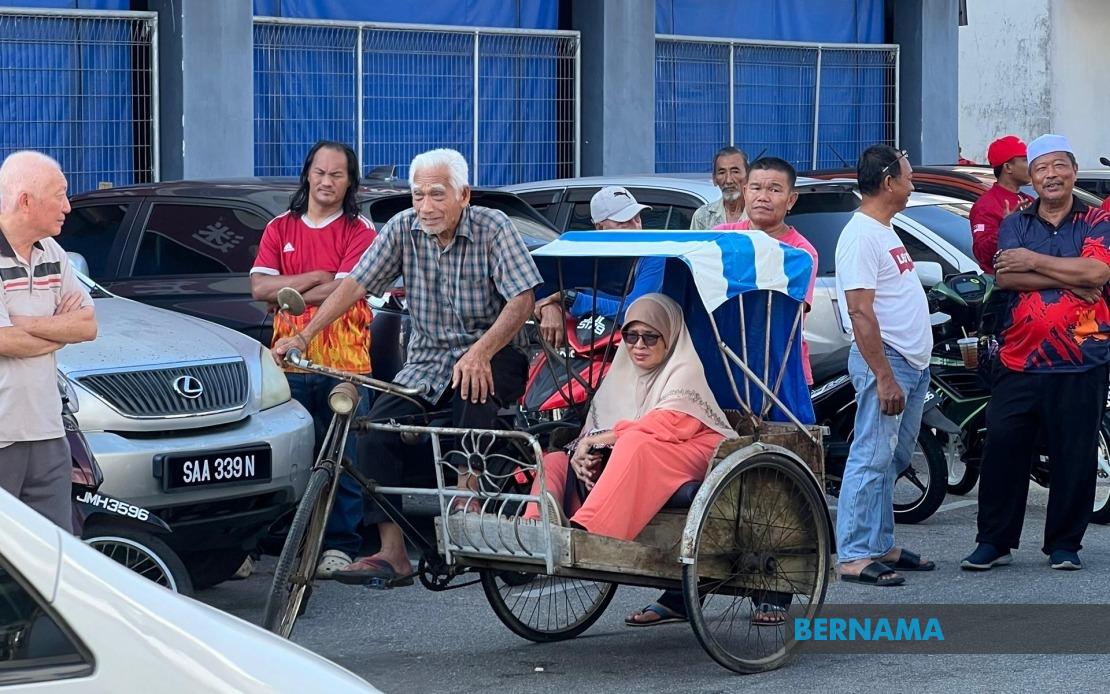
In the sweltering heat of a Johor afternoon, Abdul Razak Pelangga demonstrated the kind of dedication that characterises grassroots political engagement in Malaysia. The 86-year-old resident of Kampung Parit Bugis chose to pedal his traditional trishaw nearly a kilometre to Kedai Kopi Hailam Sri Medan in Senggarang, transporting his wife Jamilah Samsudin so that she could witness Prime Minister Datuk Seri Anwar Ibrahim during an impromptu campaign visit to the small town.
The journey itself speaks volumes about the significance Malaysians attach to direct encounters with their leaders, transcending the mediated experience of television screens and news broadcasts. Despite the oppressive temperature and the availability of motorised transport, Abdul Razak deliberately chose the trishaw route, calculating that the traditional mode of transport would prove more practical than navigating Senggarang's limited parking infrastructure. This pragmatic decision underscores how daily realities shape political participation in Malaysian communities, where infrastructure constraints often determine how citizens engage with national events.
Abdul Razak, who serves as imam of Masjid Raudhatul Jannah Parit Bugis, carries a personal connection to Anwar that predates the Prime Minister's current tenure. Years ago, before ascending to his present office, Anwar visited the mosque to lead prayers, an encounter that left a lasting impression. The imam recalls that exchange with warmth, describing Anwar's approachable demeanour during their greeting. That singular moment of human connection became the seed for a memory that Abdul Razak would later share with his wife, transforming a routine religious visit into a story worthy of being passed on.
When word circulated that the Prime Minister would be stopping in Senggarang as part of the PMX Meet-and-Greet Programme for the Senggarang state constituency—timed to coincide with the Johor state election campaign—Abdul Razak saw an opportunity to create a shared memory with his wife. The couple's inability to breach the security perimeter and meet Anwar face-to-face did not diminish their satisfaction. Proximity itself held value; witnessing the Prime Minister in person, albeit from a distance within a crowd, represented a significant upgrade from their previous engagement with political leadership through television coverage.
The visit itself was a measured affair, with Anwar spending approximately 50 minutes at the coffee shop, engaging with local residents in what has become a standard feature of contemporary Malaysian campaigning. The presence of Communications Minister Datuk Fahmi Fadzil alongside the Prime Minister reflected the coordinated nature of such grassroots political outreach, where senior members of the government deliberately position themselves within ordinary community spaces to build electoral momentum. These Meet-and-Greet sessions serve multiple purposes: they humanise political leaders, generate local media coverage, and provide voters with tangible evidence that the government acknowledges their existence and concerns.
For Abdul Razak, the timing of this political engagement carried additional personal significance that extended beyond the immediate context of state elections. The Johor state election polling date—July 11—coincided precisely with his 87th birthday, a convergence that transformed what might otherwise be a routine civic duty into something more personally meaningful. The imam expressed genuine enthusiasm about the prospect of fulfilling his electoral obligation on his birthday, framing the act of voting as a celebration rather than a mere procedural requirement. This perspective reflects how Malaysian voters of advanced age often regard participation in elections as a privilege earned through decades of citizenship and national service.
The distinction between early voting on July 7 and polling day on July 11 carries operational importance for election administration, though for Abdul Razak the choice was evident. His determination to vote on his birthday suggested a preference for marking that milestone with an act that embodied his continued engagement with democratic processes. Such decisions, seemingly personal, collectively shape voter turnout patterns and are of genuine interest to electoral researchers studying engagement patterns across different demographic groups in Malaysia.
Abdul Razak's narrative reflects broader patterns in Malaysian political culture regarding the relationship between citizens and elected leaders. The trishaw journey represents not merely transportation logistics but rather a symbolic act of commitment—choosing the slower, more labour-intensive route to participate in a political moment. In an era dominated by digital communication and mass media campaigns, the value of such physical presence and direct engagement should not be underestimated. The couple's satisfaction at viewing Anwar from within a crowd, rather than exclusively through broadcast mediums, speaks to persistent human desires for authentic presence and connection with national figures.
The Senggarang visit occurred within the broader framework of Malaysia's electoral cycle, where state elections provide opportunities for national leadership to reinforce their grassroots legitimacy. The careful choreography of such visits—selecting accessible community venues like coffee shops, allocating sufficient time for informal mingling, coordinating media participation from government communicators—reflects sophisticated understanding of how political capital is accumulated and maintained in contemporary Malaysia. Voters like Abdul Razak represent the electorate that such campaigns explicitly target: established, engaged citizens with long voting histories and stable community positions.
The temperature that day, described as scorching, functioned as an unspoken test of resolve. That an octogenarian chose to cycle rather than drive encapsulates something about the particular form of political enthusiasm that emerges in Malaysian communities, where participation often transcends rational cost-benefit analysis. The heat becomes background detail, almost irrelevant to the determination to witness and participate. This willingness to endure physical discomfort for political engagement, however modest in outward form, distinguishes genuine grassroots interest from performative participation.
As Malaysia navigates ongoing electoral cycles and evolving political landscapes, citizens like Abdul Razak anchor democratic processes in human experience and personal narrative. The trishaw journey to Senggarang, the wife who wanted to see the Prime Minister, the imam's memory of an earlier encounter, the birthday that aligned with polling day—these constitute the actual fabric of Malaysian democracy. Political campaigns and policy platforms matter, certainly, but so too do these moments of direct connection, however fleeting, that connect voters to their leaders and reinforce their sense of investment in national affairs.

