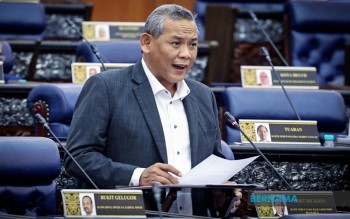
Tabung Haji's substantial investment losses require careful analysis to distinguish between legitimate market risk and institutional failure, according to Port Dickson Member of Parliament Datuk Seri Aminuddin Harun. Speaking during a special parliamentary sitting on the Royal Commission of Inquiry (RCI) report into the pilgrim fund manager, the former Negeri Sembilan menteri besar cautioned against sweeping condemnations that treat all financial underperformance as evidence of wrongdoing. His comments reflect a broader understanding that investment portfolios naturally experience fluctuations, and not every shortfall indicates negligence or corruption.
The distinction Aminuddin drew is crucial for understanding the findings of the RCI report released on July 29, which examined Tabung Haji's operations between 2014 and 2020. The 211-page inquiry identified multiple governance weaknesses and operational deficiencies, yet the precise nature of each loss—whether stemming from unforeseeable market conditions, flawed decision-making, or deliberate misconduct—has significant implications for how the institution should be reformed. Aminuddin emphasised that Parliament and the public must develop sophistication in evaluating these cases, recognising that market fluctuations and losses arising from poor governance or conflicts of interest represent fundamentally different failures requiring distinct remedial approaches.
Among the RCI's concrete recommendations was a call for forensic audits of 14 investments that experienced significant declines. This forensic examination would provide the granular analysis needed to separate genuine investment missteps from systematic governance failures or self-dealing. The rigour of such audits could help establish whether underperformance resulted from misjudgements made in good faith within accepted risk parameters or from breaches of fiduciary duty and institutional rules. For Malaysian investors in Tabung Haji, who contribute throughout their working lives in anticipation of hajj assistance and investment returns, clarity on these distinctions affects trust in the institution's competence and integrity.
Aminuddin's most pointed criticism focused on the culture of political patronage that has historically dominated Tabung Haji's board and senior management appointments. He characterised the practice of awarding leadership positions as rewards for political loyalty as fundamentally incompatible with the professional standards required to oversee a complex, multi-billion-ringgit investment portfolio managing the aspirations of millions of Malaysian Muslims. The appointment process must prioritise expertise in investment management, Islamic finance principles, risk assessment, and accounting rather than political connections, he argued. This reflects a broader governance reform imperative across Malaysian public institutions, where merit-based leadership selection remains unevenly implemented.
The RCI itself recommended that amendments to the Tabung Haji Act should explicitly prohibit serving politicians from holding positions as chairman or board members in Tabung Haji or its subsidiaries. This proposal directly addresses a structural conflict of interest where political figures might prioritise electoral considerations or personal advancement over the fund's long-term stability and the interests of contributors. However, Aminuddin proposed going considerably further, suggesting that all board candidates should undergo comprehensive screening covering integrity, investment experience, Islamic finance expertise, risk management capability, accounting and auditing knowledge, legal acumen, corporate governance understanding, and hajj management familiarity. Such screening would establish tangible professional barriers to purely political appointments.
The conflict-of-interest declaration requirement Aminuddin emphasised is equally significant. Board members with financial stakes in companies or sectors receiving Tabung Haji investment cannot objectively assess those opportunities' merits. Enhanced disclosure protocols would create transparency that shareholders—in this case, Malaysian pilgrims—could review and the institution could monitor. This preventive approach addresses governance at the structural level rather than relying solely on post-facto investigations after losses have materialised. Malaysian public institutions have progressively strengthened such protocols following various corporate governance failures, and extending these practices to Tabung Haji represents overdue alignment with international best practice.
Yet another parliamentarian, Datuk Mohd Isam Mohd Isa representing Tampin, questioned whether even the comprehensive RCI investigation adequately captured Tabung Haji's vulnerabilities. He contended that the RCI's temporal scope—limited to 2014 through 2020—omitted significant subsequent developments in the institution's management and operations. The period from 2020 onwards encompasses the COVID-19 pandemic's market disruptions, potential strategic shifts under new leadership, and additional investment decisions whose consequences may not yet be fully apparent. Mohd Isam proposed establishing a new RCI examining 2021 to 2025 to provide fuller institutional accountability and identify any persistent weaknesses that earlier reforms may have failed to address.
Mohd Isam additionally recommended that Tabung Haji matters be referred to the Public Accounts Committee (PAC) for exhaustive scrutiny, particularly covering 2022 to 2026. The PAC's ongoing oversight capacity provides continuous monitoring rather than the snapshot-in-time analysis an RCI necessarily delivers. This layered accountability approach—combining specific forensic investigations with continuous parliamentary committee oversight—creates multiple safeguards against institutional drift. Such mechanisms prove particularly important for bodies managing public funds intended for essential religious and community purposes, where deteriorating governance can affect millions of Malaysians' financial security and spiritual obligations.
Tabung Haji's leadership has reportedly implemented 75 per cent of the RCI's 25 recommendations as of late July, indicating willingness to adopt reforms. This progress demonstrates recognition that institutional credibility requires action, though implementation quality and effectiveness require ongoing verification. The government established the RCI in 2021, appointed its members in January 2022, and received its findings in August 2022, creating a timeline spanning years before formal public disclosure. Such delays in releasing inquiry findings characterise several Malaysian institutional reviews, potentially affecting stakeholder confidence during extended periods of uncertainty.
The parliamentary debate on Tabung Haji reform reflects broader governance challenges within Malaysian public institutions managing substantial assets on behalf of ordinary citizens. Whether the fund's losses stemmed primarily from market conditions, inadequate expertise, conflicts of interest, or combinations thereof, the remedial imperative centres on establishing robust institutional frameworks that prioritise professional competence, transparent decision-making, and genuine accountability. For the millions of Malaysian Muslims depending on Tabung Haji for hajj assistance and retirement benefits, restoring institutional integrity through merit-based leadership and fortified governance structures represents not merely institutional housekeeping but a matter affecting fundamental national concerns.

