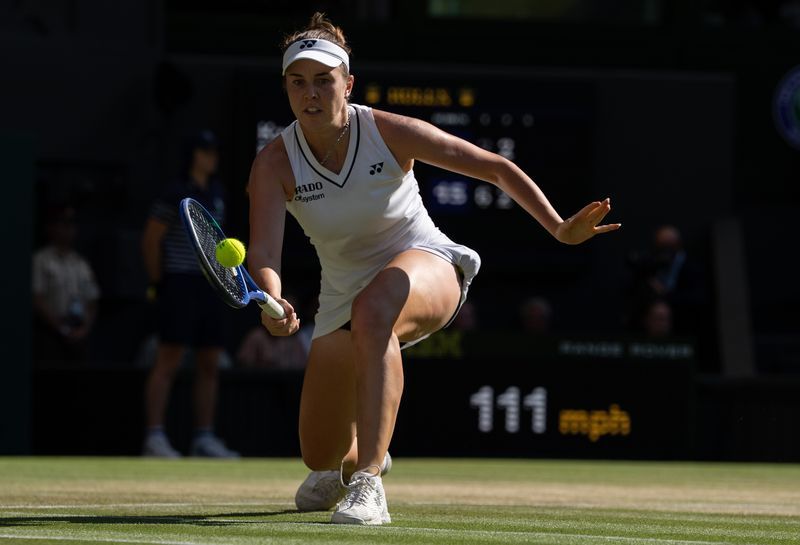
Linda Noskova's victory at Wimbledon this weekend represents far more than a routine Grand Slam triumph for the 21-year-old Czech player. Her 6-2 5-7 6-3 defeat of compatriot Karolina Muchova on Centre Court showcases a mental resilience that few athletes can muster when facing apparent catastrophe, making her one of the most compelling sporting stories of the year.
The ninth seed's path to glory was far from straightforward. Playing in her maiden Grand Slam final, Noskova appeared to have the match firmly under control when she built a commanding 5-2 lead in the second set. At that juncture, lifting the Venus Rosewater Dish seemed inevitable, and victory would have cemented her place among an exclusive cadre of Czech women to have won the Wimbledon title. Yet from that position of apparent dominance, she surrendered five consecutive games as Muchova launched an extraordinary comeback that would have psychologically broken most players of similar experience.
The manner in which Noskova squandered those match points laid bare the psychological battlefield of professional tennis. Three opportunities vanished during Muchova's service games, including a double fault at 5-3 that should have sealed matters. A fourth match point disappeared in the ninth game, and by the time the second set had slipped away, Noskova appeared devastated, walking back to her seat with her hands over her ears to shield herself from the crowd's noise. The emotional toll of such a reversal was visibly etched across her face.
What transpired next, however, revealed the psychological fortitude that distinguishes champions from merely talented players. During a comfort break, Noskova encountered the Wimbledon trophies displayed near the player facilities. This chance visual encounter proved transformative. Rather than allowing despair to consume her, she made a deliberate mental pivot. "I was just telling myself that the match is starting over," she explained to reporters afterwards. "I just splashed some cold water on me, started over again. But what really helped me was when I saw the trophies. I was like, I'm not going to take the small one, I'm taking the big one."
This straightforward declaration masked a deeper psychological recalibration. Noskova recognised that she had invested enormous energy and sacrifice to reach this moment, and that surrendering to the heartbreak of this particular defeat would constitute a uniquely devastating loss. Her resolve crystallised into a singular focus: to leave nothing on court, to make the third set irretrievable regardless of what emotions or doubts might surge through her consciousness. When she returned for the deciding set, she held serve in the opening game—a moment she later identified as absolutely critical to her mental state moving forward.
Once that first game was secured, a visible transformation occurred. Her timing on groundstrokes sharpened, her footwork became crisper, and her tactical aggression returned. When she reached match point again at 5-3, more than an hour after her first opportunity, Noskova would not be denied. The third set became hers to command, and she claimed the title with the authority of someone who had been tested and emerged stronger.
Noskova's achievement carries particular significance within the modern tennis landscape. At 21, she becomes the youngest women's champion since fellow Czech Petra Kvitova won her first Wimbledon title in 2011. She is also the third Czech woman to win the women's singles crown within four years, testament to the production line of talented players emerging from her country. This Czech dominance in women's tennis represents one of the sport's most interesting narratives, particularly in the context of smaller European nations competing at the highest professional levels.
Yet beyond her athletic achievements, Noskova's worldview suggests a player possessed of uncommon maturity and perspective. Her mother Ivana died from cancer two years before this triumph, an experience that has profoundly shaped her approach to both competition and life. The previous year, Noskova spent part of her off-season volunteering at a school in Zanzibar with a charity organisation, an experience that fundamentally altered her appreciation for the privileges her professional career affords. She has consistently demonstrated concern for environmental conservation and maintains ambitions to pursue volunteering in nature conservation once her playing career concludes.
These biographical details are far from mere curiosities in explaining Noskova's temperament during Saturday's final. A player who has confronted genuine loss, who has worked among vulnerable communities, and who consciously reflects on her relationship with the natural world brings a fundamentally different psychological architecture to moments of crisis. The nerves that might paralyse a player focused exclusively on tennis success hold less dominion over someone who understands life's deeper complexities.
For Malaysian and Southeast Asian tennis enthusiasts, Noskova's triumph offers instructive lessons about mental resilience and the importance of perspective in competitive sport. Her victory demonstrates that apparent catastrophic failure—squandering five match points from a winning position—need not define a player's trajectory. The ability to mentally reset, to reframe setback as continuation rather than conclusion, and to summon reserves of determination when emotional fatigue seems overwhelming represents the hallmark of true champions across any sport or competitive endeavour.
Noskova's quiet confidence and philosophical approach to competition also contrast sharply with the often superficial narratives that dominate professional sports discourse. Rather than focusing solely on rankings, prize money, or comparative achievements, she articulates a vision of tennis as one meaningful component within a broader life committed to growth, service, and environmental stewardship. This perspective did not hinder her competitiveness; rather, it appeared to liberate her from the paralyzing self-doubt that might have consumed her during the final's pivotal moments.
As Noskova processes her Grand Slam breakthrough, she has indicated that the full magnitude of her achievement has not yet settled. "It was all worth it, so I will definitely never forget this week, these two weeks," she said in the immediate aftermath. The two-week journey from the qualifying rounds through to the final victory represents not merely a sporting milestone but a transformative personal experience that she will carry forward into the remainder of her tennis career and her life beyond the sport.

