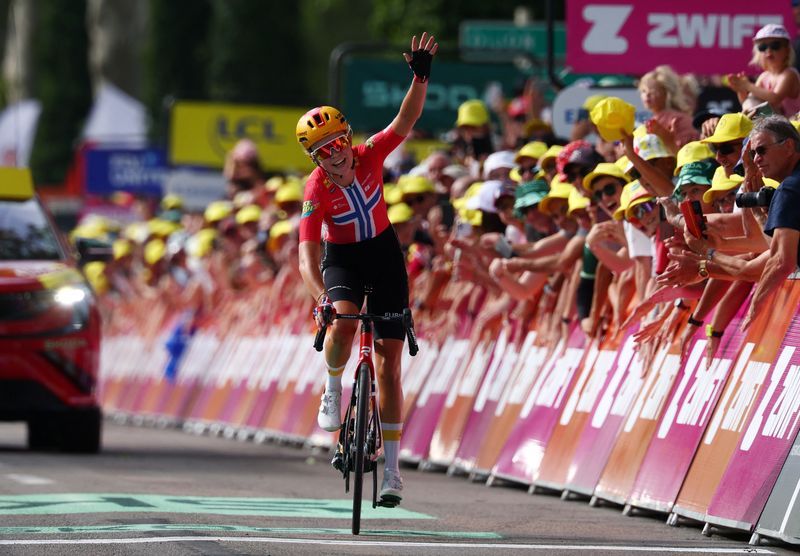
Sigrid Haugset etched her name into cycling history on Monday when the Norwegian rider powered to a solo stage victory at the Tour de France Femmes, becoming the first athlete from her country to achieve the feat at the women's edition of the race. The 27-year-old Uno-X Mobility rider's dominant performance through the challenging Alpine terrain also propelled her into the overall lead, wresting the yellow jersey from Lorena Wiebes of the Netherlands and establishing herself as a genuine contender for the title.
Haugset's victory came after a gruelling battle against Belgian rival Lotte Kopecky, who launched a determined chase in the closing stages but ultimately fell one minute and 24 seconds short. Kopecky's inability to bridge the gap proved crucial in the race's strategic battle, as the margin would determine the pecking order going forward. Marianne Vos of the Netherlands rounded out the podium in third place at the finish in Poligny, securing her position among the race's leading competitors.
The stage itself presented considerable challenges with its mountainous finish, forcing the peloton into unfamiliar terrain for the first time in the race. The ascent to Col de la Faucille proved treacherous, with several high-profile riders hitting the deck, including reigning world champion Magdeleine Vallieres and former Tour de France Femmes winner Demi Vollering. Despite the setback, the field quickly remounted and pressed forward, with the remainder of the 11.4-kilometre climb proceeding without further significant incidents or breakaway attempts that might have fractured the group.
Haugset's move came during the next major climb at Col de la Savine, where she seized her opportunity to distance herself from the bunch with decisive acceleration. Kopecky recognised the threat and countered shortly after the halfway point of the 156.5-kilometre stage, but the Norwegian's superior fitness allowed her to maintain her advantage as the race crossed the border into France proper. The mathematical picture at this point showed Wiebes, still holding the yellow jersey, trailing by 13 minutes with only 20 kilometres remaining—a deficit that would prove insurmountable given the dynamics of the day.
The closing kilometres became a fascinating psychological and physical duel between Haugset and Kopecky, with the Norwegian rider forced to manage fatigue while maintaining her lead. Kopecky's relentless pursuit saw her narrow the gap to just 10 seconds with only 10 kilometres remaining, creating genuine uncertainty about the stage outcome. However, Haugset dug deep into her reserves and produced a crucial acceleration with three kilometres to go, rebuilding her buffer to nearly a minute and effectively deciding the contest.
Haugset's total lead in the general classification now stands at two minutes and 22 seconds over Kimberly Le Court of Mauritius, a substantial but not insurmountable advantage in a multi-week stage race where circumstances can shift dramatically. This margin provides her with a working buffer but also signals that the battle for the overall crown remains genuinely open, particularly given the uncertain terrain and tactical complexity that typically characterises the later stages of major tours.
The significance of Haugset's achievement cannot be overstated for Norwegian cycling. She becomes not only the first rider from her nation to win a stage at the Tour de France Femmes but also the first to don the yellow jersey at the event, representing a landmark moment for Scandinavian representation in elite women's cycling. Her achievement reflects the growing strength of Norwegian cycling infrastructure and investment in the sport, even as larger cycling nations continue to dominate the international calendar.
Reflecting on her performance, Haugset displayed the emotional vulnerability typical of athletes confronting their own limitations and drawing on motivation from beyond themselves. "I never thought it was possible, it's unreal," she remarked after crossing the finish line, still processing the magnitude of her accomplishment. She revealed the internal debate she had conducted during the race, acknowledging that Kopecky's presence represented a genuine threat and that accepting second place would have been respectable. However, contemplating the supporters cheering from home ultimately galvanised her to push beyond her perceived limits.
Kopecky's pursuit, while ultimately unsuccessful, demonstrated why she remains a formidable force in women's cycling. Her ability to close a substantial gap to within 10 kilometres of the finish showcased her competitive mentality and aerobic capacity, even if she fell just short of the prize on this occasion. For Belgian cycling, which has produced numerous world-class female talent, Kopecky's performance suggests that the narrative of this Tour de France Femmes remains very much in its opening chapters.
The crash early in the stage proved consequential for the race narrative, as the involvement of two former champions underscored both the unpredictability of mountain racing and the stakes at play. Both Vallieres and Vollering recovered to finish within respectable distances, but the incident served as a reminder that positioning and luck play outsized roles in determining outcomes in stage racing, particularly in mountainous terrain where momentum and positioning can prove critical.
Looking ahead, Haugset will need to manage her advantage carefully while remaining alert to challenges from experienced rivals who will undoubtedly attempt to exploit any weakness in the remaining stages. The Tour de France Femmes, expanded and elevated in status in recent years, continues to showcase the elite level of women's cycling and provides a global platform for athletes like Haugset to demonstrate their capabilities. Her victory suggests that the coming weeks will produce compelling racing as contenders probe for vulnerabilities.
Haugset's refusal to celebrate prematurely at the finish line, a consequence of complete physical exhaustion rather than tactical caution, provided a fitting conclusion to her extraordinary effort. The image of the Norwegian rider unable to lift her arms from the handlebars, despite achieving a historic victory, encapsulated the physical and mental demands of professional cycling at the sport's highest level. As she moves forward with the yellow jersey, questions about whether she can sustain this level of performance over the race's remaining stages will dominate discussion among cycling analysts and observers across Europe and beyond.

