Norway's improbable World Cup comeback came to an end in Miami on Saturday when England's Jude Bellingham scored twice in extra time to secure a 2-1 quarter-final victory, denying Stale Solbakken's squad an unlikely semi-final berth. The result punctuated what amounted to a triumphant summer for Norwegian football, marking the nation's return to the tournament stage for the first time in 28 years with a campaign that exceeded even the most optimistic pre-tournament expectations and fundamentally reshaped how the world perceives Scandinavian football culture.
The Norwegian team's journey to Miami was remarkable in its own right, but the manner in which they captured the imagination of global audiences transcended the purely sporting realm. Before the tournament commenced, the squad posed for promotional photographs dressed in Viking costumes, a playful nod to their Norse heritage that set the tone for their entire campaign. This lighthearted approach masked a team of genuine technical quality and ambition, embodied most visibly by striker Erling Haaland, whose prolific finishing and personality transformed him into one of the tournament's breakout stars among supporters worldwide.
Norway's progression through the group stage established them as genuine contenders despite their long absence from the World Cup stage. The qualification pathway had been dominated by Haaland's clinical finishing, and this form translated seamlessly into the tournament proper. After navigating their opening fixtures successfully, they faced Ivory Coast in the last 32, where Haaland's brace in a 2-1 triumph set up a far more daunting encounter with Brazil, the five-time defending champions and perennial tournament favourites. Few gave the Norwegians realistic chances against such a legendary football nation.
What unfolded in that match against Brazil will be remembered as one of the tournament's defining moments. Norway dismantled the South American giants with a display of controlled, sophisticated attacking football that belied their long absence from international competition at the highest level. The 2-1 victory was achieved through superior positioning, incisive passing, and relentless intensity that exposed Brazil's vulnerabilities in a way few teams manage. The result electrified Norwegian supporters and fundamentally altered perceptions of the team's ceiling within the tournament.
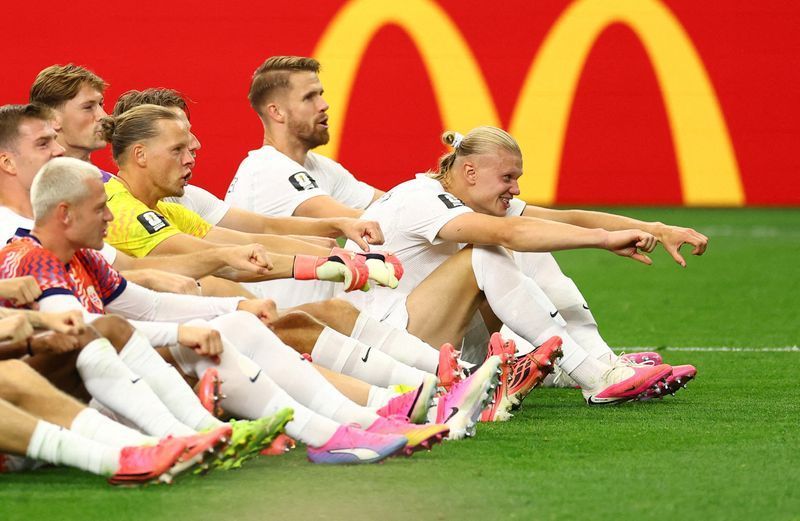
The broader Norwegian fanbase contributed significantly to the team's cultural impact, with the "Viking row" celebration becoming the tournament's most distinctive and widely adopted crowd phenomenon. This collective chanting and arm-raising motion, performed in synchronisation by thousands of supporters, became so iconic that even American spectators and neutrals began spontaneously adopting the ritual at matches. The combination of Haaland's telegenic personality, his tongue-in-cheek humour with global media, and the team's infectious confidence created a compelling narrative that extended far beyond traditional football audiences.
Yet the physical and mental demands of such an unexpected journey eventually caught up with the Nordic squad. Against England in the quarter-finals, Norway found themselves in the unusual position of leading the match, only to see their advantage slip away as the tournament's accumulated fatigue visibly manifested. Solbakken acknowledged this reality with characteristic Scandinavian understatement, commenting that by the time perspective returned in a week or two, "everyone will be able to agree that the summer of '26 has been fairly OK." This restrained assessment belied the genuine sense of achievement within the Norwegian camp.
The underlying strength of Norwegian football extends well beyond the current squad's World Cup performance. Bodo/Glimt's consistent success in European club competitions during recent seasons demonstrates that Norwegian football has successfully transitioned from a reputation as a physically direct, unsophisticated brand of play into a football culture capable of developing technically gifted, tactically intelligent young players. This institutional shift represents genuine progress within the sport's infrastructure and player development systems.
The trio of Solbakken, captain Martin Odegaard, and Haaland embodies the contemporary Norwegian football character—confident without arrogance, capable of self-deprecation while remaining utterly committed to competitive success. Their demeanor throughout the tournament reinforced the impression that Norway possesses a sustainable pipeline of talent rather than relying on isolated individual brilliance. Solbakken himself noted this promising development, observing that multiple squad members departed Miami convinced of their ability to compete effectively against global elite teams.
For Malaysian and Southeast Asian football followers, Norway's tournament trajectory offers instructive lessons about long-term player development and the value of maintaining competitive aspirations even following extended absences from major tournaments. The Norwegian pathway—building squad depth through domestic league strength, developing young players through consistent international competition, and creating a coherent tactical identity—contrasts with approaches that sometimes prioritise short-term results or individual star power over systematic institutional development.
The implications of this World Cup campaign extend into the football landscape far beyond Norway itself. European football's competitive distribution continues to shift as smaller nations develop sophisticated systems for maximising their limited player pools. Norway's performance suggests that with proper infrastructure, coaching quality, and long-term planning, even nations without vast commercial resources can produce genuinely competitive international sides.
As Norwegian supporters reflect on their team's exit, the overwhelming sentiment will likely centre on pride rather than regret. A return to the World Cup after nearly three decades, combined with victories over prestigious opponents and global recognition of their distinctive cultural expressions, represents achievement worthy of celebration. Haaland and his teammates have restored Norwegian football to international respectability and demonstrated to upcoming generations that sustained excellence remains achievable for Scandinavian football.

