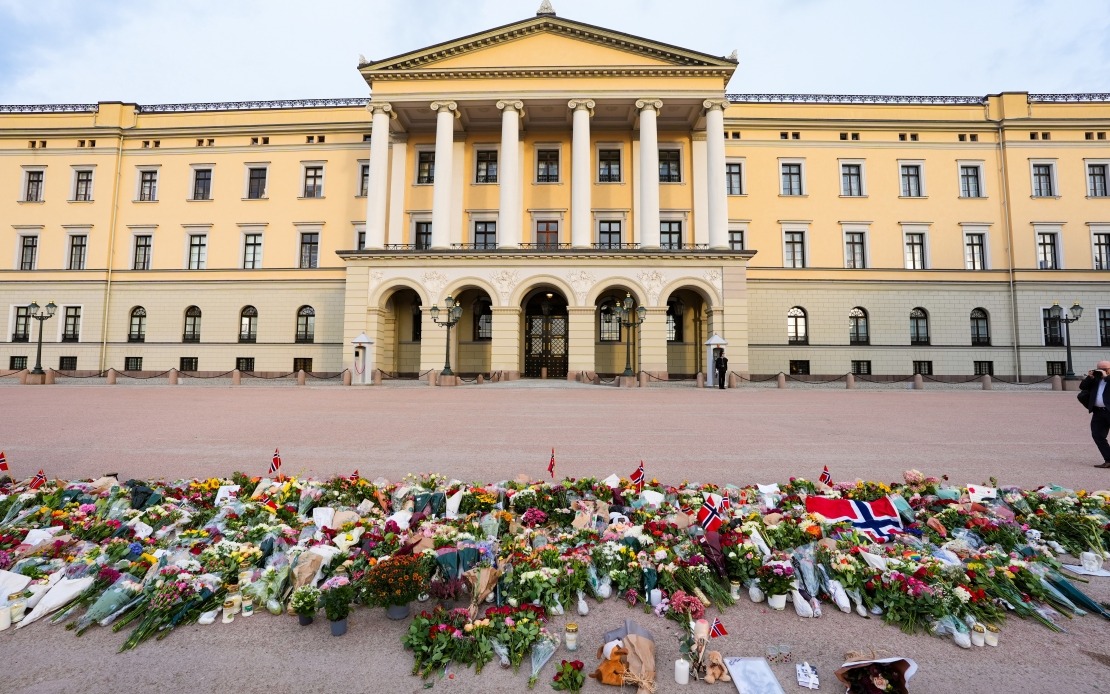
Norway's King Harald V, who had held the throne longer than any of his predecessors, died on Friday morning at the age of 89, the Royal Palace confirmed. The monarch passed away peacefully at the National Hospital in Oslo at 6:35 am local time, ending more than three decades of reign. His death marks a significant moment for the Scandinavian kingdom and closes a chapter in European royal history, as Harald held the distinction of being the continent's eldest active sovereign at the time of his passing.
The palace lowered its royal flag to half-staff immediately following the announcement. Harald's final hospitalisation began on August 17 following a routine medical examination, but his condition subsequently deteriorated. Medical staff initially managed his case through cortisone treatment for hemolytic anemia, a disorder affecting red blood cells that had caused his body to retain fluid. This underlying condition proved complicated when a bacterial infection developed in his bloodstream, ultimately leading to his death despite intensive care at Norway's leading hospital.
Succession under Norwegian constitutional law passed automatically to Crown Prince Haakon, who became king immediately upon his father's death. Unlike many European monarchies that maintain elaborate coronation traditions, Norway's system operates with greater constitutional simplicity. The new king is expected to meet with government officials at an extraordinary Council of State convened at the Royal Palace, where his regnal name will be formally announced. Following this ceremonial step, Haakon must take an oath before the Norwegian Parliament, a requirement enshrined in the nation's constitution that emphasises parliamentary sovereignty over executive monarchy.
Harald's 33-year tenure represented an exceptionally long reign for modern Scandinavia. He ascended to the throne on January 17, 1991, following the death of his father King Olav V, inheriting a stable constitutional monarchy with deep roots in Norwegian national identity. During his decades on the throne, he became a symbol of continuity and stability through significant geopolitical changes, including the end of the Cold War, Norway's sustained independence from the European Union, and the country's transformation into a global energy superpower through North Sea oil wealth.
The timing of Harald's death carries particular relevance for Malaysia and the broader Commonwealth context. Though Norway remains outside the Commonwealth realms, Harald's passing reflects broader patterns in European monarchy regarding longevity, health management in advanced age, and the smooth constitutional transitions that modern democracies expect from hereditary systems. Malaysia, as a constitutional monarchy with an elected king system, observes such transitions in established monarchies with particular interest, given the framework within which Malaysia's own Yang di-Pertuan Agong serves.
Harald's illness pattern—a blood disorder compounded by secondary infection—reflects challenges common in managing health for very elderly heads of state. The hospitalisation on August 17 and subsequent rapid deterioration over approximately two weeks demonstrates how quickly conditions can become critical in advanced age, even with sophisticated medical intervention. Norwegian public broadcaster NRK's reporting on the bacterial bloodstream infection underscored how secondary infections frequently determine outcomes in elderly patients with underlying haematological conditions, a reality familiar to geriatric medicine practitioners across developed nations.
The constitutional framework governing Harald's succession illustrates the legal clarity that modern European monarchies maintain. Crown Prince Haakon's immediate accession without interim regency or council oversight reflects Norway's streamlined constitutional provisions, which contrast with more elaborate systems elsewhere. This legal certainty provides stability for markets, institutions, and government continuity—factors increasingly important as monarchies position themselves as custodians of democratic constitutional order rather than symbols of personal executive power.
Crown Prince Haakon, who becomes Norway's third post-war monarch, assumes leadership at a time of significant geopolitical flux affecting Nordic countries. Russia's invasion of Ukraine prompted historically neutral Norway to reconsider its security posture and defence spending. The new king inherits both the ceremonial role as constitutional head of state and the significant symbolic weight that Norwegian monarchy carries in national identity. His mother, Queen Sonja, transitions to the role of Queen Emerita, a position of dignity and continued public engagement common in contemporary European royal families.
For regional observers, Harald's death and peaceful succession demonstrate how constitutional monarchies function during transitions. The absence of political uncertainty, the automatic operation of constitutional succession, and the planned ceremonial steps ahead reflect the institutional maturity that Scandinavian democracies have developed. These elements—predictability, clear legal frameworks, separation of ceremonial and executive functions—characterise modern constitutional monarchy as distinct from both historical absolutism and republican systems that concentrate authority differently.
Harald's legacy encompasses his role as a modernising monarch who maintained public popularity through decades of social change, economic transformation, and evolving public expectations regarding royal institutions. He navigated the late 20th and early 21st centuries successfully, maintaining respect across Norwegian society while adapting the monarchy's public role to contemporary sensibilities. His death after a relatively brief final illness, at an advanced age, represents the kind of natural succession that constitutional monarchies seek—the transfer of authority completing without political crisis or institutional strain.
The Norwegian government's immediate consultation with the new king through the extraordinary Council of State represents the formal transition of sovereign powers, however ceremonial in nature. These meetings, while often underselling the gravity of the occasion in their procedural appearance, mark the constitutional moment when executive authority recognises new leadership and public institutions acknowledge changed circumstances. For a nation with Norway's democratic traditions, such consultations carry weight beyond mere formality, embodying respect for constitutional process and orderly government.
As Norway enters this new reign, international observers note the significance of stable, predictable succession in a constitutional democracy. The absence of ambiguity regarding the throne's succession, the clarity of legal authority, and the planned ceremonial acknowledgment of transition all contribute to institutional confidence. For Malaysia and other constitutional monarchies globally, the Norwegian example reinforces how carefully drafted constitutional frameworks enable orderly transitions that strengthen rather than disrupt democratic governance and public confidence in state institutions.

