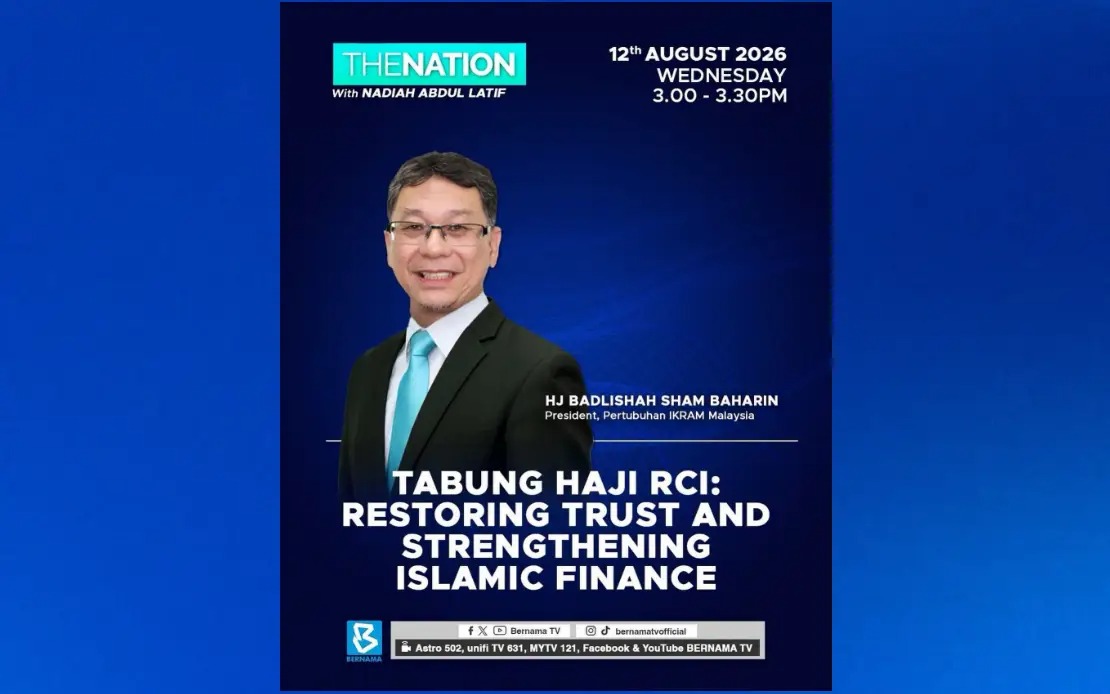
Tabung Haji does not require a separate Royal Commission of Inquiry to investigate its management during 2021 to 2025, according to Pertubuhan IKRAM Malaysia president Badlishah Sham Baharin, who argues that existing probes by law enforcement agencies provide adequate oversight. The statement comes as both opposition and government lawmakers have pushed for a broader inquiry to complement the recently released RCI report covering only the 2014 to 2020 period, a gap that has raised concerns about accountability for the pilgrimage fund's recent years.
Badlishah Sham cautioned against the indiscriminate use of Royal Commissions, cautioning that excessive reliance on such mechanisms could erode their institutional weight and public standing. He emphasised that these investigative bodies should be deployed sparingly and reserved exclusively for matters of exceptional gravity and national significance. The IKRAM president stressed that routine investigations and compliance matters fall appropriately within the purview of established law enforcement bodies, particularly the Malaysian Anti-Corruption Commission, which possesses both the statutory authority and technical capacity to pursue allegations of wrongdoing effectively.
The substance of his position centres on the sufficiency of existing investigative channels and the importance of ensuring that detected irregularities face prosecution regardless of the investigative vehicle employed. Badlishah Sham articulated a preference for conventional enforcement mechanisms over additional commissions, provided such agencies demonstrate commitment to bringing violators to account through the justice system. This perspective reflects growing recognition that institutional credibility depends on demonstrating results through existing structures rather than repeatedly establishing new ones.
Finance Minister II Datuk Seri Amir Hamzah Azizan, concluding yesterday's parliamentary debate on the released RCI findings, disclosed the staggering scale of the fund's investment losses. Tabung Haji sustained nearly RM13 billion in aggregate losses attributable to fourteen problematic investments, seven of which were written off entirely with zero recovery value. This figure comprises RM10.2 billion absorbed through a 2018 government rescue operation channelled via Urusharta Jamaah Sdn Bhd and RM2.6 billion in additional impairment charges recorded between 2018 and 2025 on investments still under management.
The Al-Rawda investment emerged as the single largest loss driver, illustrating the scope of the fund's exposure to high-risk ventures. Between 2015 and 2017, Tabung Haji remitted approximately 1.4 billion Saudi riyals—roughly RM1.5 billion—to an intermediary for lease agreements covering four hotels in Makkah and Madinah designated to house Muslim pilgrims. When Al-Rawda suspended rental payments in the first quarter of 2019, the fund found itself with depreciating assets that ultimately necessitated a full impairment charge of RM1 billion recorded in 2024. This single investment exemplifies the broader institutional weaknesses the RCI identified regarding due diligence, counterparty risk assessment, and management oversight.
While opposing a new RCI, Badlishah Sham welcomed the government's proposal to establish a multi-agency task force focused on identifying investments at heightened loss risk and implementing preventive controls. He highlighted the necessity for rigorous due diligence protocols preceding any capital deployment, emphasising that Islamic investment principles demand not merely financial prudence but also ethical compliance and procedural correctness. The task force concept represents a middle ground between demanding a full RCI and accepting the status quo, potentially offering targeted institutional reform without the resource consumption and political contention accompanying a new commission.
The RCI report, made public on July 29, documented systemic deficiencies in Tabung Haji's operational and governance frameworks during the 2014-2020 window and recommended twenty-five corrective measures. As of July 30, the fund had implemented seventy-five percent of these recommendations, suggesting some institutional responsiveness to identified failings. However, the six-year gap between the RCI's terminal year and the present creates lingering questions about whether subsequent years witnessed continued vulnerabilities or whether improved governance took hold.
Badlishah Sham also addressed the walkout staged by certain opposition parliamentarians during the special Dewan Rakyat sitting, characterising their departure as a dereliction of representative duty. He argued that elected members bear responsibility for exercising legislative oversight and safeguarding the interests of nearly ten million Tabung Haji depositors, regardless of partisan disagreements with the government. The act of departing the chamber, he contended, negated the opportunity to voice constituent concerns during the formal parliamentary forum designed for such representation.
His criticism extended to what he perceived as selective engagement with accountability mechanisms, suggesting that some opposition figures preferred publicising their positions via social media platforms rather than deploying parliamentary procedures to challenge government conduct. This critique reflects broader frustration with the performative dimensions of contemporary opposition politics, where legislative presence is subordinated to external advocacy. For depositors whose retirement security and pilgrimage savings remain at stake following the fund's travails, the absence of rigorous parliamentary scrutiny compounds concerns about inadequate institutional accountability.
The finance ministry's revelation of the full loss quantum—RM13 billion representing approximately five percent of Tabung Haji's reported asset base—underscores why stakeholders across the political spectrum called for expanded investigation. The concentration of losses in a single investment strategy suggests possible systemic governance failures rather than isolated misadventures. Whether current investigative mechanisms can adequately address questions about who authorised these commitments, what governance checkpoints were bypassed, and why risk controls failed remains contentious.
For Malaysian depositors and the broader Islamic finance ecosystem that looks to Tabung Haji as an institutional model, the implications extend beyond financial recovery. The fund's experience demonstrates that Islamic investment principles cannot be sustained through brand identity alone but require institutional discipline, transparent governance, and accountability mechanisms equal to conventional finance standards. The debate between pursuing a comprehensive new RCI versus relying on existing investigative bodies ultimately reflects disagreement about whether current institutions can deliver the systemic credibility restoration that depositor confidence demands.
The government's positioning—rejecting a new RCI while implementing seventy-five percent of prior recommendations—attempts to demonstrate responsiveness without reopening comprehensive investigations. However, the six-year investigative gap and the magnitude of disclosed losses suggest that reassurance remains incomplete. Whether existing mechanisms prove adequate or whether political pressure forces a new RCI hinges partly on whether current investigations produce meaningful prosecutions and accountability outcomes that demonstrate the system functions reliably.

