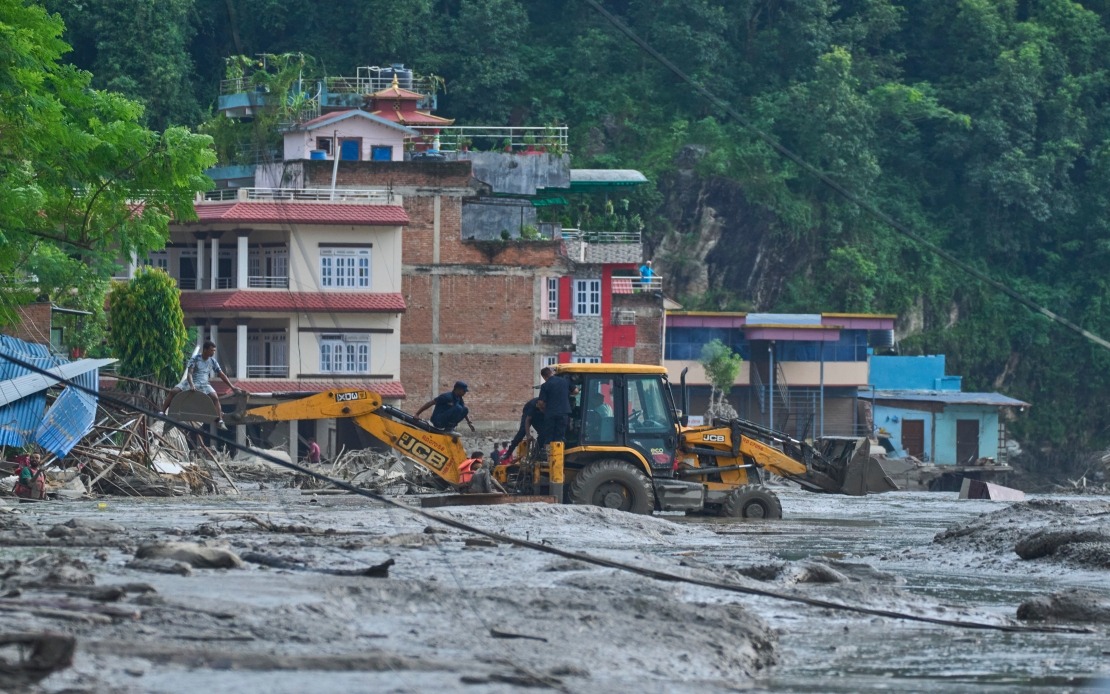
Nine South Korean nationals have gone missing following severe flooding that struck Nepal's Rasuwa district on Wednesday, prompting an immediate diplomatic and humanitarian response from Seoul. The missing workers include six employees from Doosan Enerbility Co., a prominent plant construction firm, and three staff members from Korea South-East Power Co., a state-owned electricity generator. Both groups were engaged in hydropower plant construction when the natural disaster struck the region near the Nepal-Tibet border. South Korea's Foreign Ministry confirmed that the government would dispatch a coordinated rapid response team on Thursday, comprising officials from the ministry itself along with representatives from police and fire services, with the group expected to arrive in Kathmandu later that day to coordinate search and rescue efforts with local authorities.
The scale of the disaster in Nepal has been unprecedented for the region, with initial reports indicating that the catastrophic flash floods have claimed over 160 lives and left hundreds of people unaccounted for. Foreign nationals constitute a significant proportion of the missing, reflecting the international nature of infrastructure projects underway in the region. The geographic location near the Nepal-Tibet border has complicated immediate relief efforts, with mountainous terrain and damaged communication infrastructure hampering coordination between rescue teams and stranded individuals. For South Korea, the incident represents a critical test of its government's ability to respond swiftly to crises affecting its citizens abroad, a responsibility that carries both humanitarian and diplomatic weight in an era of extensive Korean corporate presence across Asia.
Beyond the nine missing workers, the situation involves additional complexity in the form of ten other South Korean employees affiliated with Doosan who had become trapped in the flood zone but have since been confirmed alive. These individuals remain in the affected area awaiting formal rescue and extraction, adding to the government's operational burden. Approximately 200 foreign workers in total were evacuated from the construction project site as conditions deteriorated, though coordination of such large-scale evacuations in remote mountainous regions presents substantial logistical challenges. The confirmation that at least some of the stranded Koreans are safe has provided some reassurance to their families and employers, though the overall situation remains fluid and potentially dangerous.
President Lee Jae Myung has personally intervened to ensure maximum governmental effort toward locating and rescuing the missing nationals. His directives to mobilise all available state resources reflect the gravity Seoul attaches to protecting its citizens abroad and maintaining diplomatic relations with Nepal. The presidential instruction emphasises collaboration with the Nepalese government and local authorities, recognising that successful rescue operations depend critically on cooperation between Korean teams and Nepal's own emergency services, who are themselves stretched thin managing a national catastrophe. This multilateral approach also signals Seoul's commitment to supporting Nepal during the disaster, building goodwill that facilitates both immediate rescue efforts and longer-term Korean investment in the country.
Foreign Minister Cho Hyun has taken direct operational control of the crisis response, presiding over emergency coordination meetings and pledging to contact his Nepalese counterpart to secure formal cooperation. His statement outlining government priorities demonstrates how Seoul frames its responsibilities: locating missing citizens, supporting their families during this traumatic period, ensuring the safety of other South Koreans remaining in Nepal, and preventing escalation of casualties. This comprehensive approach reflects accumulated experience from previous Korean crisis responses abroad, incorporating both immediate rescue dimensions and longer-term support for affected communities. The Foreign Ministry's coordination role represents standard practice in Seoul's crisis management protocols, centralising information flow and ensuring consistent messaging to the international community.
Doosan Enerbility and Korea South-East Power have not waited for government coordination but have instead established their own emergency response mechanisms. Corporate sector mobilisation of resources represents a complementary layer of crisis response, with company officials deploying specialist field teams capable of assessing on-site conditions and potentially assisting rescue operations. These private sector efforts often prove crucial in remote locations where government resources take time to reach, and where corporate knowledge of the specific project site and local geography can accelerate rescue efforts. The dual involvement of both state and corporate entities reflects the integrated nature of Korean crisis response systems, particularly where infrastructure projects involve state enterprises like Korea South-East Power.
The hydropower construction project represents South Korean involvement in Nepal's infrastructure development, part of broader patterns of Korean companies undertaking major regional projects. The Rasuwa district location reflects Nepal's strategic focus on developing hydropower capacity in mountainous terrain where international expertise and capital prove essential. For Malaysia and other Southeast Asian nations hosting Korean infrastructure firms and workers, this incident serves as a reminder of the inherent risks in ambitious developmental projects and the importance of robust emergency preparedness protocols. The vulnerability of foreign workers to natural disasters, particularly in geographically challenging regions, underscores the need for rigorous safety standards and evacuation planning.
The flood's occurrence near the Nepal-Tibet border adds geopolitical dimensions to what is fundamentally a humanitarian crisis. The region's difficult terrain and the complications of cross-border coordination mean that rescue teams must navigate both environmental hazards and administrative complexities. For South Korea, managing the diplomatic dimensions of the crisis while maintaining focus on rescue operations requires careful coordination between Foreign Ministry officials and the government team deployed to Nepal. The situation also touches on broader questions of worker protection and corporate responsibility in international projects, issues that resonate across Asia where millions of workers participate in cross-border construction and development initiatives.
As rescue operations proceed, the families of missing workers face an agonising period of uncertainty while authorities work to establish definitive information about each individual's status. Psychological support and regular communication with families represent important dimensions of government crisis management that often receive insufficient attention. The Foreign Ministry's commitment to supporting affected families indicates awareness of this need, though the scale and remoteness of the disaster zone will inevitably constrain the speed and comprehensiveness of assistance. South Korea's experience with previous natural disasters both domestically and affecting its citizens abroad has informed institutional approaches to family support, though each crisis presents unique challenges.
The international response to Nepal's flood disaster will significantly shape how bilateral relationships evolve in subsequent months. South Korea's demonstration of willingness to commit significant resources and diplomatic attention to assisting Nepal during catastrophe builds relationships that extend beyond the immediate crisis. For a country like Nepal with limited disaster response infrastructure, international cooperation from developed nations proves invaluable. Simultaneously, the incident highlights vulnerabilities in current safety and emergency response systems for major infrastructure projects in mountainous and geographically remote regions. Future projects in similar environments may incorporate enhanced protocols based on lessons learned from this catastrophe, though institutional change typically proceeds slowly even after high-profile incidents.
Looking forward, the comprehensive nature of Seoul's response—combining presidential direction, ministerial coordination, diplomatic engagement, government team deployment, and corporate sector mobilisation—demonstrates institutional capacity for crisis management. Whether this coordinated approach successfully locates and rescues the missing South Koreans will depend heavily on Nepal's own response capacity and on environmental conditions in the flood zone. The coming days will prove critical both for determining the fate of the missing workers and for establishing patterns of cooperation between Korean and Nepalese authorities that may influence regional engagement more broadly. For Korean companies and workers operating across Asia, the incident underscores the importance of comprehensive disaster preparedness and the reality that even modern infrastructure projects remain vulnerable to nature's most destructive forces.

