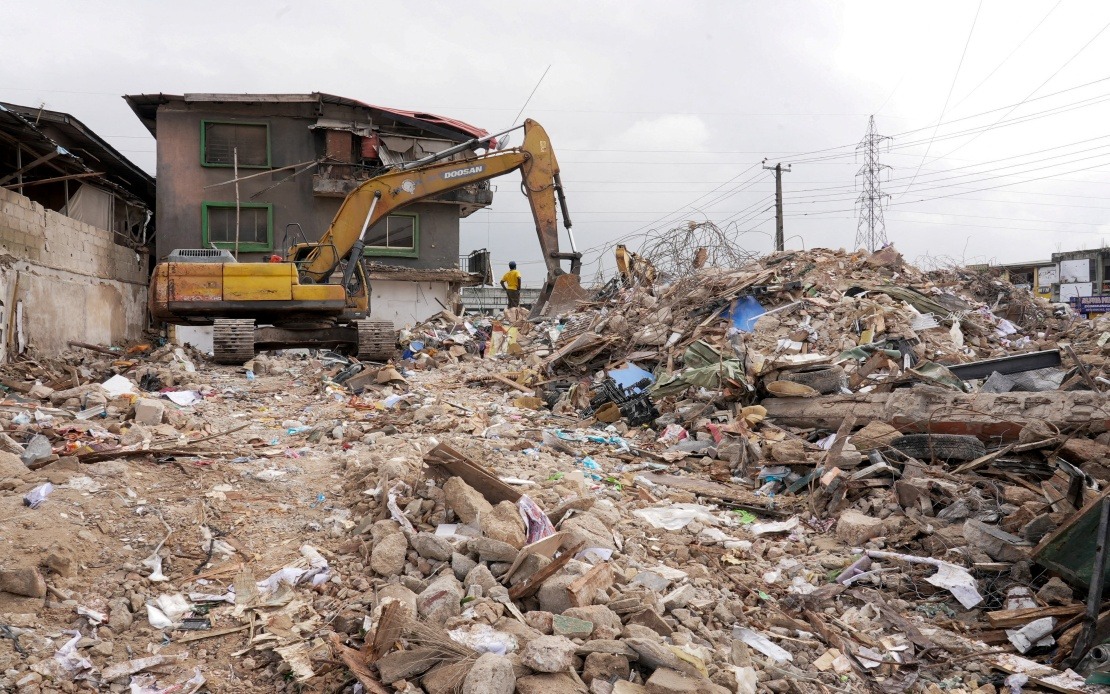
A three-storey shopping complex in Nigeria's Lagos State collapsed on Thursday morning in Alakija, a busy commercial district along the Lagos-Badagry Expressway, leaving nine people dead and prompting an intensive multi-agency rescue operation that concluded Friday after extracting 27 survivors from the debris.
The Alakija district, situated as a satellite township within Lagos's sprawling metropolitan area, has experienced rapid commercial development in recent years, making it a bustling hub for retail activity and foot traffic. When the structure gave way on Thursday, it trapped occupants who had arrived early to open their shops and begin daily trading operations, alongside numerous customers already conducting business within the complex.
Olufemi Oke-Osanyintolu, the permanent secretary of the Lagos State Emergency Management Agency, coordinated the response and reported that emergency teams worked continuously throughout Thursday night and into Friday morning to locate survivors buried beneath concrete and metal. The operation required systematic removal of collapsed materials, careful structural assessment to prevent secondary collapses, and coordinated efforts to reach pockets where victims were trapped.
Among those extracted alive were shop proprietors, retail customers, and nearby residents whose proximity to the site placed them in danger when the structure failed catastrophically. The injured survivors sustained varying degrees of trauma and wounds and were transported promptly to medical facilities across Lagos for emergency care and stabilisation. Medical teams assessed each casualty upon arrival to determine treatment priorities and recovery prospects.
The rescue effort benefited from coordination among multiple governmental and private entities. Notably, the China Civil Engineering Construction Corporation, which maintains an active railway development project in the surrounding area, mobilised personnel and equipment to assist in the extraction work. This cross-sector collaboration proved essential in accelerating the pace of recovery operations and extracting survivors before their condition deteriorated further.
Investigators have not yet determined what triggered the structural failure. Lagos State authorities have initiated a formal inquiry to establish whether the collapse resulted from defects in the original design, compromised structural integrity due to age and weathering, deferred maintenance, or other factors. Preliminary site assessments have not immediately revealed the culprit, necessitating comprehensive forensic investigation.
Building failures represent a persistent hazard across Nigeria's construction landscape. Structural engineers and urban planners have long identified a cluster of risk factors that combine to create unsafe conditions: many structures in active use exceed their intended lifespan without adequate reinforcement or rehabilitation; construction firms frequently deviate from approved designs or use materials that fall below specified standards; and enforcement of building codes remains inconsistent across different municipal jurisdictions. The combination of rapid urbanisation, cost-cutting pressures, and regulatory gaps creates environments where structural disasters occur with distressing frequency.
For Malaysia and other Southeast Asian nations pursuing rapid urban development, the Lagos incident underscores persistent challenges in ensuring construction safety during periods of accelerated growth. Many cities across the region share similar vulnerabilities: aging housing stock coexisting with new construction, varying levels of regulatory oversight, and occasional lapses in material quality control. The incident serves as a cautionary reminder that robust building standards, rigorous inspection regimes, and consistent enforcement mechanisms represent essential infrastructure for protecting public safety during urban expansion.
The Lagos collapse also highlights the importance of emergency preparedness and rapid response capacity. The successful extraction of 27 people alive depended on the immediate mobilisation of rescue teams, availability of appropriate equipment, and coordination among different agencies. Southeast Asian governments have increasingly invested in such capabilities, recognising that structural disasters strike without warning and that the window for rescuing trapped survivors narrows quickly.
Localauthorities in Lagos will likely face pressure to accelerate structural audits of other commercial buildings in the Alakija area and across the broader metropolitan region. Similar safety reviews might be warranted in other Nigerian cities experiencing comparable development patterns. The incident may also prompt more stringent enforcement of building code compliance and periodic inspection requirements for commercial structures.
As the investigation proceeds and authorities establish the precise cause of the collapse, questions will inevitably arise regarding whether regulatory oversight was adequate, whether warning signs preceded the failure, and whether preventive action might have been taken. These findings will inform policy responses not only in Lagos but potentially across the West African region, where similar construction challenges persist in multiple countries navigating rapid urbanisation.

