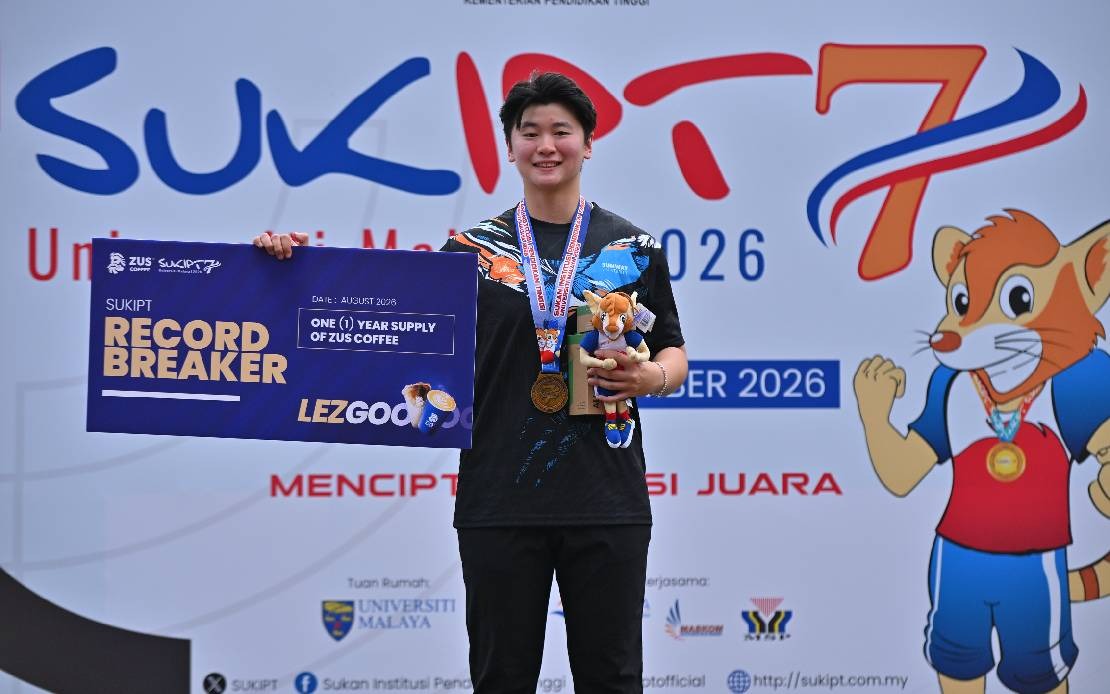
Javelin thrower Ng Jing Xuan produced a stellar performance at the 2026 Higher Education Institutions Sports Games (SUKIPT) on Malaysia's National Day, launching the javelin to 46.92 metres and becoming the first athlete to surpass the previous meet benchmark. Her achievement at UM Arena, Universiti Malaya, delivered a symbolic gold medal to Sunway University at a moment of national celebration, cementing her status among the country's most accomplished track and field performers.
The 22-year-old's throw obliterated the decade-old record of 44.41 metres set by Nur Fatin Adibah Suharman of Universiti Malaysia Perlis (UniMAP) during the 2016 competition. In doing so, Jing Xuan joined an elite cohort of Malaysian athletes who have redefined standards within the university sports circuit, demonstrating the rising calibre of performance in domestic competitions. Her winning margin was commanding, with the silver medallist Farisha Athirah Wai from Universiti Pendidikan Sultan Idris (UPSI) trailing at 36.21 metres, while Tai Yu Tian of Universiti Putra Malaysia (UPM) captured bronze with 32.74 metres.
Despite the celebratory nature of her victory, Jing Xuan acknowledged a layer of unfulfilled ambition beneath the success. Her primary objective had been to breach her own national record of 52.17 metres, a target she has pursued across multiple competitions. The gap between her competition throw and personal best represents the margin between continental achievement and world-class performance—a distinction that separates athletes competing primarily in regional arenas from those capable of challenging global standards. For Jing Xuan, whose trajectory suggests aspirations beyond Southeast Asian recognition, this shortfall stung even amid the milestone of the SUKIPT record.
The athlete attributed her inability to reach the national benchmark partly to circumstantial factors beyond her control. A late revision to the event schedule, shifting the javelin final from afternoon to morning slots, disrupted her preparatory rhythm and the throwing patterns she had refined during training. Such logistical complications, while seemingly minor in casual observation, carry genuine consequences for precision sports where muscle memory and environmental consistency profoundly influence performance. Jing Xuan explained that the accelerated timeline left her feeling less explosive in her approach and release, ultimately costing metres that might have seen her approach the national standard.
Her preparation for SUKIPT had been intensive and disciplined. Jing Xuan compressed an entire month of focused training into the immediate period following her participation in the Asian U23 Athletics Championships, channelling the experience and competitive sharpness gained from that continental platform into the university games. This back-to-back competition schedule speaks to the demands placed on Malaysian athletes who must juggle multiple sporting calendars while maintaining employment or academic obligations. Yet the toll of such intensity occasionally manifests in inconsistent performances, and she openly reflected that the result fell below what her training sessions had suggested she could achieve.
Jing Xuan's resilience in framing disappointment as opportunity underscores the psychological maturity required of elite athletes. Rather than dwelling on the national record eluding her grasp, she redirected her focus toward the immediate horizon: the ASEAN University Games in December and, more significantly, the SEA Games in the following year. These competitions represent progressively elevated stages where Malaysian athletes can secure the international exposure and recognition that fuels career trajectories. Her invocation of the Merdeka Day spirit in committing to future performances suggests an athlete motivated by national pride, not merely personal records.
The landscape of women's javelin in Malaysia has benefited from increased investment in coaching, facilities, and athlete development pathways over recent years. Jing Xuan's emergence as a record-breaker reflects these systemic improvements, though Malaysia remains dependent on a relatively narrow base of specialists in field events. The competition outcomes at SUKIPT—with representatives from Sunway University, UPSI, and UPM all securing places—indicate that javelin training has dispersed across several institutions rather than concentrating in one. This dispersion strengthens the depth of the sport nationally but also means that breaking records and achieving excellence requires consistent excellence across multiple competitive cycles.
Looking beyond the immediate SUKIPT results, Jing Xuan's trajectory carries implications for Malaysian athletics' prospects at upcoming international events. The SEA Games, held biennially within the region, have historically proven more accessible to Malaysian medallists than continental or global championships. Her current form suggests that a SEA Games medal is attainable, provided she executes the technical refinements and physical conditioning necessary to bridge the gap between her SUKIPT performance and the national record she seeks. Success at that level would elevate her profile substantially and could inspire younger athletes entering the sport.
The timing of her record-breaking performance on National Day carries symbolic weight beyond athletic achievement. Sunway University, which she represents in SUKIPT, benefited from the gold medal at a moment when Malaysian citizens reflect on national accomplishment and progress. Sports achievements, particularly by young women, resonate within a broader narrative about Malaysia's capacity to develop world-class talent across diverse disciplines. Jing Xuan's javelin record becomes part of the collective memory of the 2026 National Day festivities, even as she personally continues chasing faster, longer achievements.

