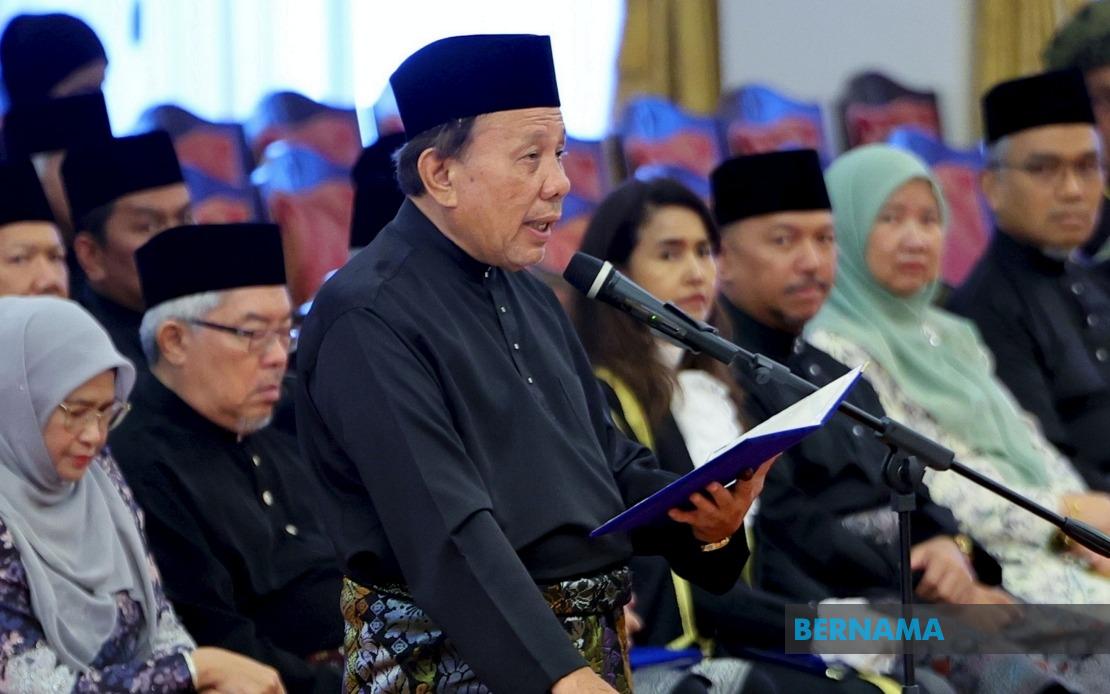
Datuk Ismail Lasim took his oath of office as the new Menteri Besar of Negeri Sembilan before the Yang Dipertuan Besar Tuanku Muhriz Tuanku Munawir at Istana Besar Seri Menanti, formally marking the transition in the state's leadership following the recent 16th Negeri Sembilan State Election. The ceremony in Kuala Pilah represents a critical moment for the northern Selangor state as it enters a new administrative chapter under fresh political direction.
In his inaugural address, Ismail characterized the electoral mandate as a weighty responsibility that demands demonstrable commitment to public welfare. Rather than treating the victory as a political prize, he framed it as a binding obligation to prove that the government would function with genuine accountability to the people. This rhetorical positioning signals an awareness that Malaysian voters increasingly demand substantive results rather than merely accepting campaign promises at face value. For a state like Negeri Sembilan, which has experienced significant political transitions in recent years, such assurances take on heightened importance.
The new Menteri Besar's emphasis on listening to public aspirations reflects broader expectations within Malaysian governance. He committed specifically to ensuring that administrative decisions would be grounded in fairness, transparency and effectiveness. These three pillars—if successfully implemented—would address persistent complaints from Malaysian citizens regarding opaque decision-making and perceived inequitable treatment. The pledge carries particular weight in Negeri Sembilan, where historical patterns of administrative practice may require deliberate recalibration to meet contemporary standards of governance.
Ismail's commitment to constitutional monarchy and parliamentary democracy underscores respect for Malaysia's institutional framework. His explicit undertaking to uphold the Yang Dipertuan Besar's guidance and to defend both the Federal Constitution and the state constitution demonstrates understanding that legitimate governance operates within established legal bounds. For Malaysian readers familiar with recent political turbulence, such respect for constitutional norms provides reassurance regarding institutional stability.
The new leadership has also pledged to preserve and promote Adat Perpatih, the distinctive customary system unique to Negeri Sembilan. This commitment acknowledges the state's exceptional position within Malaysia's federal structure, where customary law holds particular significance. Ismail's recognition that Adat Perpatih embodies values of consensus, justice, unity and wisdom suggests his administration will seek to ground modern governance decisions within this traditional framework rather than treating heritage as merely ceremonial. For residents of Negeri Sembilan, this represents validation of their distinct cultural and administrative identity within the broader Malaysian federation.
Economic development features prominently in Ismail's administrative vision. He outlined intentions to strengthen the state economy, attract quality investments and generate employment opportunities while maintaining focus on improving living standards across both urban and rural areas. Given that Negeri Sembilan occupies a strategic position within the Klang Valley region, economic policies carry implications extending beyond state boundaries. The commitment to inclusive development—ensuring progress reaches all communities rather than concentrating benefits geographically—addresses persistent regional inequality concerns that plague Malaysian development efforts.
Ismail's definition of genuine progress extends beyond conventional metrics. Rather than evaluating success solely through infrastructure completion or GDP growth, he argued that true advancement encompasses social harmony, institutional strength and public confidence in government systems. This perspective aligns with emerging global discussions about development paradigms that balance economic expansion with human welfare. For Malaysian policymakers grappling with questions about whether growth alone constitutes progress, this framing offers an alternative approach worthy of implementation and observation.
The Menteri Besar committed to strengthening relationships between multiple constituencies—the Royal Institution, state government, federal authorities, civil service, private sector and community leaders. In Malaysia's complex federal system where state-federal tensions occasionally surface, maintaining harmonious coordination represents essential infrastructure for effective governance. Ismail's recognition that progress requires coordinated effort across institutional boundaries suggests sophisticated understanding of Malaysia's administrative realities. Whether this coordination translates into practical effectiveness will determine his administration's ultimate success.
Within Negeri Sembilan's civil service, the new administration has signaled expectations regarding dedication, professionalism and responsibility. Ismail's emphasis on building processes grounded in trust and integrity establishes standards against which public employees will be measured. For Malaysian citizens experiencing frustration with bureaucratic inefficiency and corruption, such explicit commitment to professional standards carries significance. State civil services often face less scrutiny than federal agencies, making Ismail's public promises regarding administrative conduct potentially consequential for residents' actual experiences.
The new Menteri Besar also acknowledged his predecessor Datuk Seri Aminuddin Harun's contributions, framing the transition as one of continuity rather than complete rupture. This diplomatic acknowledgment recognizes that successful governance builds upon existing foundations while introducing necessary improvements. For Negeri Sembilan, where development projects and administrative initiatives require multi-year implementation, understanding which elements will continue and which will shift becomes crucial for stakeholders planning investments or anticipating policy changes.
Ismail's openness to constructive criticism and emphasis on consensus-building represent procedural commitments that could influence administrative culture. In Malaysian contexts where top-down decision-making traditionally dominates, genuine receptiveness to alternative viewpoints would constitute meaningful institutional change. Whether the new administration institutionalizes mechanisms for gathering and incorporating public feedback, or merely maintains rhetorical commitment to consultation, will significantly affect how transparently the government actually operates.
The swearing-in ceremony itself, conducted before the Yang Dipertuan Besar in accordance with constitutional protocols, reinforces legal legitimacy and institutional propriety. For Malaysian observers accustomed to political dramas involving disputed transitions or constitutional challenges, this orderly procedure provides stability. Negeri Sembilan's constitutional arrangements, which grant the Yang Dipertuan Besar distinctive roles, receive formal respect in these proceedings. The ceremony's adherence to established protocols demonstrates that democratic processes, despite Malaysia's complex political history, continue functioning according to constitutional prescriptions.
Moving forward, Ismail's administration faces the practical challenge of translating rhetorical commitments into measurable outcomes. The pledges regarding transparency, economic development, social inclusion and administrative integrity constitute a substantial agenda. Success requires not merely good intentions but effective implementation, sustained political will and institutional cooperation across multiple sectors. For Malaysian and particularly Negeri Sembilan residents, observing whether this new administration converts aspirational statements into tangible improvements in governance quality will ultimately determine public trust in the political system.

