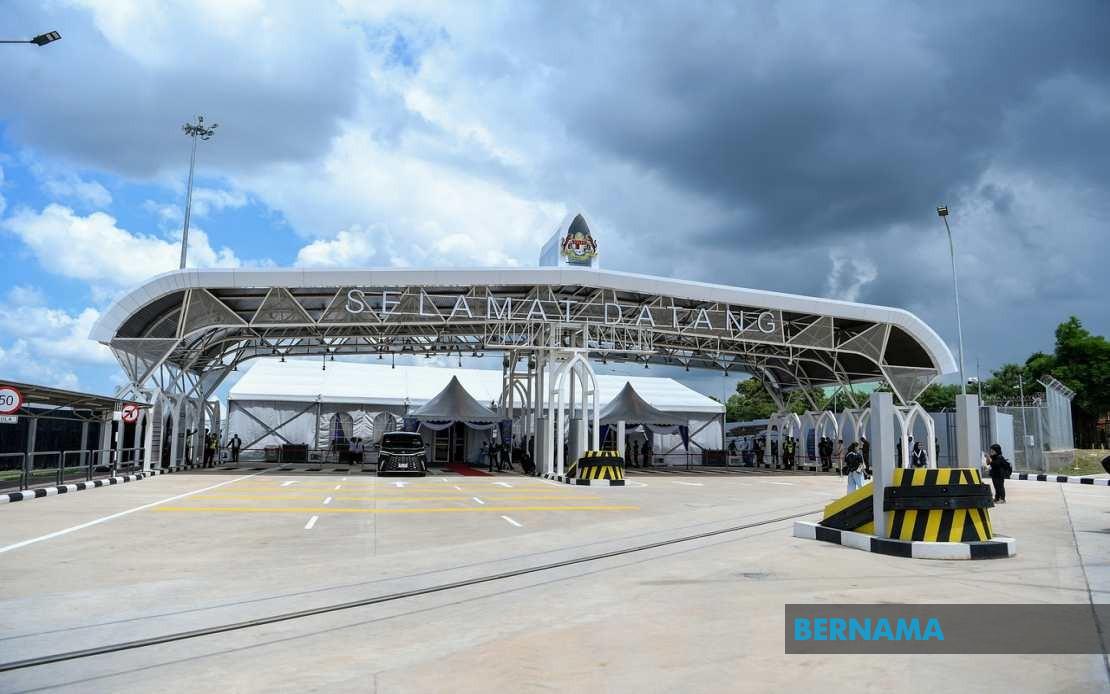
A newly constructed border crossing linking Malaysia's Kedah state with Thailand's Songkhla province is delivering tangible benefits to cross-border commerce after commencing operations last month, with preliminary data showing marked improvements in the movement of goods and heightened bilateral trade activity. The 900-metre corridor, which connects the Bukit Kayu Hitam Immigration, Customs, Quarantine and Security Complex in Malaysia to the Sadao Customs, Immigration and Quarantine facility in Thailand, has already achieved near-universal adoption among commercial transport operators seeking quicker passage between the two nations.
The route was inaugurated jointly by Thai Prime Minister Anutin Charnvirakul and Malaysian Prime Minister Datuk Seri Anwar Ibrahim on July 10, with formal operations commencing the following day. The infrastructure project represents a coordinated effort between Kuala Lumpur and Bangkok to eliminate bottlenecks that have historically constrained the flow of merchandise across this vital economic corridor, one of Southeast Asia's busiest international checkpoints.
According to Sadao Customs director Buntoon Oucharoen, lorries, buses and vans have shifted almost completely from the older crossing to this new passage, alleviating previous congestion issues. The redirection of traffic has proven remarkably swift, with approximately 100 per cent of eligible vehicles now utilising the fresh infrastructure. This wholesale transition underscores the significant operational advantages the new facility offers compared to its predecessor.
The efficiency gains stem largely from technological integration. The facility employs advanced X-ray scanning technology branded as "Fast Scan," which has dramatically compressed container inspection intervals. Previously, a single container required roughly five minutes for thorough screening; the new system accomplishes equivalent scrutiny in under sixty seconds. This acceleration alone constitutes a substantial improvement in processing capacity at what remains one of Malaysia and Thailand's most strategically important land border complexes.
Beyond hardware upgrades, the crossing incorporates computerised cargo management protocols that permit real-time information verification without requiring vehicles to queue excessively. Drivers can proceed with their shipments once digital documentation has been validated, substantially reducing idle time during transit. The combination of automated scanning and digitalised customs procedures has created a processing environment markedly more efficient than the previous arrangement, allowing the facility to handle more than 1,000 logistics vehicles daily.
The commercial impact has been substantial and immediate. During the initial three-week operational period from July 11 through July 31, Sadao Customs reported import values reaching 19 billion baht, equivalent to approximately RM2.35 billion, compared with 12 billion baht during the corresponding month last year—a gain of roughly 58 per cent. Export performance proved even more impressive, with merchandise shipments totalling over 24 billion baht, or approximately RM2.97 billion, versus 13 billion baht for the same period previously—a surge of approximately 85 per cent.
These figures demonstrate that the corridor improvements have not merely moved existing traffic to a faster lane but have genuinely stimulated incremental bilateral commerce. Businesses previously deterred by congestion and extended processing delays now find the Malaysia-Thailand trade route more commercially viable, evidenced by this sustained expansion in both directions. For Malaysian exporters seeking Thai market access and Thai suppliers targeting Malaysian consumers and manufacturing sectors, the operational improvements translate directly into competitive advantages and reduced logistical costs.
The facility's design incorporates comprehensive infrastructure for passenger movements as well. The opening featured 11 inbound and 11 outbound lanes specifically configured for tourist and private vehicle traffic, enabling enhanced tourism flows across the border. Regional hospitality leaders, including Hatyai-Songkhla Hotel Association president Sittipong Sitthiphataraprabha, have welcomed this expanded capacity, recognising that improved border passages typically correlate with increased visitor movements during holiday periods and weekends.
The timing of this infrastructure investment occurs amid broader momentum in Malaysia-Thailand bilateral relations. During the January-to-March 2026 quarter, two-way merchandise trade between the nations reached RM31.33 billion, approximately US$7.90 billion, compared with RM27.35 billion during the identical period in 2025. This upward trajectory reflects underlying economic complementarities and expanding commercial interdependence between the two Southeast Asian neighbours.
Looking ahead, both governments have articulated ambitious targets for deepening economic integration. Malaysia and Thailand are jointly pursuing a bilateral trade objective of US$30 billion—approximately RM122.6 billion—by 2027, a milestone that would represent meaningful expansion from present levels. The Bukit Kayu Hitam-Sadao corridor's enhanced capacity positions it as instrumental infrastructure supporting achievement of this target, reducing friction costs that historically constrained trade volumes.
For Malaysian stakeholders, particularly logistics companies, agricultural exporters, and manufacturing enterprises integrated into Thai supply chains, the border crossing improvements offer material competitive advantages. Shorter transit times reduce warehousing requirements, lower fuel expenditure, and accelerate inventory turnover—economic benefits that ripple through downstream commercial activities and ultimately enhance Malaysia's attractiveness as a logistics hub for Southeast Asian trade.
The cross-border initiative also carries significance for regional integration efforts beyond bilateral commerce. Enhanced Malaysia-Thailand connectivity supports broader Association of Southeast Asian Nations development objectives emphasising seamless intra-regional movement of goods and services. As the two nations approach their 70th anniversary of diplomatic relations next year, infrastructure investments such as this border crossing demonstrate sustained commitment to deepening practical cooperation and economic partnership.
The Bukit Kayu Hitam-Sadao project exemplifies how targeted infrastructure modernisation, combined with technological advancement and cross-border coordination, can generate measurable economic dividends. Initial performance metrics suggest the facility has succeeded in its fundamental objective: facilitating commerce between two major Southeast Asian economies whilst maintaining rigorous security and regulatory standards. As operations mature and stakeholders fully adapt to the new systems, trade volumes may expand further, positioning this corridor as an increasingly vital artery for Malaysia-Thailand economic exchange.

