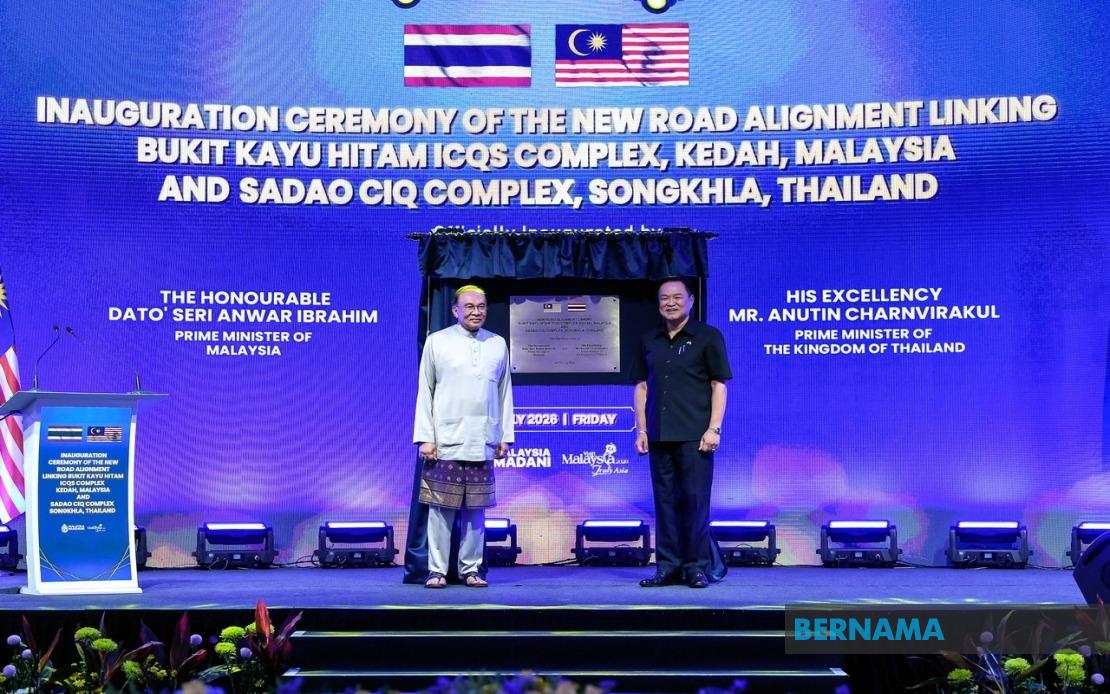
Prime Minister Datuk Seri Anwar Ibrahim has flagged the launch of a new road connection between Malaysia's Bukit Kayu Hitam border facility and Thailand's Sadao checkpoint as a watershed moment for bilateral economic integration. Unveiled at a joint ceremony with Thai Prime Minister Anutin Charnvirakul in Kedah on July 10, the infrastructure initiative signals renewed commitment from both nations to harness their shared frontier as an engine for prosperity rather than a mere administrative boundary.
The road alignment itself represents more than a straightforward connectivity project. Both premiers framed the undertaking as foundational to a broader vision of establishing a special economic border zone spanning northern Malaysia and southern Thailand. This conceptual shift—moving beyond conventional cross-border trade arrangements toward institutionalised regional cooperation—reflects a maturing approach to leveraging geographic proximity for mutual gain. For Malaysia, the five northern and upper-central states of Perlis, Kedah, Kelantan, Perak and Penang stand to benefit substantially from streamlined movement of goods, services and capital.
Anwar emphasised that such transformative projects demand sustained political will and cannot materialise overnight. The Malaysian premier acknowledged the complexity inherent in rewiring decades of regulatory and administrative frameworks that have traditionally compartmentalised the two economies. Yet the very act of inaugurating the road link alongside his Thai counterpart signals seriousness about translating ambition into tangible infrastructure. This carries particular weight given that such high-level ceremonial endorsement often precedes sustained bureaucratic follow-through at working levels.
The economic targets underpinning the initiative reveal the scale of aspirations involved. Malaysia and Thailand have committed to achieving bilateral trade worth USD30 billion by 2027—a figure representing meaningful growth from current levels and implying annual expansion that demands functional, friction-free border operations. The new road, by reducing transit times and logistical costs, directly supports this objective by making cross-border commerce more efficient and cost-effective for traders and manufacturers spanning both nations.
Critically, Anwar and Anutin have identified outstanding impediments requiring expedited resolution. Customs procedures, immigration protocols, fisheries regulations and general trade mechanics have accumulated inefficiencies and inconsistencies over time. Both leaders have pledged to accelerate the dismantling of these barriers, recognising that regulatory harmonisation or mutual recognition of standards often delivers greater commercial benefit than infrastructure alone. The framing of these technical challenges as policy priorities—rather than enduring constraints—suggests a shift in mindset toward problem-solving collaboration.
For Malaysia's border communities, the implications extend beyond abstract economic growth. Residents of rural Kedah and neighbouring states have historically experienced their geographic position as a liability, isolated from major commercial hubs and lacking industrial opportunity. A functioning special economic zone could reverse this dynamic, attracting manufacturing, logistics and services investment while creating employment that matches skills available locally. The emphasis on improving livelihoods for border-area traders reflects an acknowledgment that regional development must benefit ordinary people, not merely headline economic figures.
The timing of the Thai premier's visit itself carries significance. Anutin's willingness to travel to a remote border area—rather than confining bilateral engagement to Bangkok or Kuala Lumpur diplomatic circuits—underscores the seriousness of the commitment. Anwar's public appreciation of this gesture further emphasises a shared understanding that border communities warrant attention from the highest levels of government, a perspective that can only accelerate downstream implementation of supporting policies.
Southeast Asian regional dynamics provide context for this Malaysia-Thailand rapprochement. As the region navigates geopolitical uncertainties and competing great-power interests, bilateral partnerships that deepen economic interdependence acquire strategic dimension. Stronger Malaysia-Thailand integration, anchored in mutually beneficial commerce and people-to-people connectivity, strengthens the broader ASEAN framework. For investors and businesses across the region, demonstrable commitment to border efficiency signals the viability of supply chains spanning both nations.
The special economic zone concept itself reflects lessons learned from similar arrangements elsewhere. The Shenzhen model and various ASEAN cross-border initiatives have demonstrated that dedicated regulatory environments, coupled with infrastructure investment, can catalyse rapid development. However, success invariably requires sustained political commitment extending beyond inaugural ceremonies. The fact that both nations have identified this approach—rather than pursuing piecemeal border improvements—suggests institutional learning and potentially greater likelihood of implementation.
Looking forward, the critical test will be administrative execution. Customs officials, immigration personnel and trade regulators on both sides must align procedures and prioritise efficiency without compromising security or revenue collection. Early successes in resolving specific outstanding issues—whether customs clearance times, phytosanitary standards or documentation requirements—will establish momentum and demonstrate to business communities that the political commitment translates into operational reality. These frontline outcomes ultimately determine whether the road and special zone concept delivers promised economic uplift.
The Malaysian private sector, particularly manufacturers in the automotive, electronics and agricultural value chains, should monitor implementation closely. Companies currently navigating Malaysia-Thailand supply chains face real costs from border inefficiencies; streamlining these operations directly enhances competitiveness. Equally important are small and medium enterprises in border towns that could benefit from simplified cross-border business registration and labour movement arrangements, should the special zone framework include such provisions.
For policymakers and investors monitoring Southeast Asian development, the Malaysia-Thailand border initiative exemplifies how bilateral infrastructure and economic zone projects can serve dual purposes: immediate commercial stimulus and longer-term geopolitical anchoring. Success would provide a replicable model for other ASEAN border pairs seeking to convert geographic proximity into shared prosperity, while failure would reinforce scepticism about transformative cross-border cooperation. The stakes for both nations extend accordingly.

