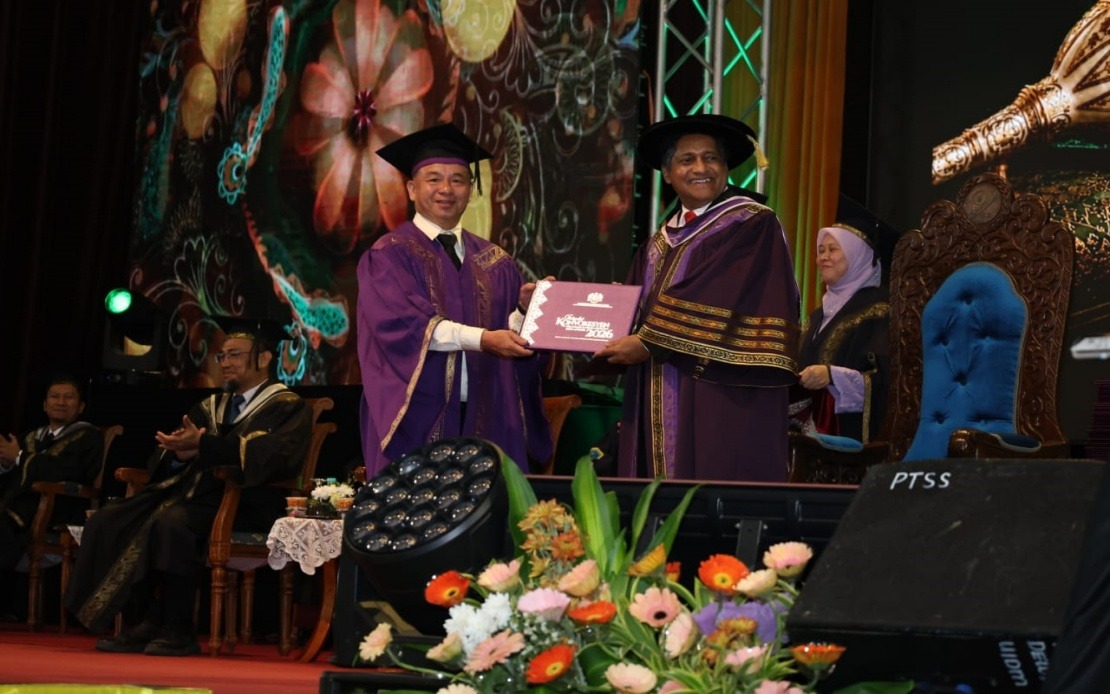
Heng Meng Lai's journey to the graduation stage at Seberang Perai Polytechnic (PSP) in Bukit Mertajam represents far more than a personal milestone—it exemplifies a growing movement across Malaysia recognising that formal education need not be confined to youth. At 57, Heng became the polytechnic's oldest graduate upon completing his Diploma in Electrical and Electronic Engineering at the PSP Convocation Ceremony 2026, a distinction that carries profound implications for Malaysia's lifelong learning agenda and workforce development strategy.
The path leading to this achievement spans nearly five decades of deferred ambition. Heng had harboured desires to pursue tertiary education throughout his adult life, yet the demands of employment and familial obligations repeatedly pushed such aspirations to the margins. His circumstances were shaped by early hardship—losing his father at age nine forced his mother into factory work as a seamstress to sustain her family of seven children. Born into constraint rather than privilege, Heng absorbed from those formative years a determination to transcend his circumstances through self-improvement, even if the timing of that improvement proved prolonged.
The trajectory of his working life provided both practical experience and intellectual motivation. Beginning as a storekeeper, Heng progressed to a supervisory position on the production line at an electronics manufacturing facility. This career progression exposed him intimately to the technical operations underlying industrial production, and that exposure kindled curiosity about the engineering principles governing his daily work environment. When the opportunity finally materialised to formalise his knowledge through structured study, selecting Electrical and Electronic Engineering became the natural confluence of accumulated experience and awakened interest.
What distinguishes Heng's narrative is not merely his persistence, but the institutional environment that enabled him to succeed. Despite occupying classroom space alongside students three decades his junior, he encountered no ostracisation or dismissiveness from PSP's academic staff. The lecturers who guided his progress demonstrated what might be termed pedagogical maturity—recognising that an older learner brings distinct advantages including discipline, contextual understanding, and intrinsic motivation. Heng's testimony that he never felt marginalised testifies to deliberate institutional choices favouring inclusivity over homogeneity in student cohorts.
For Malaysia's polytechnic sector, Heng's achievement arrives at a strategically significant moment. The nation's aspiration toward becoming a high-income economy increasingly depends on cultivating a workforce capable of navigating technological transition and sectoral evolution. Traditional pathways—wherein individuals complete formal education before entering employment and remaining in fixed career trajectories—are progressively obsolete. The global economy now demands adaptability, continuous skill acquisition, and the capacity to reinvent professional identity across multiple career iterations. Heng embodies this necessity.
The implications extend beyond individual gratification. Seberang Perai Polytechnic director Mohd Ruzi Hamzah framed Heng's graduation as validation of the institution's commitment to democratised access. He articulated that polytechnics serve not narrow demographic cohorts but the entire society, irrespective of age or prior educational credentials. This positioning aligns with Malaysia's stated commitment to lifelong learning as a cornerstone of human capital development. When institutions actively recruit and support mature-age learners, they simultaneously address skills shortages, improve utilisation of existing facilities, and demonstrate that educational institutions function as engines of genuine social mobility rather than credentialing mechanisms exclusively for school-leavers.
Heng's next horizon illuminates another dimension of educational progression increasingly relevant to Malaysian contexts. Having obtained his diploma at 57, he expresses intention to continue toward a bachelor's degree—a progression suggesting that the completion of one qualification need not represent educational terminus but rather a waypoint in extended learning journeys. This aspiration reflects recognition that professional development increasingly requires multiple credentials stacked across different institutions and timeframes. For Malaysia, where the demographic bulge of working-age adults far outnumbers the population cohort approaching traditional university entry age, older learners represent an underutilised reservoir of talent and motivation.
The gender dynamics merit brief notation. Heng's journey, undertaken as a single male, navigates different social terrain than mature-age women re-entering education whilst managing childcare or household responsibilities. Malaysian policymakers and educational institutions would benefit from interrogating whether equivalent supports exist for older female learners, whose numbers attempting educational re-entry may substantially exceed male counterparts given historical patterns of female workforce participation and domestic responsibilities. Heng's success story, valuable as it is, potentially obscures the more complex barriers confronting women's lifelong learning participation.
From Heng's perspective, the immediate intention involves returning to employment to apply newly acquired technical competencies before pursuing tertiary qualifications. This sequencing—combining study with work, rather than segregating them—reflects evolving international best practices in adult learning. Individuals mature enough to articulate learning objectives rooted in workplace application typically progress more efficiently through academic content because relevance and utility are immediately apparent. Heng's prior exposure to electronics manufacturing creates immediate context into which his engineering knowledge maps, enhancing retention and practical application capacity.
The broader significance of Heng's achievement transcends the individual narrative. It functions as public demonstration that Malaysian educational institutions, at least at the polytechnic level, increasingly embrace inclusive admission philosophies. It validates the investment of public resources in institutions remaining accessible to populations beyond traditional school-leavers. Critically, it contests potentially internalised barriers within working-age adults—the silent assumption that certain educational pathways are foreclosed once particular life stages pass. When a 57-year-old successfully completes a technical diploma, younger adults reconsidering their educational trajectories receive powerful evidence that institutional doors remain open.
For Malaysia's broader workforce development architecture, Heng Meng Lai's distinction as Seberang Perai Polytechnic's oldest graduate provides a template worth replicating across the sector. His journey illustrates that mature-age learners bring distinct pedagogical assets—discipline, context, motivation—whilst serving institutional and national objectives simultaneously. As Malaysia navigates sectoral transitions and seeks competitive advantage through technological adoption and workforce reskilling, the population of individuals like Heng—possessing decades of work experience but lacking formal credentials—represents an enormous and largely untapped pool of potential students whose trajectories, once supported, can substantially contribute to national human capital objectives.

