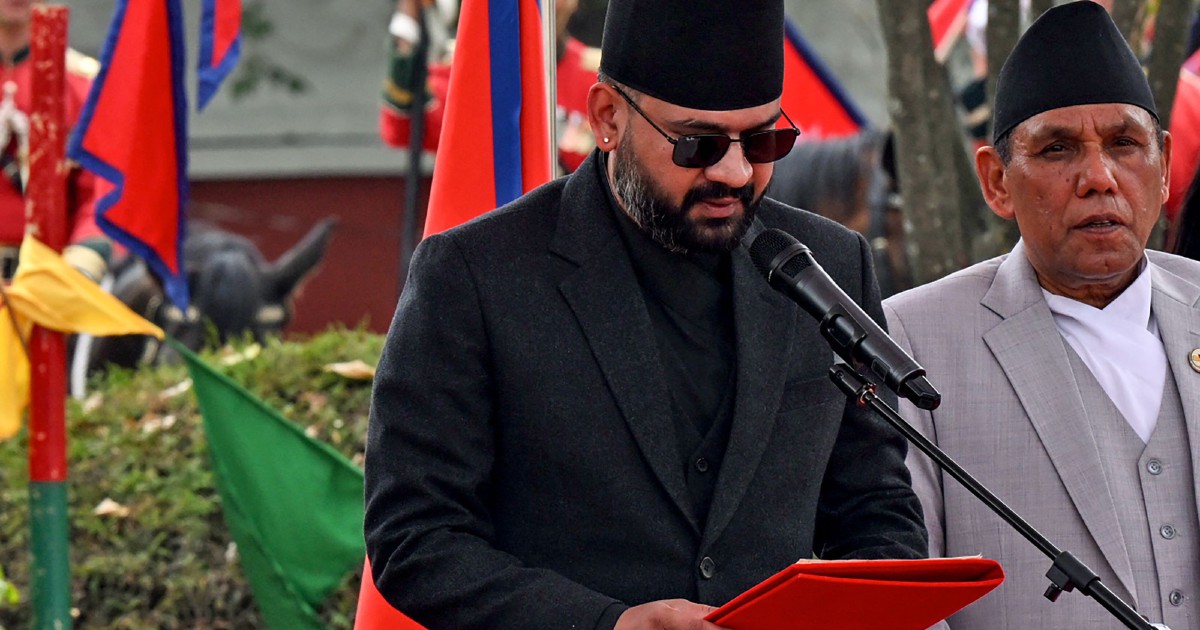
Nepal's government has granted Prime Minister Balendra Shah an official exception permitting him to continue wearing his characteristically dark sunglasses while present in parliamentary proceedings, resolving a brief protocol dispute that had emerged within the legislature this week. The authorisation came after officials cited legitimate health grounds justifying the use of the eyewear, effectively overriding an initial recommendation from the parliament speaker that the Prime Minister remove them during sessions.
The decision reflects an evolving approach to parliamentary protocol in Nepal, where traditional rules governing legislative decorum have historically discouraged members from wearing sunglasses or other accessories that could obstruct their facial features during official business. However, the recognition of medical necessity as grounds for exemption signals growing flexibility in how such conventions are applied in practice, particularly when personal health circumstances warrant deviation from standard procedures.
Balendra Shah's signature sunglasses have become a recognisable element of his public identity, making the parliamentary permission particularly significant from a symbolic perspective. The accessory has featured prominently in news photographs and public appearances, and its potential prohibition during legislative sessions raised questions about how far formal institutional rules should extend when addressing the personal presentation choices of senior government officials. The controversy, while relatively minor in institutional terms, touched upon broader questions regarding individual expression and the adaptation of traditional rules to contemporary circumstances.
The parliament speaker's initial guidance appears to have reflected conventional interpretations of legislative dress codes and behavioural standards, standards which many democratic institutions worldwide maintain to preserve the formal atmosphere of parliament. Yet the medical justification for Shah's sunglasses demonstrates how such guidelines inevitably encounter situations requiring nuanced application. Officials did not publicly specify the exact nature of the medical condition necessitating the eyewear, maintaining privacy while satisfying the formal requirement for parliamentary approval.
This development occurs within Nepal's broader political landscape, where procedural matters and parliamentary norms have periodically generated debate among legislators and governance observers. The country's democratic institutions, which have undergone significant evolution following earlier constitutional transitions, continue refining internal practices and protocols to balance institutional traditions with contemporary governance needs. The handling of the sunglasses issue exemplifies how even seemingly straightforward matters of protocol can become subjects requiring official deliberation and resolution at senior levels.
For Malaysian readers observing parliamentary practices across the region, the Nepalese situation offers perspective on how different legislatures navigate the intersection of formal procedure and individual circumstance. While Malaysian parliamentary conventions similarly emphasise professional appearance standards, the resolution in Nepal's case demonstrates that medical necessity can provide legitimate grounds for reasonable exceptions to established dress codes. The approach taken by Nepalese officials reflects a pragmatic recognition that rigid adherence to protocol without consideration of health factors may be neither equitable nor necessary.
The incident also illustrates the prominent role that personal presentation plays in political imagery and public perception. Politicians' distinctive visual characteristics often become integral to their public profiles, and restrictions on such elements can generate broader questions about the appropriateness and necessity of particular institutional rules. Balendra Shah's sunglasses have transcended mere fashion to become part of his recognisable political identity, making the parliamentary permission a matter extending beyond simple protocol compliance into questions of personal autonomy and official identity.
Regionally, various South Asian legislatures maintain their own protocols regarding acceptable parliamentary attire and appearance, with interpretations varying significantly across jurisdictions and evolving over time. The Nepalese parliament's flexibility in accommodating medical requirements reflects trends toward more adaptive governance practices across the region, where institutions increasingly seek to balance respect for traditional protocols with acknowledgement of legitimate individual circumstances that may necessitate exceptions.
The resolution of this matter through official sanction rather than simple tolerance represents an important distinction. By formally permitting the sunglasses rather than merely overlooking their use, Nepalese parliamentary authorities created an explicit precedent acknowledging that protocol rules can accommodate medical necessity. This approach provides clearer institutional guidance while respecting both the individual needs of senior officials and the legitimate purposes underlying parliamentary conventions.
Moving forward, the decision may influence how Nepal's parliament approaches other similar requests for exceptions to dress or appearance standards, establishing a framework for evaluating such matters based on documented medical grounds. The precedent recognises that democratic institutions, while properly concerned with maintaining standards and decorum, must also remain flexible enough to accommodate the legitimate health requirements of their members. This balance between institutional consistency and individual circumstance represents an ongoing challenge for legislatures worldwide, and Nepal's handling of the issue offers one example of how such tensions might be reasonably resolved.

