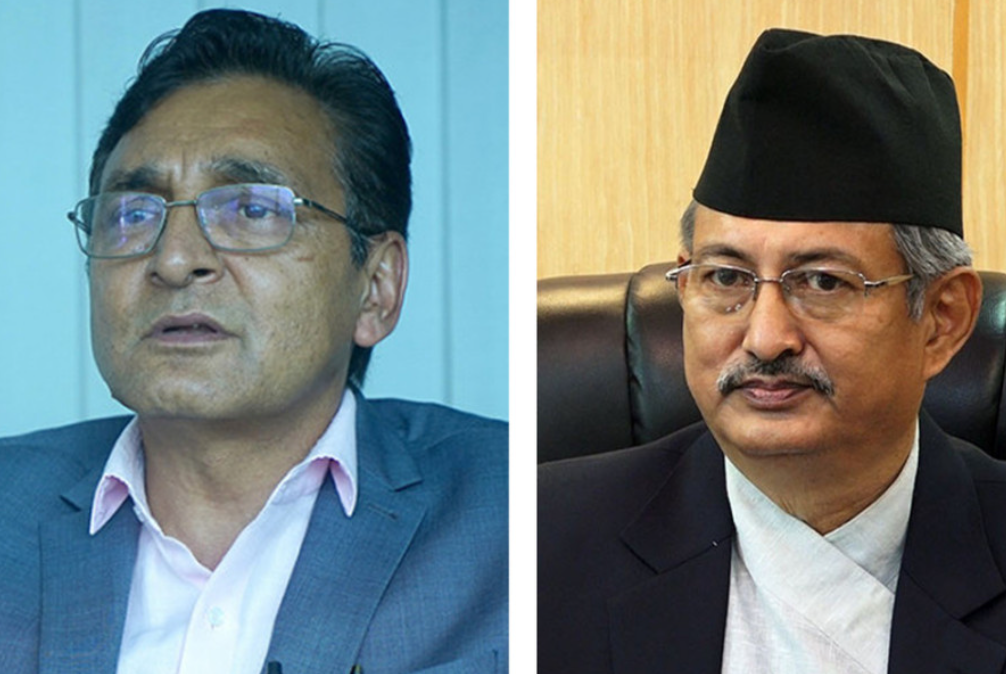
Nepal's judicial system has delivered guilty verdicts against two high-ranking former government officials implicated in an audacious refugee fraud that exploited resettlement pathways designed for genuinely displaced Bhutanese nationals. Top Bahadur Rayamajhi, who previously held the Deputy Prime Minister portfolio and oversaw the Energy Ministry, faces a four-year prison sentence following convictions on charges of document forgery, defrauding the state, and involvement in organised crime. Bal Krishna Khand, his predecessor in the Home Ministry position, received a two-year custodial sentence as an accomplice to the scheme. The verdicts, delivered late Tuesday from the district court in Kathmandu, mark a significant escalation in accountability for what authorities describe as a systematic abuse of international humanitarian protections.
Neither Rayamajhi nor Khand has publicly acknowledged wrongdoing. Rayamajhi remains in police custody, while Khand secured bail pending appeals. Their legal representatives have signalled intentions to challenge the convictions. Dharma Raj Regmi, counsel for Rayamajhi, contends his client bore no responsibility for refugee policy formulation and maintains his innocence. Khand's lawyer, Pankaj Karna, has similarly committed to mounting an appellate defence, suggesting the case will extend through Nepal's court system for some time.
The investigation's scope extends beyond the two ministers. Prosecutors successfully convicted fourteen additional individuals, including former senior civil servants within the Home Ministry bureaucracy and leadership figures within Bhutanese refugee communities resident in Nepal. These co-conspirators received sentences ranging up to four years, indicating the fraud involved coordination across multiple institutional levels and community networks.
A critical remaining question concerns whether any Nepali nationals actually succeeded in reaching the United States through this fraudulent mechanism. Official documentation has not confirmed the actual resettlement of Nepali citizens misidentified as Bhutanese refugees to American territory. This ambiguity raises concerns about the investigation's completeness and whether authorities have fully traced the scheme's operational endpoints. The conspiracy surfaced publicly in 2023, by which time both Rayamajhi and Khand had already departed their ministerial positions, complicating the prosecution's task of establishing culpability during active governmental service.
The fraud's existence reveals vulnerabilities within resettlement verification systems that have processed over 113,000 individuals from Nepali camps since the early 1990s. The underlying refugee population comprises approximately 120,000 Bhutanese nationals of Nepali ethnicity who fled Bhutan during successive waves of political upheaval and communal tension. Bhutan's Buddhist-majority population of fewer than 800,000 historically marginalised its substantial Nepali-speaking Hindu minority, prompting mass migration across the border into eastern Nepal. Rather than facilitating voluntary repatriation between the South Asian neighbours, this impasse created circumstances where international resettlement became the primary solution.
The United States has absorbed roughly 100,000 of these refugees under third-country resettlement arrangements, with Canada and Australia accepting substantial additional numbers. These transfers reflect the international community's long-standing recognition of Bhutan's political restrictions and the genuine vulnerabilities facing the displaced population. However, the resettlement infrastructure's reliance on documentary evidence created precisely the conditions that enabled the fraudulent exploitation now being prosecuted. Officials forging citizenship and refugee status documentation could theoretically exploit documentation gaps that distinguish genuine Bhutanese claimants from Nepali nationals seeking alternative pathways to Western resettlement.
Thousands of Bhutanese-Nepali refugees remain in camps throughout eastern Nepal, still expressing preferences to return to Bhutan despite decades of displacement. These individuals inhabit liminal humanitarian spaces where permanent settlement in either country remains politically contentious. Conditions within the camps have deteriorated as international attention has shifted elsewhere, and the resettlement programme has gradually wound down without addressing the remaining population's aspirations for repatriation.
The fraud convictions arrive within a broader context of anti-corruption mobilisation that has reshaped Nepal's political landscape. Youth-driven anti-corruption protests in September claimed 76 lives while forcing the incumbent government's collapse. These demonstrations reflected generational frustration with institutionalised malfeasance and elite disregard for public interest. The resulting electoral mandate, delivered in March, installed Balendra Shah, a 36-year-old former music industry figure-turned-politician, leading a government explicitly committed to prosecuting historical corruption. Shah's administration has signalled that prior governments' financial misconduct and abuse of public office will face serious legal consequences.
The refugee fraud prosecution must therefore be understood partly as an expression of this anti-corruption mandate. Whether the verdicts ultimately survive appellate scrutiny remains uncertain, but their delivery demonstrates the new government's willingness to pursue cases involving prominent predecessors. For Malaysian and broader Southeast Asian observers, the case illustrates how humanitarian mechanisms designed to address genuine displacement can become vehicles for personal enrichment when institutional oversight weakens and documentary verification procedures rely excessively on officials' honesty. The fraud also underscores the vulnerability of smaller nations' citizens to exploitation within regional migration systems where documentation disparities create opportunity for forgery schemes.

