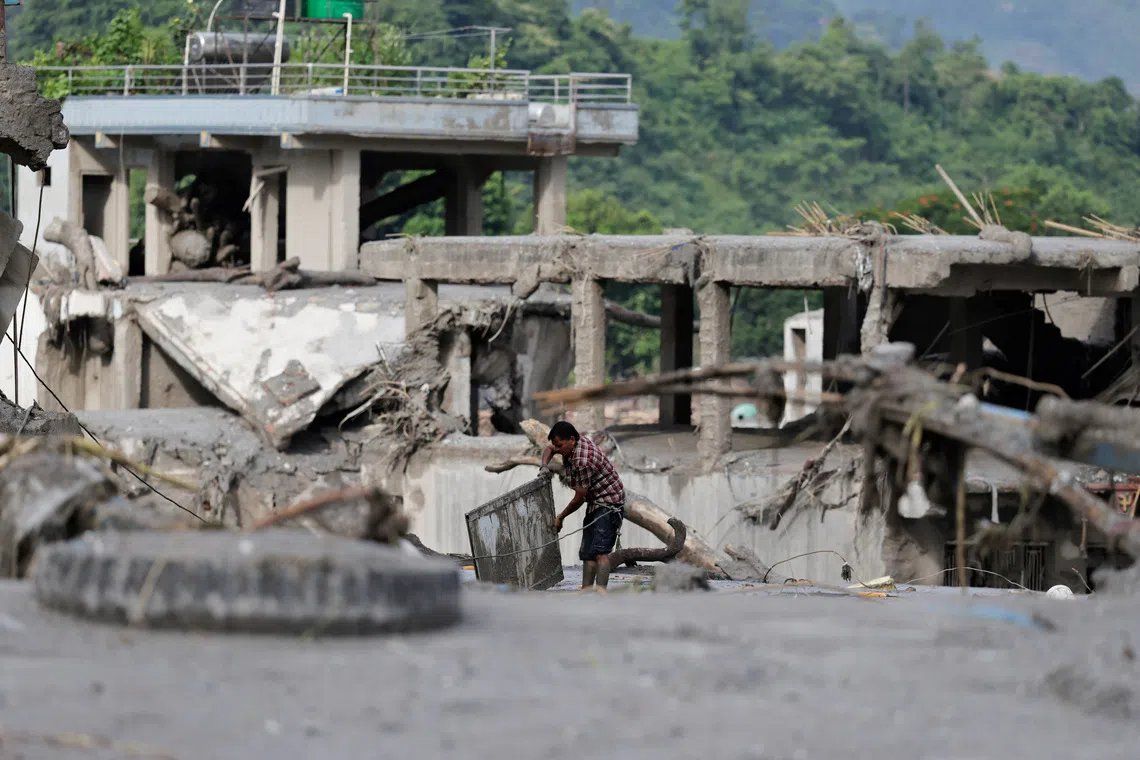
The humanitarian crisis unfolding across the Nepal-China border has taken on a new dimension as authorities in both nations grapple with the prospect of secondary flooding events. On Thursday, disaster management officials simultaneously warned that lakes created by massive debris blockages from a catastrophic glacier collapse pose an acute danger of rupturing and sending torrents of water cascading through already ravaged valleys. The warnings underscore the cascading nature of natural disasters in the Himalayan region, where one catastrophic event can trigger multiple hazards across borders and across weeks.
The initial calamity struck on Wednesday when a glacier collapsed in the mountainous terrain straddling Nepal and Tibet, China. The enormous volume of rock, ice, mud and other debris swept down into river systems with devastating force, obliterating communities and washing away the infrastructure of daily life. At least 362 people have been confirmed dead, with over 1,000 still unaccounted for as rescue teams continue their painstaking search through the debris-choked landscape. Search and rescue operations remain the dominant focus across both nations, though workers now face the additional complication of impending secondary hazards.
In Nepal, the country's disaster authority identified a particularly acute threat in the form of a lake that has accumulated behind a massive natural dam of debris blocking a river channel at the original flood site. This lake continues to rise as water accumulates upstream, creating what hydrologists term a glacial lake outburst flood or GLOF scenario. The authority issued formal public notices cautioning residents in downstream areas to evacuate to elevated terrain and instructing rescue personnel to relocate from riverbank positions. The guidance reflected growing concern that the temporary barrier of debris could give way with little warning, potentially sending a wall of water into communities that had just begun assessing damage from the initial disaster.
China's warnings proved even more specific in quantifying the hazard. Officials from the country's water resources ministry disclosed that approximately 3 million cubic meters of water—a volume equivalent to roughly 1,200 Olympic-sized swimming pools—is expected to flow into an already-constructed reservoir located on the Chinese side of the border over the coming three days. This influx threatens to overwhelm the dam's capacity and trigger a catastrophic breach that could inundate downstream valleys in Tibet. Chinese hydrological experts predicted that the peak flow situation would develop around September 1, giving emergency management teams a narrow window to prepare contingency measures and issue evacuation orders.
The severity of the threat is compounded by weather forecasts predicting substantial rainfall across the Himalayan region throughout the following week. Zhu Jinfeng, a researcher at the water resources ministry's hydrology department, explained the compounding nature of these risks to state broadcasters, noting that the continuous accumulation of water coupled with anticipated precipitation creates an exponentially dangerous situation. The prospect of heavy rain falling on unstable terrain already saturated from the initial flood creates conditions for additional slope failures, debris flows, and accelerated water accumulation behind the temporary barriers.
This secondary threat illustrates the particular vulnerability of the Himalayan region to what scientists term cascading hazards. The towering mountains, steep terrain, abundant glacier fields, and the concentration of rivers in narrow valleys mean that a single failure event can trigger multiple follow-on disasters. Communities in both Nepal and China have historically experienced devastating impacts from glacial lake outburst floods, where impoundments collapse with minimal warning and send destructive waves of water, debris, and sediment racing downslope. Climate change appears to be increasing both the frequency and magnitude of such events as warming temperatures destabilize glacier systems and alter precipitation patterns.
Rescue operations in both nations have adjusted tactics in response to the warnings. Teams working in Nepal's affected valleys began a coordinated movement toward higher ground Thursday, relocating from riverbed positions where they had been conducting search and rescue activities. Pawan Koirala, coordinating a team of 13 rescue workers, explained that maintaining operational readiness for rescue work takes secondary priority to ensuring rescuer safety in the face of a credible secondary threat. The repositioning represents a difficult calculation between the urgency of finding missing persons and the imperative to avoid putting rescue personnel in the path of an anticipated disaster.
The dual warnings from Nepal and China underscore the transnational implications of Himalayan disasters. Natural hazards in this region do not respect national borders, and water flowing from Nepal's mountains will eventually impact communities and infrastructure in China, India, and Bangladesh. The coordination between Nepalese and Chinese authorities in issuing simultaneous warnings reflects growing recognition that effective disaster management in the region requires cross-border communication and synchronized response protocols. However, the enormous scale of the initial disaster and the scarcity of resources in the affected regions highlight the continuing challenges facing South Asian nations in managing extreme natural events.
For Malaysia and other Southeast Asian nations, the unfolding situation in the Himalayan region offers important lessons regarding climate adaptation and disaster preparedness. While the immediate crisis unfolds thousands of kilometers away, the mechanisms driving Himalayan disasters—warming temperatures, glacial retreat, changing precipitation patterns, and steep terrain—parallel vulnerabilities affecting mountain regions and river systems throughout Southeast Asia. The propensity of a single geological event to generate cascading secondary disasters argues for investment in early warning systems, evacuation planning, and emergency preparedness in vulnerable communities across the region. As climate change continues to alter weather patterns and destabilize natural systems, the types of compound disasters currently confronting Nepal and China may become increasingly frequent across Asia.
The international response to the Nepal-China crisis will likely shape how the region approaches similar emergencies in the future. The relatively rapid dissemination of warnings and the coordination between national authorities represent progress compared to historical responses to Himalayan disasters. However, questions remain about whether early warnings can be effectively communicated to remote communities, whether evacuation infrastructure exists to protect populations from secondary hazards, and whether economic resources exist to rebuild after disasters of such magnitude. For rescue teams still searching through debris and for governments managing competing demands for limited resources, the next several days will test the resilience of both organizations and communities.

