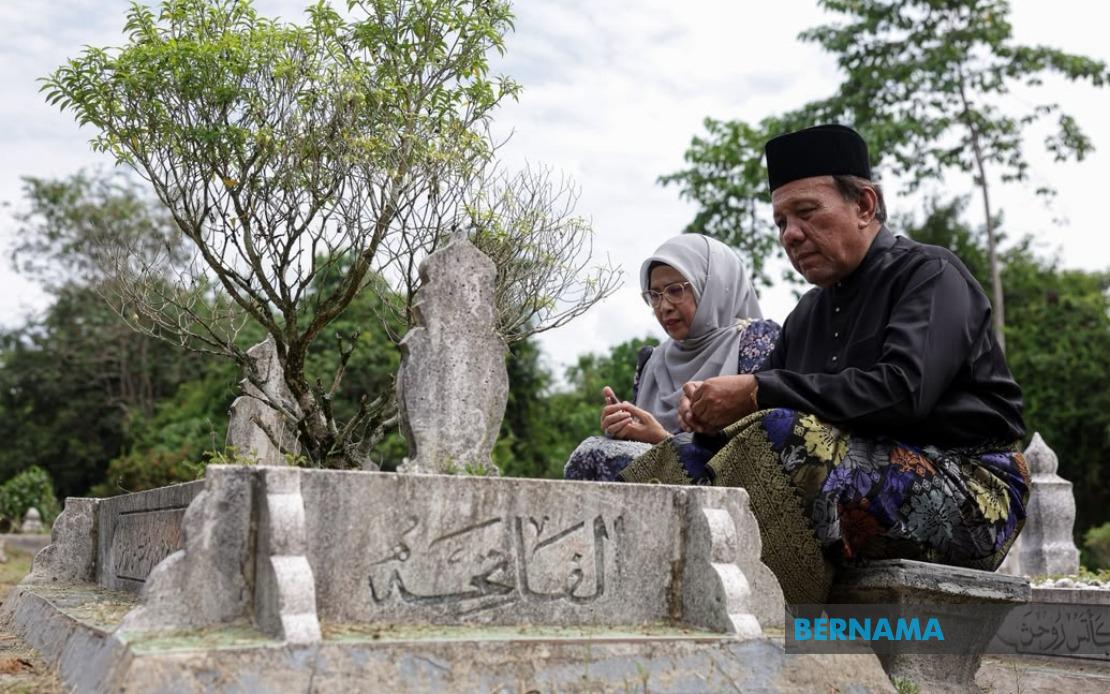
Datuk Ismail Lasim, the newly installed Menteri Besar of Negeri Sembilan, made an emotionally significant journey to Tebing Tinggi Muslim cemetery in Kuala Pilah shortly after taking his oath of office. Accompanied by his wife Datin Noraishah Othman and dressed in traditional formal black Malay attire, the ceremony reflected the personal priorities of Malaysia's newest state leader—a quiet moment of remembrance set against the backdrop of electoral triumph and new governmental responsibility.
The pilgrimage held symbolic weight in Malaysian political culture, where newly elected leaders often undertake such acts of reverence to acknowledge family sacrifices and blessings. For Ismail, the visit was particularly poignant given the lengthy span since his parents' deaths. His father, the late Lasim Yaman, passed away on March 5, 2020, at the advanced age of 97, while his mother, the late Bedah Othman, had died earlier on September 16, 2014. The considerable gap between their passing and his ascent to the state's highest executive position suggests a long political journey, perhaps making this moment of filial acknowledgment especially meaningful.
Ismail's path to the Menteri Besar's office came through his election as the representative for the Juasseh state seat in yesterday's 16th Negeri Sembilan state election. The Juasseh constituency forms part of the broader political landscape that determined the state's direction for the coming years. His constituency victory was part of a broader electoral mandate that would reshape Negeri Sembilan's governance structure and set the tone for policy priorities in the coming term.
The swearing-in ceremony itself unfolded at Istana Besar Seri Menanti, where Ismail took his oath of office before the Yang di-Pertuan Besar of Negeri Sembilan, Tuanku Muhriz Tuanku Munawir. This formal constitutional moment officially transferred executive authority to Ismail and established his legal and ceremonial standing as the state's chief minister. The presence of the Ruler underscored the traditional constitutional framework within which Malaysian state governments operate, connecting the modern electoral process to the historic institution of Malay-Muslim monarchy.
The electoral results that propelled Ismail to this position reflected a decisive outcome for the state. Barisan Nasional, the long-dominant coalition in Malaysian politics, secured 18 state seats, while Perikatan Nasional captured seven seats. Combined, these two coalitions commanded more than two-thirds of the state assembly, a supermajority that would provide significant legislative flexibility and policy-making capacity. This arithmetic also suggested political stability for the incoming administration, as such supermajorities typically indicate unified government and reduced vulnerability to sudden political shifts.
The formation of a government between Barisan Nasional and Perikatan Nasional marks an interesting development in Malaysian coalition politics. Rather than confrontation, the two blocs chose partnership, which in recent Malaysian political history has often followed contentious or uncertain electoral outcomes. For Negeri Sembilan specifically, this arrangement shapes the ideological and policy direction that Ismail's administration will pursue, as the coalition agreement presumably allocates ministerial portfolios and policy priorities between the partners.
Ismail's immediate pivot to family commemoration rather than political celebration or immediate policy announcements suggests a leadership style that prioritises personal values and family bonds. In Malaysian governance, such gestures often resonate with the electorate, particularly in more traditionally oriented communities where respect for family and filial piety remain deeply rooted cultural values. By leading with this symbolic act, the new Menteri Besar may be signalling to constituents that success and official position have not diminished his personal integrity or family orientation.
For the broader Malaysian political landscape, Negeri Sembilan's election result contributes to the ongoing realignment of coalitional politics that has characterised the post-2018 era. The state's choice to partner Barisan Nasional and Perikatan Nasional, rather than other possible governing combinations, adds a data point to understanding voter preferences and coalition viability in different Malaysian contexts. As political observers track how these partnerships evolve and perform in office, Negeri Sembilan becomes a test case for whether such arrangements can deliver stable, effective governance.
The transition to Ismail's leadership also opens questions about the new administration's agenda for Negeri Sembilan. The state, often overshadowed by larger neighbours Selangor and Kuala Lumpur, will now face scrutiny regarding its economic development strategy, social service delivery, and position within the broader Klang Valley metropolitan region. How Ismail's government manages these challenges and opportunities will significantly influence the state's trajectory and potentially affect the broader Southeast Asian region's economic dynamism.
Looking forward, the stability provided by the supermajority offers Ismail's administration genuine capacity to pursue medium-term initiatives without immediate threats from legislative obstruction. However, the reliance on a coalition arrangement between two distinct political forces means that consensus-building and compromise may be necessary for major policy initiatives, potentially tempering the scope and pace of transformative change. The weeks and months ahead will reveal whether this coalition structure enhances or constrains effective governance in Negeri Sembilan.

