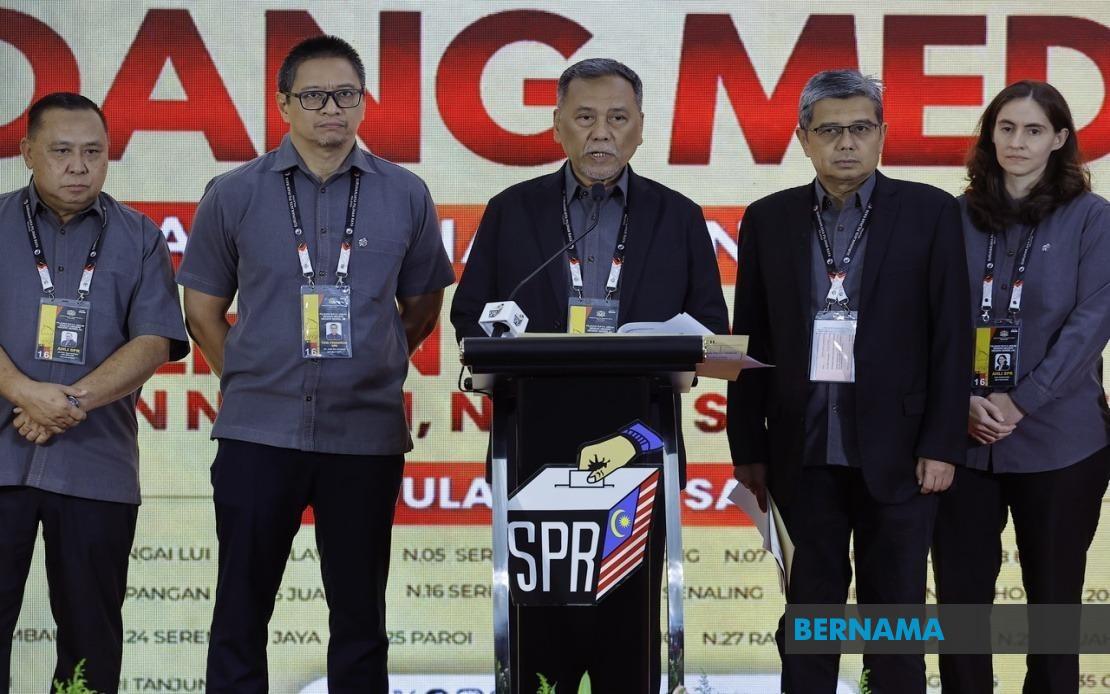
Malaysia's Negeri Sembilan will hold its state election on August 1 with a notably fragmented political landscape, as the Election Commission confirmed that 103 candidates have been approved to contest across the state's 36 legislative seats. The confirmation came after the formal nomination process concluded at ten nomination centres throughout the state, with EC chairman Datuk Seri Ramlan Harun verifying all submissions that closed at 10 am on July 18. This electoral configuration signals a competitive and unpredictable contest that could reshape the political balance in one of Malaysia's smaller but strategically significant states.
Pakatan Harapan enters the race as the dominant force, having fielded candidates in all 36 seats, underscoring its ambition to consolidate support after several years of rivalry with other coalitions. Barisan Nasional has put forward 25 candidates, maintaining a presence across most constituencies but notably abstaining from some seats where it may judge its prospects limited. The fractionalisation becomes apparent with Bersatu's 24 nominees and Perikatan Nasional's 11 contenders, representing competing visions within the Malay-Muslim political space that has long been a defining feature of Malaysian electoral dynamics. Smaller parties and independent voices add texture to the contest: Barisan Jemaah Islamiah Se-Malaysia, the Malaysian Orang Asli Party, and the Socialist Party of Malaysia each contributed one candidate, while four independent candidates registered to run without party affiliation.
The distribution of contests across constituencies reveals the intensity of competition and the degree of market saturation in particular areas. Approximately 58 percent of the 36 seats, or 21 constituencies, will witness three-way battles where voters will choose among representatives from different coalitions and parties. A further 11 seats will see straightforward two-candidate races, offering voters a binary choice between competing visions. The complexity increases in four constituencies: Nilai and Sri Tanjung will stage five-cornered contests with five candidates each, while Jeram Padang and Rahang will feature four-way races. This fragmentation, while enriching democratic choice, complicates the path to victory for any single party and creates unpredictability in outcomes that would be more readily predictable in conventional two-party systems.
The demographic profile of the 103 candidates offers insights into the representation patterns and generational composition of the political field. Males constitute the overwhelming majority of candidates, with 94 men standing for election compared to only nine women—a gender imbalance of roughly 10-to-1 that reflects persistent structural inequities in Malaysian political recruitment and advancement. The age range spans from a 23-year-old Bersatu candidate in Sri Tanjung representing the younger generation's entry into formal politics, to a 70-year-old Pakatan Harapan contender in Gemencheh, demonstrating that both established and emerging political forces are contesting. This generational diversity, though notable, is shadowed by questions about how younger candidates will navigate the established patronage networks and resource asymmetries that characterise Malaysian politics.
The electoral register comprises nearly 890,000 eligible voters, a figure that encompasses ordinary citizens as well as uniformed personnel whose voting rights in state elections reflect Malaysia's democratic inclusion of military and police staff. Ordinary voters number 867,151, while 16,884 military personnel and their spouses are registered, alongside 5,455 police officers. This composition underscores how security forces constitute a meaningful proportion of the electorate in Malaysian states, with implications for how campaigns are conducted and which constituencies may prove particularly sensitive to messages around law and order, national security, and institutional matters that resonate with uniformed voters.
The election schedule has been structured to allow early voting on July 28, four days before the principal polling day of August 1. Early voting provisions are designed primarily to accommodate police officers and military personnel who may be on duty or unable to vote on the main election day, ensuring that these segments of the electorate can exercise their franchise without compromising security operations. The concentration of voting into a brief window between nomination verification and early voting demonstrates the logistical intensity of organising state elections in Malaysia, requiring coordinated effort across government, security agencies, and electoral administration bodies.
The dissolution of the Negeri Sembilan state assembly on June 5 initiated the electoral cycle that culminates in August's vote. This timing allowed roughly seven weeks for campaigns, candidate recruitment, and political mobilisation—a period that compresses the opportunities for ground-level organising but intensifies the use of digital and mass media strategies. The interim period between dissolution and polling also tested the stability of coalitions and exposed fissures where parties struggled to agree on candidate allocations or seat divisions, particularly evident in the decision by some established parties not to contest every seat.
For Malaysian observers and political analysts, the Negeri Sembilan election serves as a barometer of broader political sentiment and coalition stability at the national level. The performance of Pakatan Harapan will indicate whether it can sustain momentum from recent electoral successes or faces erosion from competing coalitions. Bersatu's showing will reveal the extent to which it has retained influence among Malay-Muslim voters despite its complex history of party-switching and coalition-building. The results will also signal whether Perikatan Nasional, as an opposition coalition, has credibly positioned itself as an alternative government or remains confined to niche constituencies. For Barisan Nasional, results will either confirm a stabilised but reduced political base or suggest further decline.
The Southeast Asian region monitors Malaysian electoral outcomes as bellwethers of stability and democratic health in a key regional economy. Negeri Sembilan, though smaller than Selangor or Johor, has historically produced political dynamics that foreshadow or clarify national trends. An election characterised by three-way fights and voter fragmentation may indicate deepening multipolarity in Malaysian politics, shifting away from binary two-coalition competition toward a more fluid, issue-based landscape where local candidates and personalities gain outsized influence. Alternatively, the prevalence of triangular contests might reflect parties' strategic calculations rather than genuine voter realignment, with traditional coalitions and networks still underpinning electoral outcomes despite surface-level fragmentation.
The implications of the Negeri Sembilan result for Putrajaya's political calculus should not be underestimated. State elections serve as proving grounds for candidates seeking federal positions, testing grounds for campaign tactics and messaging, and indicators of demographic and regional shifts in voter preferences. A strong showing by any coalition might embolden it to push for earlier federal elections or press for cabinet adjustments reflecting its newly confirmed electoral strength. Conversely, disappointing results could accelerate internal party reassessments and trigger leadership challenges. With 889,490 voters preparing to cast ballots across 36 contested seats, the August 1 election will provide Malaysia with one more data point in its evolving democratic trajectory.

