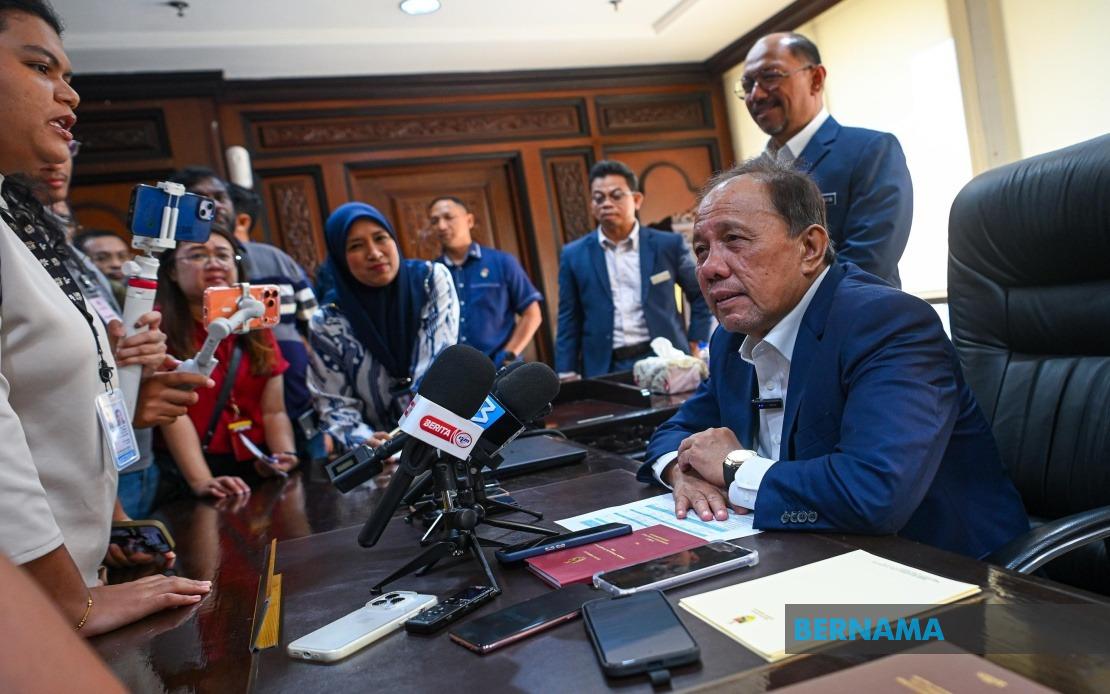
Negeri Sembilan's newly sworn-in Menteri Besar Datuk Ismail Lasim has indicated that the state government is exploring a structural reorganisation of its executive council, specifically considering the creation of Deputy Executive Council positions to address capacity constraints within the cabinet. Speaking to journalists at Wisma Negeri in Seremban, Ismail explained that the proposal stems from a pragmatic recognition that traditional Exco positions may be insufficient to accommodate all qualified candidates from the governing coalition's component parties.
The anticipated appointments would distribute additional responsibilities among state assemblymen representing the three parties that form the current administration: Barisan Nasional, PAS, and Parti Wawasan Negara. By introducing Deputy Exco posts for what Ismail characterised as strategically important portfolios, the government seeks to broaden its executive capacity while maintaining a structured hierarchy within the cabinet. This represents a departure from conventional state administration practices in Malaysia, where Deputy Exco positions are not standardly established across all states, making Negeri Sembilan's potential move noteworthy within the regional governance landscape.
The exact number of Deputy Exco positions to be created remains undetermined, with Ismail confirming that finalisation of the broader Exco line-up is still underway. He also noted that provisions for Senior Exco appointments—another tier of executive positions—remain under consideration, though such appointments have not yet been formally decided. This multi-layered approach to cabinet restructuring suggests the Menteri Besar is attempting to construct a governance framework that accommodates diverse political interests whilst preserving clear lines of authority and responsibility. The announcement of the complete Exco composition was expected by Friday or Monday at the latest, providing the administration with a functioning cabinet shortly after Ismail's assumption of office.
Ismail, the 67-year-old representative for Juasseh state constituency, marked his initial day in the Menteri Besar's office with a formal engagement at Wisma Negeri beginning at 9 am, where he was received by State Secretary Datuk Mohd Zafir Ibrahim and departmental heads. This ceremonial commencement underscores the transition to a new administrative phase for Negeri Sembilan, with Ismail formally sworn in before Tuanku Muhriz Tuanku Munawir, the Yang Dipertuan Besar, at Istana Besar Seri Menanti on Sunday. The symbolism of his first-day activities reflects institutional continuity whilst signalling fresh governance priorities for the state.
The political context informing these administrative decisions is shaped by the outcome of the recently concluded Negeri Sembilan state election, which delivered a clear mandate to the Barisan Nasional and Perikatan Nasional coalition. Combined, these two blocs secured 25 of the 36 state assembly seats—BN obtained 18 seats whilst Perikatan Nasional won seven—granting them a commanding two-thirds supermajority that effectively places them beyond the reach of opposition legislative challenges. Pakatan Harapan retained 11 seats, positioning itself as the principal opposition force in the state legislature.
For Malaysian political observers and regional analysts, the structural innovations being contemplated in Negeri Sembilan merit attention as potential templates for governance arrangements elsewhere. The introduction of Deputy Exco positions addresses a recurring challenge in Malaysian state administrations: balancing the political imperatives of coalition partners who expect ministerial or near-ministerial appointments with the practical limitations of traditional cabinet sizes. In this instance, the coalition's supermajority provides sufficient political capital to absorb such appointments without destabilising parliamentary arithmetic, yet the decision to formalise Deputy Exco roles signals an institutional shift rather than merely ad-hoc accommodation of coalition pressures.
The cross-coalition composition of Negeri Sembilan's executive also reflects broader patterns in Malaysian politics, where state governments increasingly feature alliances spanning traditionally distinct political families. The inclusion of PAS and Parti Wawasan Negara alongside Barisan Nasional components indicates fluid coalition dynamics at the state level, decoupled from federal-level alignments. This flexibility allows states to develop governance arrangements responsive to local political conditions, though it also introduces complexity in maintaining policy coherence and administrative discipline across coalition partners with potentially divergent policy orientations.
From a Southeast Asian governance perspective, Negeri Sembilan's forthcoming administrative restructuring exemplifies how Malaysian states remain laboratories for institutional experimentation within the broader constitutional framework. Unlike fully centralised systems, Malaysia's federal architecture permits states considerable latitude in structuring their own executive arrangements, provided they remain consistent with constitutional provisions and established constitutional convention. This flexibility has historically enabled states to innovate in response to specific political circumstances, and Ismail's administration appears inclined to utilise this discretionary space constructively.
The implications of Deputy Exco appointments extend beyond immediate political accommodation. Such positions, if properly defined with substantive portfolios and genuine executive authority, could enhance administrative efficiency by allowing closer oversight of specific issue domains and providing policy continuity through additional hands-on engagement with departmental operations. Conversely, if created primarily as honorific titles or politically motivated concessions, they risk diluting executive accountability and complicating administrative hierarchies without corresponding functional benefits. The success of this innovation will likely depend on how Ismail and his cabinet define and deploy these positions in practice.
As Negeri Sembilan's new administration takes shape, the introduction of Deputy Exco posts represents a calculated attempt to reconcile political coalition management with administrative effectiveness. Whether this structural experiment proves successful will influence not only state governance outcomes but potentially shape approaches adopted by other Malaysian states facing similar pressures to accommodate coalition partners whilst maintaining lean, efficient executive structures. The coming weeks will reveal how substantively these Deputy Exco positions are defined and whether they ultimately enhance or complicate Negeri Sembilan's governance landscape.

