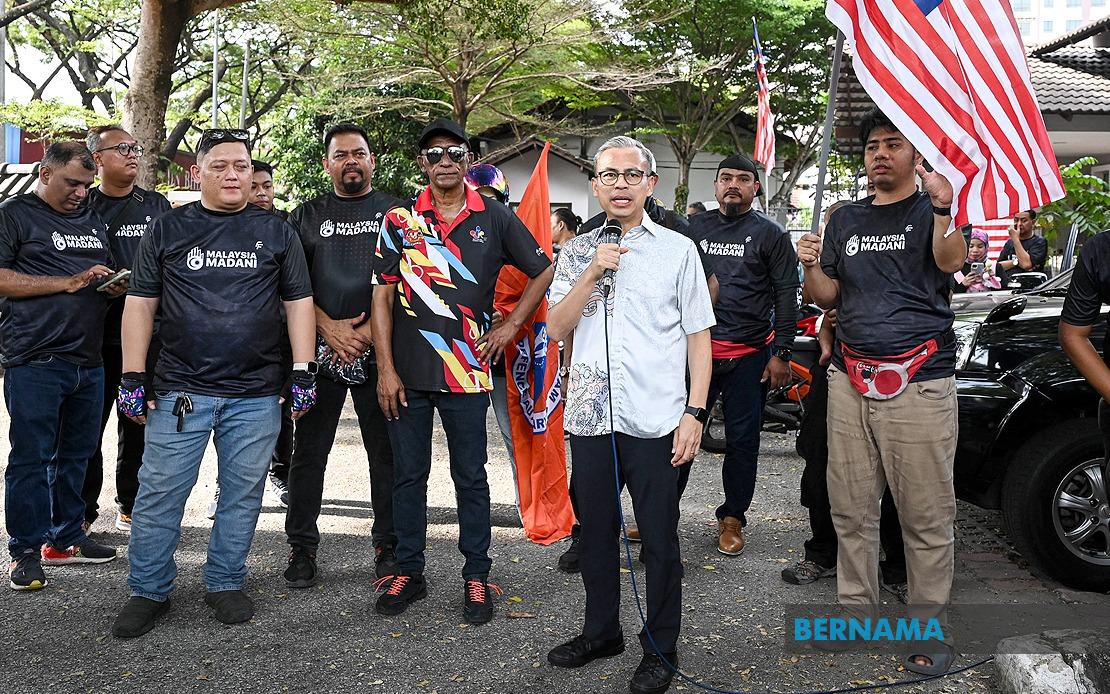
A motorcycle convoy drawing together nearly 300 riders wound through the Lembah Pantai constituency on Merdeka eve, serving as a grassroots celebration of national unity and patriotic spirit ahead of Malaysia's Independence Day festivities. The Lembah Pantai Kembara Merdeka Convoy brought together residents from across the multiethnic urban area, with Communications Minister Datuk Seri Fahmi Fadzil spearheading the initiative to forge community bonds and demonstrate the inclusive character of Malaysian identity.
Fahmi, the Member of Parliament for Lembah Pantai, framed the event as a deliberate effort to harness the constituency's demographic diversity as a strength rather than a challenge. Speaking to participants and observers, he highlighted how the area's residents—drawn from numerous ethnic and cultural backgrounds—represent the broader Malaysian experience of coexistence and shared national purpose. His remarks underscored a deliberate political messaging around unity that has become increasingly central to public discourse in the lead-up to major national occasions.
The convoy's route reflected careful planning to ensure maximum community engagement and symbolic reach. Beginning at Taman Seri Sentosa, the motorcade navigated through five designated pit stops, including Kampung Pasir, the IWK Eco Park, and Vista Angkasa in Kampung Kerinchi, before concluding at Bangsar LRT station. This routing ensured that the procession traversed both established and developing neighbourhoods within the constituency, maximising visibility among residents and creating multiple touchpoints for community participation.
A particularly significant ceremonial element involved the distribution of Jalur Gemilang flags at each pit stop. Representatives from Resident Representative Councils and local community organisations received these national flags as symbolic gestures intended to transmit patriotic sentiment throughout the constituency. This choreographed distribution served dual purposes: it created visual moments for media documentation while physically embedding national symbols within community leadership structures, potentially extending the campaign's reach beyond the convoy itself.
Fahmi's public statements during the programme revealed an emphasis on continuity and sustained engagement rather than treating the event as a one-off celebration. He explicitly called for the interpersonal connections fostered during the day to translate into ongoing community initiatives, suggesting a strategic approach to building political goodwill and grassroots participation. His reference to future programmes encompassing both charitable contributions and additional festive activities indicated a longer-term framework for community mobilisation.
For the broader Malaysian context, the Lembah Pantai convoy represents a microcosm of how ruling political actors approach national celebrations in urban, multicultural constituencies. Rather than purely formal or state-led commemorations, such initiatives emphasise participatory grassroots events that ostensibly demonstrate organic community enthusiasm. The motorcycle convoy format itself carries particular appeal in Malaysian urban culture, combining accessible transportation with visible public presence and a sense of collective motion and energy.
The timing of the event, positioned explicitly as a Merdeka eve activity, strategically places it within the crescendo of Independence Day preparations. This positioning allows political actors to associate themselves and their administrations with patriotic sentiment during a period of heightened national consciousness. For Fahmi and the ruling coalition, such events serve to reinforce narratives of inclusive governance and multiethnic consensus, particularly important in constituencies like Lembah Pantai where electoral competition remains substantial.
The constituency of Lembah Pantai itself carries political significance within Kuala Lumpur, representing an affluent, educated, and ethnically diverse urban area. Events held within this constituency are often observed closely by national media and political observers as indicators of political sentiment and organisational capacity. The successful mobilisation of 300 motorcyclists suggests effective grassroots coordination and willing community participation, elements that political parties carefully monitor and amplify through media narratives.
From a sociological perspective, the convoy model of community mobilisation offers particular advantages in Southeast Asian urban contexts. It allows for simultaneous celebration, political messaging, and community participation without requiring large stationary gatherings. The distributed format across multiple pit stops also accommodates varying levels of engagement, permitting residents to participate at whichever location proves most convenient or compelling to them. This flexibility likely contributed to the strong turnout of participants.
The broader implications for Malaysian politics and governance extend to questions about how national unity narratives are constructed and disseminated in contemporary urban settings. State-adjacent actors and political representatives increasingly employ experiential, participatory events rather than relying solely on top-down messaging through traditional media. The Lembah Pantai convoy exemplifies this shift toward mobilisation-based communication strategies that position residents as active participants in national narratives rather than passive recipients of patriotic messaging.
Looking ahead, such initiatives may become templates for how political parties approach community engagement during major national occasions. The combination of patriotic symbolism, multiethnic representation, and accessible participatory formats addresses challenges of political communication in increasingly fragmented and diverse urban constituencies. Whether such events genuinely foster lasting community bonds or primarily serve as spectacular moments in media cycles remains an open question for observers of Malaysian politics.

