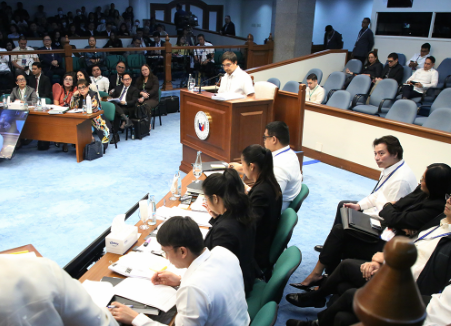
The impeachment trial of Vice President Sara Duterte entered a critical phase on Tuesday when National Bureau of Investigation regional director Jeremy Lotoc provided testimony central to prosecutors' case that her assassination threats against President Ferdinand Marcos, first lady Liza Araneta-Marcos and former Speaker Martin Romualdez constitute grave threats and a betrayal of public trust. On the fifth day of proceedings before the Senate sitting as an impeachment court, Lotoc delivered what prosecutors characterized as damning evidence: the NBI had concluded that Duterte's statements were not rhetorical flourishes or isolated remarks, but rather serious, real and active threats backed by both intent and capability.
The significance of Lotoc's testimony extends beyond the immediate question of whether Duterte made threatening statements—a point she has not directly disputed. Instead, prosecutors have focused on establishing the crucial legal element that distinguishes criminal threats from protected speech: capacity to execute them. The NBI's original investigation recommended charges to the Department of Justice, and Lotoc's court appearance was designed to anchor that recommendation in detailed findings about Duterte's position and circumstances. When Senate President Sherwin Gatchalian directly asked whether the Vice President possessed the capability to carry out her threats, Lotoc's response was unequivocal: "Definitely," followed by a straightforward explanation that her office itself conferred significant power and resources.
Lotoc's reasoning about capability warranted closer examination, as the distinction between holding high office and actually possessing the means to execute assassination plots proves legally complex. When Gatchalian suggested that the Vice Presidency alone might not automatically grant such capacity, Lotoc pivoted to broader considerations: Duterte's political background and family connections. Her father's prior presidency, according to the NBI official, contributed to the bureau's assessment that she maintained networks and capabilities consonant with executing a killing. This argument, while providing prosecutors a foundation for demonstrating capacity, also revealed the thinness of the NBI's evidentiary foundation—the bureau was inferring capability from position and family history rather than from identified resources or concrete links to potential assassins.
The heart of the prosecution's case rested on Duterte's own public admissions, particularly her November 23 online press conference and a November 26 television interview where she stated she had spoken to someone to exact revenge if she were killed. Lotoc testified that investigators interpreted these statements literally, concluding she had contracted with an actual person for this purpose. The NBI official emphasized that the bureau viewed Duterte as serious in these remarks, not joking or using hyperbole. This interpretation proved crucial: if Duterte's statements were merely venting or theatrical posturing, they might fall outside the definition of grave threats. But if she had genuinely discussed arrangements with a third party, the legal character of her conduct transformed from incitement to actual conspiracy.
Yet Lotoc's testimony also exposed significant evidentiary gaps that the defense sought to exploit. The NBI conducted no independent investigation confirming the existence of any alleged assassin or identifying who this person might be. The bureau's entire conclusion that Duterte had "contracted someone" rested exclusively on her own statements and admissions—her words alone formed the basis for inferring the existence of a criminal conspiracy. When pressed by senators, Lotoc acknowledged this straightforward fact: the NBI had no corroborating evidence, no witness testimony, no communications intercepts, and no financial records documenting payment or coordination with any would-be killer. The investigation remained at the level of what the Vice President said about what she allegedly did, without independent verification of any actions.
This evidentiary weakness became more pronounced when Lotoc discussed the NBI's failed attempt to question Duterte directly. The bureau wanted to conduct personal interviews with the Vice President to explore her claims and test her statements, but she did not appear before investigators. Her response consisted of a written denial that she had hired any assassin. Lotoc characterized this denial as insufficient, arguing that mere written refutation could not negate the evidence of her own public statements. The prosecution strategy rested on the theory that once Duterte made public declarations about contracting someone, she had already created sufficient evidence of the crime; her subsequent denial could not simply erase that earlier admission. However, Duterte's absence from NBI interviews also meant investigators could not probe inconsistencies, clarify ambiguities, or assess her credibility through questioning.
During the redirect examination, prosecutors concentrated on a subtler distinction: Duterte has never actually denied making the controversial statements themselves. Private prosecutor Amado Virgil Ligutan emphasized that the Vice President contests only whether she actually hired an assassin, but not whether she made the public remarks about doing so. Lotoc pointed to the November 26 interview where Duterte reiterated her position rather than walking it back, suggesting she remained committed to the substance of her original statements. The implication was that Duterte's failure to retract or minimize her comments, combined with their repetition in subsequent interviews, indicated they reflected genuine intent rather than momentary anger or misstatement. She had opportunities to clarify or soften her position but instead elaborated and reinforced the core themes.
Another dimension of the trial involved claims about "Operation Romanov," which Duterte cited as justification for her statements, arguing she faced genuine threats to her life. The NBI investigation found that the term originated from Davao City Mayor Sebastian "Baste" Duterte (her brother) during a January 2024 rally and was directed at President Marcos and his family, not at the Vice President herself. Moreover, when vlogger Princess Maui raised Operation Romanov during Duterte's November 23 press conference, providing ostensible evidence of threats against the Vice President, the NBI deemed this information unreliable after Maui failed to substantiate her claims through subsequent investigation or testimony. The bureau concluded it could not validate any Operation Romanov threatening the Vice President, and the investigation stalled because neither Duterte nor her supporters provided actionable information that investigators could verify.
The defense strategy during cross-examination focused on procedural and documentary issues rather than directly challenging the substance of Lotoc's conclusions. Defense attorneys highlighted typographical and clerical errors in NBI documents, suggesting sloppiness that might undermine the bureau's overall findings. However, Lotoc dismissed these documentary problems as irrelevant to the substantive conclusions, arguing that such errors did not alter the fundamental findings that Duterte had committed grave threats and incitement to sedition. Prosecution adviser Robert Ace Barbers subsequently argued that the defense had failed to meaningfully undermine Lotoc's testimony, concentrating instead on peripheral issues of documentation quality rather than addressing the core evidence about Duterte's statements and capacity.
The broader constitutional question underlying the testimony concerns whether Duterte's conduct, assuming the factual allegations are proven, represents an impeachable offense. Prosecutors argued that public threats by the Vice President against the President and first lady constitute a betrayal of public trust under the Constitution. The argument rests on the theory that the second-highest official in the nation making assassination threats against the sitting president demonstrates conduct fundamentally unbecoming of that office and raises serious questions about fitness to serve as constitutional successor. This framing moves the trial beyond narrow questions of criminal threat law into territory about what behavior is compatible with holding the second-highest office in a democratic system and about whether such conduct alone, even without proven conspiracy to kill, warrants removal.
For Malaysian observers, the trial raises significant questions about institutional accountability for high officials and the political use of impeachment processes. The proceedings demonstrate both the power and the limitations of legislative impeachment as a tool for addressing serious misconduct by senior executives. The reliance on public statements as the primary evidence, combined with the absence of the accused from investigative processes, creates a distinct procedural posture that differs substantially from ordinary criminal prosecution. The trial also illustrates the intersection of constitutional law, criminal allegations, and political judgment—Duterte's trial is simultaneously about whether she violated criminal law and whether she committed conduct incompatible with holding high office, two separate but related questions that the Senate must navigate as both prosecutor and judge.

