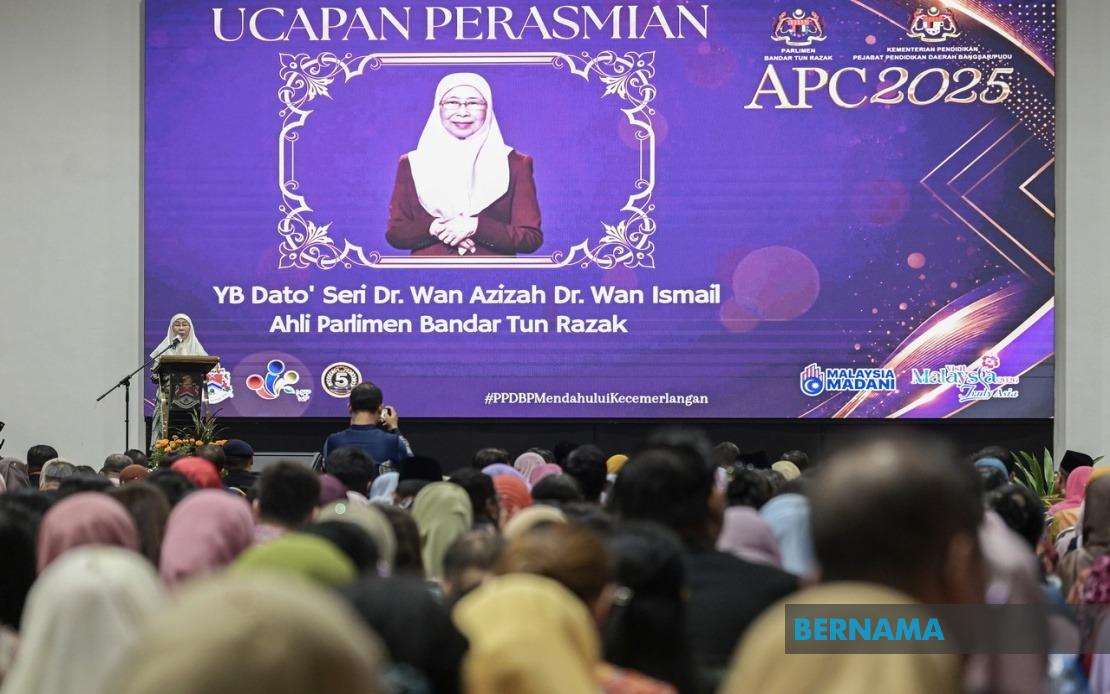
Datuk Seri Dr Wan Azizah Wan Ismail, the Prime Minister's wife and Member of Parliament for Bandar Tun Razak, has underscored that genuine national advancement transcends conventional markers such as gross domestic product, innovation, or infrastructure development. Instead, she argues that a country's true measure of success rests upon its capacity to develop inhabitants who possess intellectual rigour, moral integrity, and emotional sensitivity. Speaking at the 2025 Excellent Service Award ceremony hosted by the Bangsar/Pudu District Education Office at the Kuala Lumpur City Hall Training Institute, she positioned character formation as equally vital to any economic or technological progress Malaysia aspires to achieve.
The gathering, which drew approximately 1,000 attendees, celebrated 746 teachers and school administrators from 143 institutions across the Bangsar/Pudu district for their outstanding contributions throughout the year. This recognition programme reflects a broader governmental focus on honouring the often-overlooked contributions of educators who labour within classrooms and administrative roles across the nation's school system. The scale of the ceremony demonstrates the commitment to acknowledging educators' pivotal influence on successive generations of Malaysian students.
Dr Wan Azizah highlighted the irreplaceable function educators perform in moulding young people's values and behaviour, particularly given the substantial proportion of childhood hours children invest in educational settings. For many Malaysian youngsters, especially those in urban centres where both parents typically engage in full-time employment, schools become secondary social environments where formative development occurs. Teachers thus shoulder responsibility extending far beyond textbook instruction, functioning as role models and moral guides during critical developmental periods.
She articulated a vision of schooling that transcends the conventional limitation of knowledge transfer. Rather than treating education as a mechanism purely for delivering curriculum content, she advocated for an integrated approach wherein schools deliberately cultivate virtuous character, refined conduct, and heartfelt compassion alongside academic competencies. This perspective challenges narrower interpretations of educational success that prioritise examination outcomes and measurable academic indicators at the expense of holistic human development.
The contemporary educational landscape presents particular challenges requiring thoughtful pedagogical responses. Dr Wan Azizah specifically identified artificial intelligence proliferation and information saturation as phenomena demanding educational systems anchored in robust values and analytical reasoning capabilities. In an environment where digital technologies generate unprecedented volumes of content—much of it unreliable, misleading, or deliberately fabricated—students require guidance in developing discernment and critical faculties. Values-based education provides ethical frameworks through which young people can evaluate information sources and distinguish credible knowledge from misinformation.
The Bangsar/Pudu district programme recognised specific achievements in strengthening institutional effectiveness and advancing educational outcomes. This acknowledgement system serves multiple functions within the profession: it validates the demanding emotional labour teachers undertake, incentivises continued excellence, and creates visible benchmarks of professional aspiration that inspire colleagues throughout the system. For educators themselves, such recognition provides validation that their work—often conducted under resource constraints and expanding demands—receives acknowledgement from governmental leadership.
Attending officials included Datuk Azman Abidin, serving as the Prime Minister's Political Secretary, alongside Megat Affandi Ismail, Director of the Kuala Lumpur Federal Territory Education Department. Their presence signalled institutional commitment to honouring educators and underscored that this initiative carries backing from senior governmental structures. The participation of such officials helped position educators' work within broader national development discourse.
Dr Wan Azizah expressed confidence that honouring these 746 educators would generate positive momentum, encouraging recipients to maintain elevated service standards whilst inspiring their colleagues to reinvigorate dedication to educational excellence. This approach recognises that sustainable institutional improvement depends upon cumulative individual commitments multiplied across thousands of schools nationwide. Recognition ceremonies function as rallying moments within professional communities, refocusing attention on shared missions and collective aspirations.
For Malaysia's education sector specifically, this emphasis on values-based development addresses longstanding policy discussions concerning curricular priorities. While technical and vocational skills remain important for economic competitiveness, Dr Wan Azizah's remarks reflect ministerial positioning that character formation constitutes equally essential educational outcomes. This stance carries implications for how schools allocate time and resources, suggesting that ethical development and critical thinking deserve equivalent institutional investment to subjects traditionally considered academically central.
The broader context involves Malaysia's positioning within regional and global knowledge economies where human capital quality increasingly determines competitive advantage. Nations cultivating citizens who combine technical capability with ethical judgment, collaborative capacity, and adaptive reasoning secure advantages in attracting investment and maintaining social stability. Dr Wan Azizah's framing thus connects educational philosophy to economic strategy and social cohesion objectives.
Moving forward, the challenge lies in translating such rhetorical commitments into systematic institutional change. Schools require adequate resourcing, teacher professional development focussed on values education delivery, and curricular structures that genuinely accommodate character formation alongside academic content. The 2025 award ceremony provided important symbolic affirmation, yet sustained progress demands corresponding policy implementation and resource allocation decisions.

