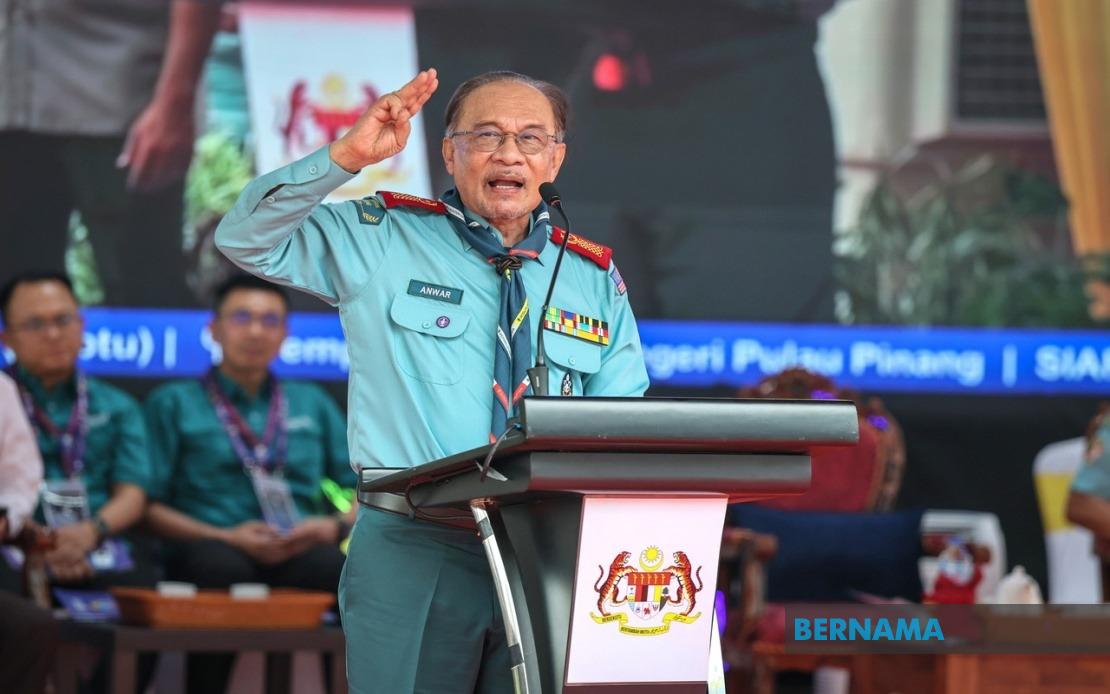
Prime Minister Datuk Seri Anwar Ibrahim has articulated a vision of national progress that extends beyond conventional measures of economic achievement and technological sophistication, arguing instead that true development rests upon cultivating a generation anchored in character, discipline and service. Speaking at the opening of the 15th Malaysian Scouts Jamboree (MYJAM15) at the Penang State Stadium, Anwar pressed the case that material advancement without corresponding moral development creates a hollow foundation for sustainable progress.
Anwar's remarks reflect a broader concern among policymakers about the trajectory of youth development in an era of rapid technological change. He articulated a philosophy wherein education serves not merely as a pathway to economic productivity but as a crucible for shaping individuals capable of balancing personal ambition with familial loyalty, civic responsibility and national commitment. The Prime Minister stressed that parents, educators and institutions must deliberately foster values alongside intellectual capability, recognising that knowledge without conscience poses risks to social cohesion and institutional trust.
The timing of these comments carries particular resonance given Malaysia's ongoing navigation of digital transformation and artificial intelligence adoption. Anwar cautioned that as younger Malaysians engage with accelerating technological change, they must remain tethered to cultural identities and heritage frameworks that have historically provided social ballast. This tension between progress and preservation represents a challenge faced across Southeast Asia, where rapid modernisation sometimes erodes traditional knowledge systems and community structures that historically managed social integration.
Anwar's emphasis on cultivating unity across Malaysia's diverse population assumes added weight given the demographic composition of the jamboree itself. MYJAM15 assembles over 5,450 scouts from both domestic and international backgrounds, representing eleven nations including South Korea, Indonesia, Singapore and Sri Lanka. For a multi-ethnic, multi-religious nation, the capacity of young people to bridge differences while maintaining personal integrity becomes not merely a desirable trait but a functional necessity for inter-communal peace and economic cooperation.
The Prime Minister specifically highlighted the scouts movement as an institutional vehicle for transmitting these values, recognising that formal education systems alone cannot shoulder this responsibility. Scouting, with its structured methodology, progressive achievement frameworks and emphasis on outdoor learning and team dynamics, offers a complementary educational space where discipline, self-reliance and collective responsibility become embodied through practical activity rather than classroom instruction. The movement's century-long global track record in character formation has consistently demonstrated resilience across changing social contexts.
Anwar's remarks also contained implicit commentary on governance philosophy, suggesting that a nation's leaders must attend deliberately to the formation of successors rather than assuming that institutional structures alone will produce capable administrators and citizens. This perspective suggests recognition that Malaysian institutions, however well-designed, require custodians possessed of both competence and moral grounding to function effectively. The current political environment in Malaysia, marked by continuing efforts to rebuild institutional credibility following recent years of governance challenges, makes this emphasis on generational character formation particularly salient.
The hosting of MYJAM15 in Penang marked a significant symbolic moment for Malaysia's youth development agenda. The state had previously hosted the national jamboree in 1966 at Teluk Bahang, meaning this event represented a return to the peninsula after six decades. This temporal arc underscores generational continuity—today's scouts follow in the footsteps of their predecessors from the immediate post-independence era, a period when nation-building and character formation were inseparable national imperatives. The symbolic weight of this return speaks to how scouting has embedded itself within Malaysia's institutional memory as a trusted mechanism for youth development across distinct historical periods.
Chief Minister Chow Kon Yeow's presence alongside Anwar and Chief Scout Datuk Prof Dr Mohd Zin Bidin reflected multi-level governmental commitment to the scouting mission. This institutional alignment—from federal prime minister to state chief minister to national scouting leadership—demonstrates that youth development remains a priority spanning different political jurisdictions and administrative levels. Such coordination becomes essential in Malaysia's federal system, where education, welfare and community development responsibilities distribute across multiple governance tiers.
Looking toward the 2026 National Day celebrations, Anwar called upon young Malaysians to sustain their patriotic commitment while preparing for future challenges. This forward-looking orientation acknowledges that the nation faces evolving tests—geopolitical shifts in Southeast Asia, climate-related pressures, technological disruption of labour markets and continued social integration challenges. The capacity of Malaysia's youth cohort to navigate these pressures while maintaining institutional loyalty and inter-communal harmony will substantially determine national resilience over the coming decade.
The jam boree's nine-day programme, extending through September 4, will host not only Malaysian scouts but also young people from regional and global contexts. This international dimension transforms MYJAM15 from a domestic youth assembly into a cross-cultural exchange mechanism where Malaysian scouts engage with peers facing parallel challenges in different national contexts. Such exposure potentially broadens perspectives on how different societies balance tradition with innovation, and demonstrates practically that values formation need not be parochial or exclusionary but can accommodate engagement with global citizenship.
Anwar's intervention in the national conversation about youth development carries weight extending beyond ceremonial remarks at a sporting event. It represents a high-level articulation that Malaysian prosperity cannot rest on economic indicators alone, and that the nation's leaders remain attentive to the moral and character dimensions of national building. For a country where institutional trust has faced pressures in recent years, explicit emphasis on values-based education and disciplined citizenship formation suggests an attempt to reconstruct the philosophical foundations upon which developmental progress rests. Whether such rhetoric translates into sustained policy investment in character formation through institutions like scouting, schools and community organisations will ultimately determine whether Malaysia successfully produces the knowledgeable, disciplined generation that Anwar identifies as essential to national success.

