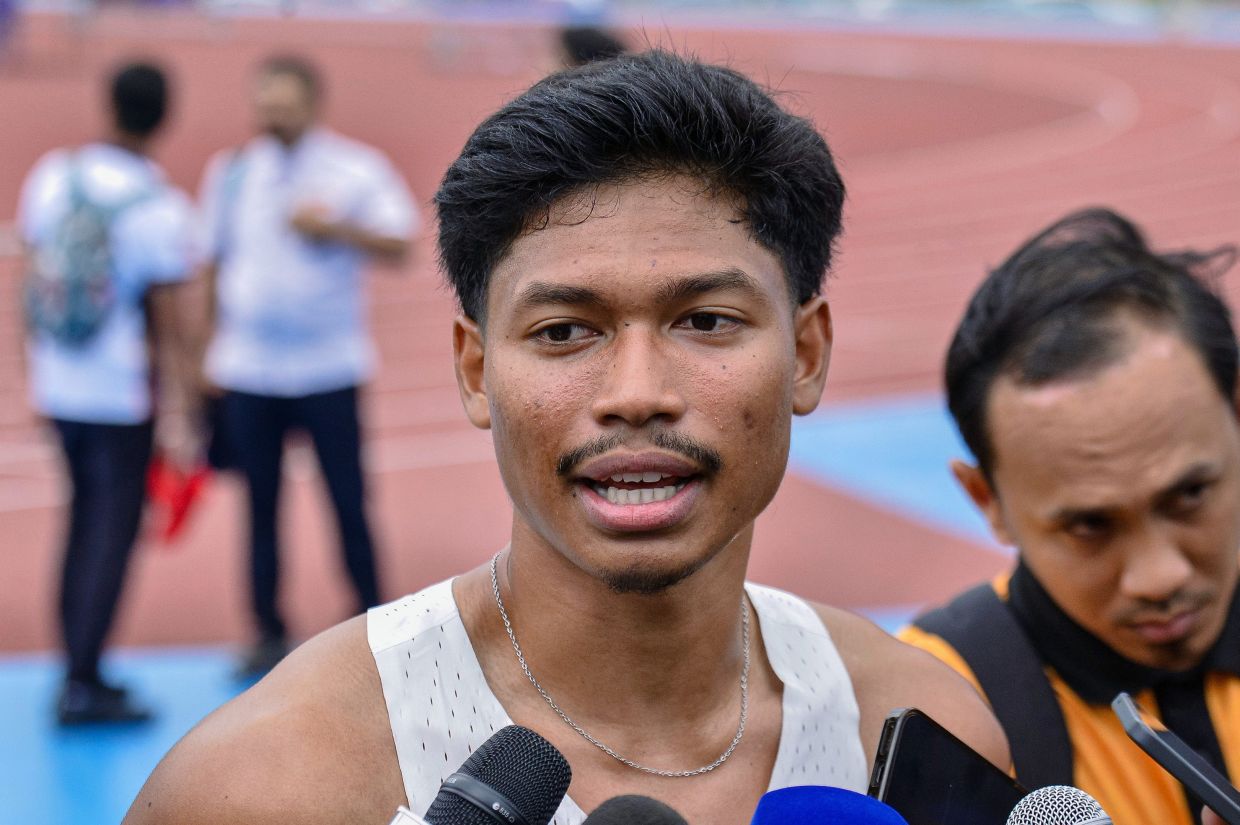
Mohd Azeem Fahmi, one of Malaysia's most promising track and field talents, is making his return home to further his academic pursuits. The young sprinter has committed to enrolling in a master's programme at Universiti Malaya following the successful completion of his undergraduate degree at Auburn University in the United States. The decision marks a significant milestone in Azeem's dual pursuit of athletic excellence and higher education, signalling a new chapter in his development as both a scholar and competitor.
Azeem's transition to postgraduate study at UM came into focus during a formal courtesy visit to the university's leadership this week. Universiti Malaya's vice-chancellor, Prof Datuk Seri Dr Noor Azuan Abu Osman, received the accomplished sprinter at his office on Monday, accompanied by several senior academic and administrative figures. The gathering included Associate Prof Dr Zulkarnain Jaafar, who leads the Faculty of Sports and Exercise Sciences, as well as Afizal Abu Othman, director of the university's Sports Centre. The presence of these institutional leaders underscored the university's commitment to supporting Azeem's continued development.
During their meeting, the vice-chancellor emphasised that Universiti Malaya would create an optimal pathway for Azeem to balance his postgraduate academic responsibilities with his training and competitive obligations. This institutional pledge reflects a broader understanding among Malaysian universities that nurturing world-class athletes requires flexible frameworks capable of accommodating the demands of elite sport. Such arrangements have become increasingly important as the nation seeks to produce athletes who are both competitive on the international stage and educated contributors to society.
Azeem's choice of Universiti Malaya places him squarely within a distinguished lineage of Malaysian sporting champions who have walked the same halls. The institution boasts an impressive roster of Olympic and international medal winners among its alumni. Datuk Pandelela Rinong and Ooi Tze Liang, both accomplished divers who have represented Malaysia at the Olympic Games, studied at UM, as did Bryan Nickson Lomas, another diver of considerable repute. The Faculty of Sports and Exercise Sciences itself has produced numerous athletes who have gone on to represent their country at continental and global competitions, making the institution a natural destination for serious student-athletes.
Beyond diving, badminton has also contributed to UM's sporting legacy. Vivian Hoo, a former national women's doubles player, completed her Bachelor of Sports Science at the university in 2019, further illustrating the institution's appeal to Malaysia's competitive sports community. These examples demonstrate that UM has established itself as an environment where athletic talent is not merely accommodated but actively nurtured and valued as part of the university's identity.
Azeem's recent achievements provide compelling evidence of his credentials as an athlete worthy of such institutional support. At the Malaysian Open championship, held just days before his university visit at Universiti Putra Malaysia's Serdang campus, the 21-year-old secured a gold medal in the men's 100-metre sprint—one of track and field's most prestigious individual events. His success extended to the relay competitions, where he anchored the Malaysian men's 4x100 metres relay team to gold, running alongside talented teammates Danish Iftikhar Mohd Roslee, Pengiran Aidil Auf Hajam, and Mohd Armin Zahryl. These victories demonstrated that Azeem remains at the cutting edge of Malaysian sprinting, capable of competing effectively against the nation's best.
Azeem's pathway to excellence began in earnest when he relocated to the United States in January 2023 to pursue undergraduate studies in exercise physiology and kinesiology at Auburn University. This decision proved transformative. Training under Ken Harnden, an experienced coach with extensive expertise in track and field development, Azeem benefitted from exposure to world-class coaching standards and training methodologies prevalent in American collegiate athletics. The two-year stint at Auburn provided invaluable international experience and academic preparation that has positioned him well for postgraduate work.
His return to Malaysia carries significant implications for the nation's sports development strategy. The brain-circulation model—where talented Malaysians train internationally before returning home to compete and study—has become increasingly important in maintaining competitiveness across multiple sports. Azeem's homecoming, coupled with his commitment to advanced study, suggests a maturation in how elite athletes view the balance between performance and education. This perspective proves essential in building sustainable sporting legacies that extend beyond athletic careers.
The institutional backing Azeem receives at Universiti Malaya also signals confidence in his potential to become a major force in Southeast Asian sprinting over the coming years. The master's programme in his chosen field will deepen his understanding of the physiological and biomechanical principles underpinning elite athletic performance, potentially enabling him to contribute not merely as a competitor but also as an educator and mentor to future generations of Malaysian athletes. Such compound benefits—where world-class competitors become informed voices in sports science and coaching—strengthen the entire ecosystem of athletic development across the region.

