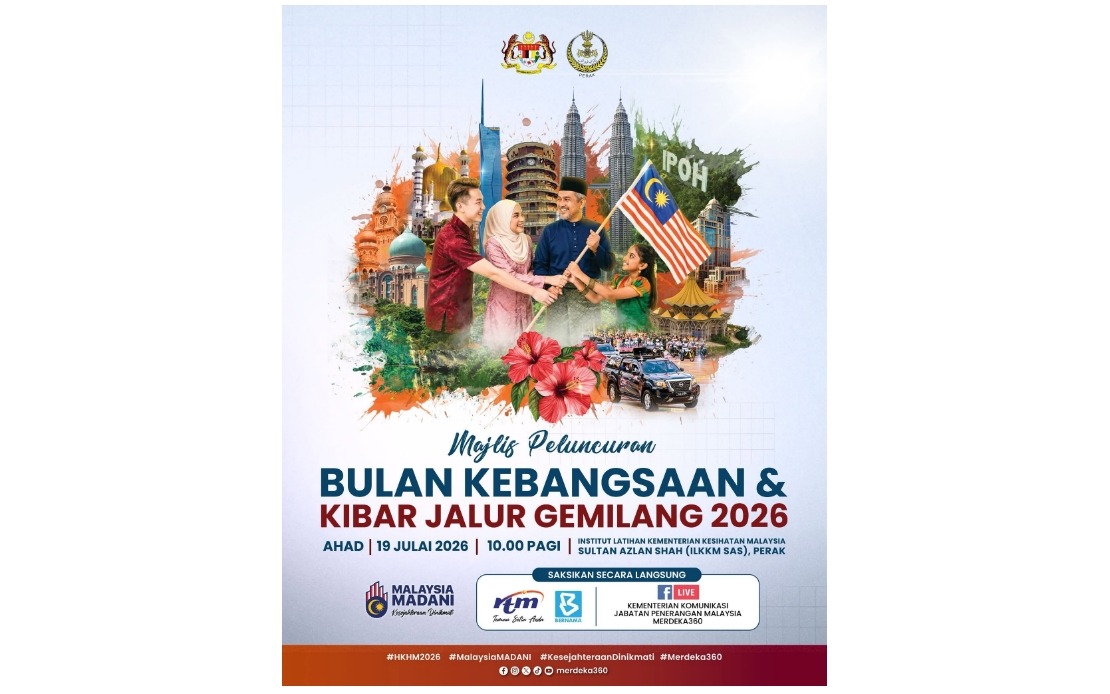
The official inauguration of Malaysia's 2026 National Month campaign and Fly the Jalur Gemilang initiative will commence on July 19 at Institut Latihan Kementerian Kesihatan Malaysia Sultan Azlan Shah in Perak, signalling the beginning of nationwide festivities ahead of National Day and Malaysia Day celebrations. The ceremony, which gets underway at 10 am, will reach audiences through multiple broadcast channels including Radio Televisyen Malaysia, BERNAMA TV, and livestreamed via Facebook across the official Merdeka360, Ministry of Communications and Department of Information platforms, ensuring broad public participation across Malaysia's diverse population.
The campaign theme selected for 2026's national celebrations, "Malaysia MADANI: Kesejahteraan Dinikmati", represents a deliberate messaging strategy that extends beyond mere ceremonial symbolism. This phrase, which translates to "Malaysia MADANI: Prosperity Enjoyed", encapsulates the current administration's policy vision of constructing a nation that is simultaneously progressive, inclusive and economically prosperous. By framing prosperity as something to be collectively experienced rather than individually pursued, the theme emphasises shared national wellbeing as a core government objective.
The Malaysia MADANI framework underlying this year's celebrations rests upon three foundational pillars: justice, humanity and public welfare. These values indicate an intentional pivot toward governance messaging that prioritises equitable distribution of national resources and benefits, articulating that economic advancement should reach all Malaysian communities comprehensively rather than concentrating among privileged segments. For a multicultural nation navigating complex socioeconomic dynamics, this positioning carries particular significance in reinforcing the social compact.
The Merdeka360 Facebook announcement included a call for public participation in patriotic activities, directing citizens toward the campaign's dedicated digital portal to access the official logo, patriotic songs and diverse promotional materials. This decentralisation of campaign resources through online platforms reflects contemporary approaches to civic engagement, enabling individuals and community groups throughout the peninsula and Malaysian Borneo to independently organise and participate in commemorative activities without requiring top-down coordination.
Communications Minister Datuk Seri Fahmi Fadzil had previously outlined the logistics for this year's major celebration events. The primary National Day observance on August 31 will take place at Dataran Putrajaya, deliberately scaled as modest yet vibrant rather than attempting grandiose spectacle. This calibrated approach suggests budgetary consciousness and an intent to emphasise authentic celebration over performative pageantry. Separately, Malaysia Day on September 16 will shift the spotlight geographically by relocating festivities to Sarawak, reflecting the federal structure's emphasis on honouring both peninsular and East Malaysian identities within the unified national framework.
Complementing the dual flagship events, organisers have choreographed seven supporting programmes and patriotic activities to sustain momentum throughout the broader celebration period. These initiatives include Kembara Bahasa HKHM, which likely emphasises Malaysian languages as unifying cultural elements; Quran Hour, acknowledging Islam's significance in the nation's constitutional framework; Ambang Merdeka and Merdeka Countdown, building anticipation through staged engagement; RIUH Merdeka, which suggests grassroots cultural expressions; and the National Statesmen Commemoration Ceremony, honouring individuals who shaped national independence and development. Together, these programmes construct a multi-layered celebration architecture accessible to citizens with varying religious beliefs, linguistic preferences and cultural backgrounds.
The retention of the Malaysia MADANI logo as the official symbol through 2026 indicates governmental continuity in branding the broader policy agenda. Rather than adopting a unique National Month emblem, the decision to maintain consistent visual identity across campaigns demonstrates how national celebrations increasingly serve as vehicles for reinforcing broader policy narratives and government initiatives. This integration of commemorative occasions with developmental messaging has become standard practice globally, though the specific content emphasising shared prosperity reflects Malaysia's particular governance priorities.
For Malaysian audiences, these celebrations carry layered significance beyond ceremonial patriotism. The emphasis on shared prosperity through the Malaysia MADANI theme invites reflection on whether current economic policies and resource allocation mechanisms genuinely serve all demographic groups equitably, or whether the celebration messaging outpaces substantive policy implementation. Similarly, for Southeast Asian observers, Malaysia's approach to constructing inclusive national narratives through integrated programming across religious and linguistic communities offers a case study in managing cultural diversity within state-sponsored commemorations.
The nationwide scope of the campaign, leveraging broadcast media alongside digital platforms and decentralised community activities, reflects evolving approaches to civic engagement. Rather than concentrating celebration authority among elite national institutions, the distribution of campaign materials and programming opportunities empowers state governments, municipal authorities and civil society organisations to shape local commemorative experiences. This represents a more horizontal conception of national celebration compared to vertically-directed historical models.
The staggered timing of National Day and Malaysia Day celebrations across different geographic locations—Putrajaya for the former and Sarawak for the latter—carries constitutional and symbolic weight. Rotating celebration venues acknowledges both peninsular and East Malaysian contributions to national formation and development, visually reinforcing federal equality principles that undergird Malaysia's constitutional structure. For a nation occasionally marked by centre-periphery tensions, this deliberate geographic distribution of ceremonial significance operates as political messaging alongside celebration.
Citizens and organisations interested in participating are directed toward the Merdeka360 portal as the central repository for campaign resources and activity guidelines. This digital-first approach reflects recognition that Malaysian society increasingly coordinates collective action through online platforms, and that patriotic participation among younger demographics particularly depends upon accessible digital engagement mechanisms. The provision of downloadable logos, songs and promotional materials democratises campaign participation, enabling vernacular communities to localise celebration activities according to regional preferences and cultural contexts.
As Malaysia progresses through 2026's commemorative calendar, the underlying Malaysia MADANI messaging framework will likely feature prominently across various official communications and media coverage. Understanding these celebrations as integrated components of broader governance narratives—rather than solely as historical remembrance—provides crucial context for assessing how national identity is being actively constructed and contested in contemporary Malaysia. The success of these initiatives will partly depend upon whether rhetoric of shared prosperity finds concrete validation in citizens' lived economic experiences throughout the year.

