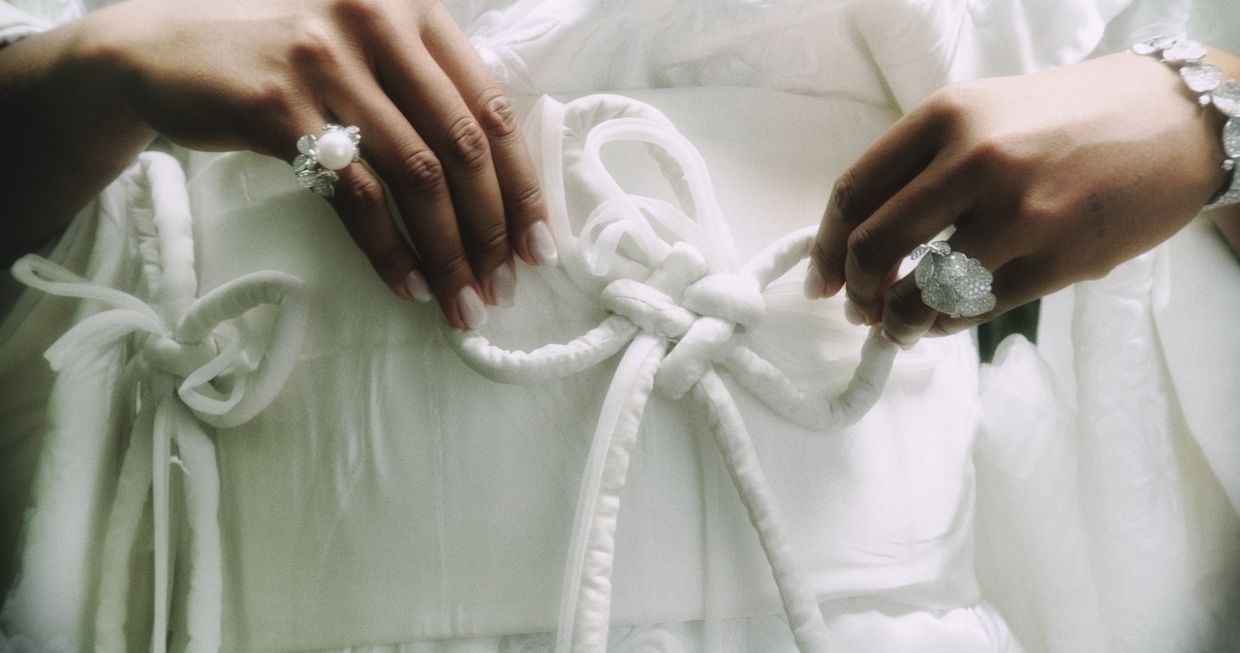
When Naomi Osaka stepped onto the Wimbledon court on June 29, the tennis world was watching not for the strength of her serve or the precision of her forehand, but for what she was wearing. Her entrance in an all-white creation titled "Evolving Ceremony" by independent Japanese designer Hana Yagi proved once again that the 14th-seeded former world number one has fundamentally rewritten the rules of how athletes present themselves in sport. Where other players view their walk-on as mere prelude to the match, Osaka has transformed it into a carefully orchestrated cultural statement.
The gown itself represents layers of intentionality that extend far beyond typical sports fashion. Constructed from seven different textiles salvaged from vintage kimonos, a traditional shiromuku wedding dress, and a deconstructed bridal gown, the design drew inspiration from both the classical kimono and the junihitoe, the elaborate twelve-layer court dress worn by noblewomen during Japan's Heian period from 794 to 1185. This was not accidental heritage marketing but deliberate cultural reclamation. Even the jewellery—pieces from Mikimoto, Japan's legendary pearl house—reinforced the narrative of Japanese pride woven through every detail of her presentation.
The transformation began months earlier, at the Australian Open in January, when Osaka emerged from the tunnel in a jellyfish-inspired Robert Wun gown complete with a butterfly hat that subtly referenced her journey as a young mother. That look established the template for what would become an evolving trilogy of grand entrances. At the French Open, she wore a black corset and ballgown skirt by Kevin Germanier, deliberately crafted from upcycled Nike kits and designed as a visual homage to the Eiffel Tower. Now, with the Yagi creation at Wimbledon, three distinct chapters revealed an overarching narrative of purposeful artistic expression.
Looking across these three appearances, several interconnected themes emerge that distinguish Osaka's approach from typical athlete styling. First and most prominently, she has committed to sustainability as a non-negotiable principle, choosing to upcycle and repurpose existing garments rather than demand entirely new productions. This decision carries particular resonance in Southeast Asia, where fashion waste and consumption patterns increasingly concern environmental advocates and policymakers. Second, she deliberately leverages her enormous platform to champion emerging and independent designers, as her stylist Marty Harper explained, to "give voices to new kids on the block." Hana Yagi herself, still in her twenties and operating from Tokyo, gained international exposure worth far more than traditional advertising could provide. Third, Osaka has recognized something that few athletes have fully grasped: that in today's media ecosystem, the entrance walk may prove more culturally significant than the match outcome, allowing her to build a distinctive personal brand entirely separate from her competitive record.
The actual mechanics of executing these visions involve logistical complexities that most observers never consider. Designers must create garments that satisfy seemingly contradictory demands: they must be visually stunning from the furthest seats in a stadium while remaining removable within the rigid time constraints of pre-match preparation. Harper revealed the extraordinary constraint: "We really only have three minutes to dress her, and she has less than one minute to undress" before competition begins. Other players typically discard warm-up jackets with casual ease; Osaka requires engineering solutions worthy of haute couture houses.
Yagi's answer to these spatial and temporal puzzles demonstrated inventive design thinking. She rendered each of the nine segments of the Wimbledon gown as independently detachable units, secured with velcro, allowing rapid removal while maintaining the dress's architectural integrity. More impressively, this modularity enabled the look to evolve as the tournament progressed, with segments recombined in different configurations. The nearly ten-foot train itself adjusts depending on which court Osaka occupies—a practical consideration reflecting the physical distances between player lounges and outer courts at Wimbledon, where lengthy trains risk material damage during the walk from preparation to competition.
The conscious pairing of heritage-inspired outer garments with performance innerwear proved equally strategic. The custom Nike dress underneath referenced traditional Japanese kirigami paper-folding techniques through its floral appliques and micro-pleated, curving hem—a detail that sold out before the tournament even began. This layering allowed Osaka to maintain performance functionality (the Nike technical dress optimizes movement and comfort) while projecting cultural narrative through her initial appearance. The integration felt seamless rather than forced, suggesting months of coordination between her style team and multiple design partners.
For Malaysian and Southeast Asian audiences particularly, Osaka's approach carries special significance. In a region where both Japanese cultural soft power and Asian representation in Western-dominated sports remain subjects of genuine pride and occasional anxiety, her strategy of explicitly centering Japanese heritage within international contexts offers an alternative model to assimilation or invisibility. Rather than adopting generic Western fashion standards like many athletes from non-Western backgrounds, she has insisted on making her cultural identity the centerpiece of her public presentation. This assertion becomes especially powerful at Wimbledon, perhaps world tennis's most tradition-bound institution.
Yet Osaka's fashion innovation ultimately transcends questions of cultural representation or environmental responsibility. She has intuitively understood that in an era of social media saturation and infinite visual content, the attention economy rewards novelty and narrative coherence. Every outfit connects to previous choices, every design decision carries intentional meaning, and every entrance creates genuine conversation that extends far beyond sports media into fashion criticism, cultural commentary, and design discourse. Her tournament appearances generate sustained discussion across audiences who might never watch her matches but who engage enthusiastically with discussions about sustainable fashion, emerging designers, and cultural representation.
Whatever her results on court—and her foot injury created genuine uncertainty about her even competing—Osaka has already secured victory in what matters equally in modern athletics: commanding attention before the competition begins. By treating each entrance as a collaborative art project rather than a commercial endorsement, she has established a template that other athletes may eventually attempt to replicate but will struggle to match. The walk to court has become her primary competitive advantage, a space where her creativity and cultural identity prove as decisive as her tennis talent.

