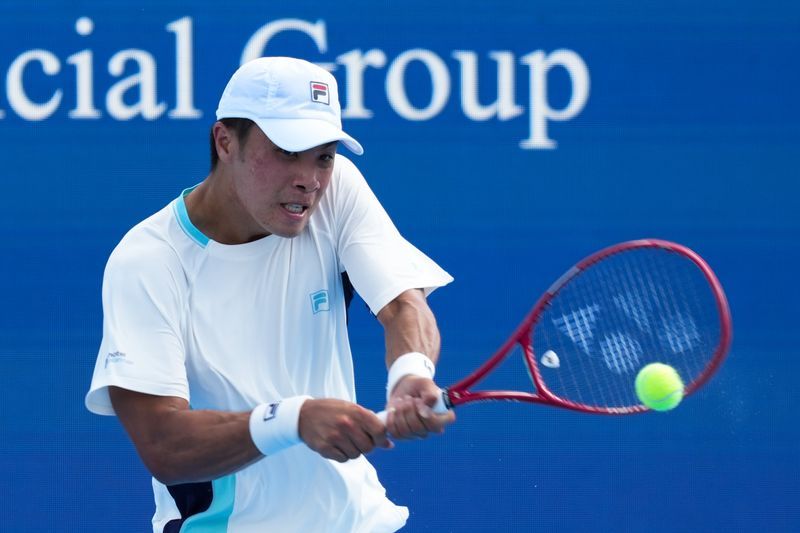
Brandon Nakashima's remarkable resurgence on the North American hardcourt circuit continued Friday in Cincinnati as the 25-year-old American dispatched fellow countryman Taylor Fritz 7-6(9) 4-6 6-3 to secure a place in the Masters 1000 semifinals. The victory marks Nakashima's second consecutive appearance in the final four of a premier event, having also reached the semis at the Montreal Masters the previous week, signalling a dramatic shift in his competitive standing just days before the US Open begins.
Nakashima's journey through Friday's encounter demonstrated the sort of mental fortitude increasingly defining his season. Despite holding a modest 1-4 head-to-head record against Fritz entering the match, he navigated a contest that swung dramatically in momentum multiple times. The opening set proved a tightly contested affair, with both competitors wielding commanding serves that kept break point opportunities at a premium. The set ultimately hinged on a first-set tiebreak, where Nakashima's patience and precision eventually prevailed after he converted his fifth set point when Fritz's return sailed long.
Fritz responded emphatically to the setback, channeling aggressive returning tactics to break Nakashima's serve early in the second set and subsequently close it out with an ace. The sixth-seeded American appeared poised to force the match toward a decisive outcome, particularly when he capitalised on Nakashima's mounting unforced errors to secure a 3-2 lead in the final set. Yet this moment represented a crucial turning point where the match fundamentally shifted.
Down 30-0 on his own serve, Nakashima exhibited the composure that has characterised his recent performances, recovering from what appeared an almost lost cause to convert his second break point of the encounter and restore parity at 3-3. The momentum swing proved decisive and unrelenting. From that point forward, Nakashima dominated the closing exchanges, winning the final three games consecutively as Fritz's error count accumulated and his confidence visibly ebbed. The 27th-seeded American's clinical execution down the stretch underscored his growing ability to finish tight matches against quality opposition.
This victory represents far more than a single tournament result for Nakashima. His current run represents his hottest stretch of professional tennis, extending what observers are increasingly describing as the most impressive period of his career. Among his recent accomplishments stands a quartet of victories against top-10 ranked opponents during the 2024 season, an achievement that places him among the year's emerging American success stories.
The implications of Nakashima's consecutive Masters 1000 semifinal appearances cannot be overstated within the broader context of American tennis. His emergence on the premium circuit comes at a moment when American men's tennis seeks viable contenders capable of competing at the sport's highest level. The timing is particularly fortuitous given that the US Open, where American players typically enjoy home advantage and enthusiastic crowd support, commences within the fortnight.
Nakashima now confronts either Lorenzo Musetti, the Italian 10th seed, or Frances Tiafoe, his American compatriot, in the semifinals. Both represent formidable obstacles, yet Nakashima's current trajectory suggests he approaches such encounters with the self-belief characteristic of a player hitting peak form. The manner in which he dismantled Fritz, particularly his capacity to recover from apparent disadvantage and maintain composure under pressure, provides compelling evidence that his recent achievements represent genuine form rather than happenstance.
For Malaysian and Southeast Asian tennis observers, Nakashima's rise carries particular relevance given the region's growing interest in American hardcourt tennis and the US Open's position as one of the calendar's marquee events. His trajectory demonstrates how players can rapidly ascend rankings through sustained excellence against elite competition, a pathway that regional players increasingly study as they develop their own campaigns.
The broader narrative surrounding Nakashima's emergence also speaks to the unpredictability that characterises modern professional tennis. Despite his earlier struggles against Fritz and questions about his ceiling among elite ranks, he has systematically dismantled such concerns through committed play and demonstrable improvement. His performance against Fritz showcased the full range of his capabilities—defensive excellence, aggressive opportunism, and mental resilience when circumstances deteriorated.
As Nakashima prepares for either Musetti or Tiafoe in Cincinnati's penultimate round, he carries the confidence that accompanies multiple victories against quality opposition. Whether he can sustain this momentum through a Masters 1000 final and subsequently into the US Open remains to be determined, yet the trajectory suggests he has definitively established himself among America's credible hardcourt contenders heading into autumn tennis.

