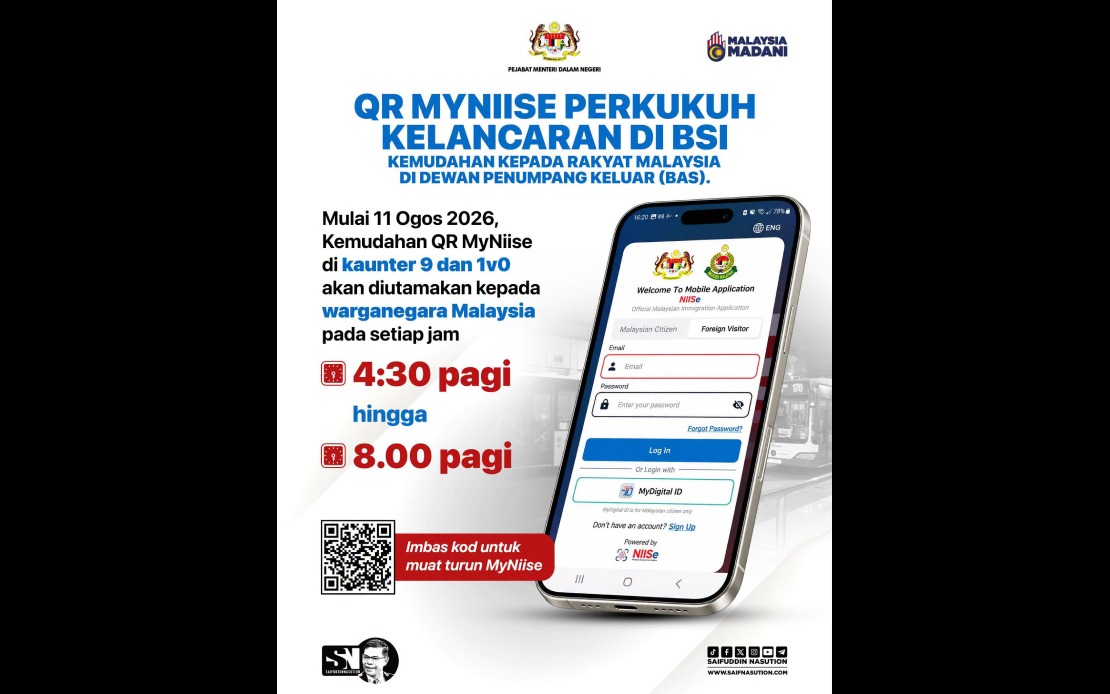
The Malaysian government has rolled out an express immigration channel for citizens using the MyNIISe QR code system at Bangunan Sultan Iskandar, the main bus departure point for cross-border travel into Singapore. Home Minister Datuk Seri Saifuddin Nasution Ismail announced the initiative, which began operation at dedicated counters 9 and 10 in the Bus Departure Hall. The accelerated clearance service operates during the most congested period of the day, from 4.30 am to 8 am, when thousands of Malaysian workers and commuters typically depart for Singapore.
The timing of this announcement reflects the government's recognition of a persistent logistical challenge that affects hundreds of thousands of cross-border commuters. Daily travellers to Singapore who leave during the early morning window face considerable delays as they navigate standard immigration procedures while racing against tight work schedules. Many depart before dawn to secure bus seats and ensure timely arrival at their workplaces across the causeway. This creates a cascading effect where congestion at immigration counters directly translates into late arrivals, missed connections, and operational inefficiencies for both individual commuters and employers relying on Malaysian workers.
MyNIISe, the National Integrated Immigration System, represents a cornerstone of Malaysia's digital transformation agenda within the immigration framework. The system streamlines border processing by consolidating traveller information and allowing pre-clearance verification through a mobile application interface. Rather than queuing at physical counters with passport documents, users with the QR code can proceed through expedited lanes where immigration officers scan the code and retrieve all necessary travel and identity information instantly. This technological approach significantly reduces the time required for manual document checks and questioning, addressing both efficiency and capacity constraints at busy border crossings.
Access to the MyNIISe system is straightforward for Malaysian citizens and residents. The application can be downloaded from three major platforms—Apple App Store, Google Play Store, and Huawei App Gallery—ensuring compatibility across the vast majority of smartphones in use. The government's decision to distribute the app across multiple platforms rather than limiting it to a single ecosystem demonstrates awareness of device diversity among the Malaysian population, including those using devices from Chinese manufacturers popular in the region. This inclusive approach reduces barriers to adoption and acknowledges the realities of technology adoption patterns in Malaysia and Southeast Asia.
The priority clearance initiative specifically targets the morning peak period, which is when the bottleneck most severely impacts commuters and overall border efficiency. Between 4.30 am and 8 am, Bangunan Sultan Iskandar typically processes thousands of passengers, with conventional immigration procedures creating significant delays. By designating counters 9 and 10 exclusively for MyNIISe QR users during this window, the government effectively creates a two-tier system that incentivizes digital adoption while maintaining capacity for those using traditional methods. This phased approach allows the immigration authority to gather performance data and gradually shift more traffic to digital channels as adoption increases.
For the broader Malaysian economy, this development carries implications beyond mere convenience. The cross-border workforce represents a significant economic relationship between Malaysia and Singapore, with tens of thousands of Malaysians employed across various sectors in Singapore's economy. Reducing commute friction directly improves worker punctuality and productivity while lowering transportation costs associated with congestion-related delays. Employers in Singapore benefit from more reliable workforce availability, while Malaysian commuters gain tangible time savings that translate into reduced stress and improved work-life balance. Cumulatively, these individual benefits aggregate into measurable economic gains across both nations.
The implementation at Bangunan Sultan Iskandar also signals the government's broader commitment to modernizing immigration infrastructure across Malaysia's major entry and exit points. As a location handling some of the highest daily passenger volumes in the country, BSI serves as a testing ground for scalable solutions that could eventually be replicated at other border crossings, airports, and land entry points. Success at this location could justify investment in similar systems at the Kuala Lumpur International Airport, Port Klang, and various land borders with Thailand, justifying the infrastructure and training costs required for wider deployment.
The MyNIISe QR initiative also reflects global trends in border management, where countries increasingly adopt biometric and digital verification systems to balance security with efficiency. Many developed nations have implemented similar systems, and this Malaysian implementation positions the country as forward-thinking within the Southeast Asian context. For regional travellers, the system demonstrates Malaysia's technological capability and willingness to invest in modern border infrastructure, potentially enhancing Malaysia's reputation as a well-managed entry point for international visitors and workers.
Adoption rates will ultimately determine the system's success and impact. The government's strategic placement of the priority lanes during peak hours creates a powerful incentive for digital adoption—commuters using MyNIISe will experience demonstrably faster processing compared to traditional queues. However, sustained promotion and awareness campaigns will be necessary to ensure that eligible users understand the system's benefits and download the application. Government coordination with bus operators, employers, and community groups could accelerate awareness and adoption among target commuter populations.
The initiative also touches on broader questions about digital equity and access in Malaysia. While smartphone penetration is high, ensuring that all eligible commuters have access to the technology and data necessary to use the system requires attention to affordability and digital literacy. The government may need to provide additional support channels for users unfamiliar with mobile applications, particularly among older workers who form a meaningful segment of the cross-border commuting population. Without such measures, the priority lanes could inadvertently advantage younger, more digitally fluent commuters while disadvantaging older workers.
Looking forward, the success of this initiative will likely influence broader government digitalization efforts across immigration and customs operations. If the Bangunan Sultan Iskandar deployment demonstrates measurable improvements in processing times and traveller satisfaction, it could catalyze investment in similar systems at other high-traffic borders and airports. This would represent a significant modernization of Malaysia's immigration infrastructure and position the country competitively within a region increasingly adopting digital border solutions. The initiative ultimately reflects recognition that modernizing border operations serves economic development, worker welfare, and national competitiveness.

