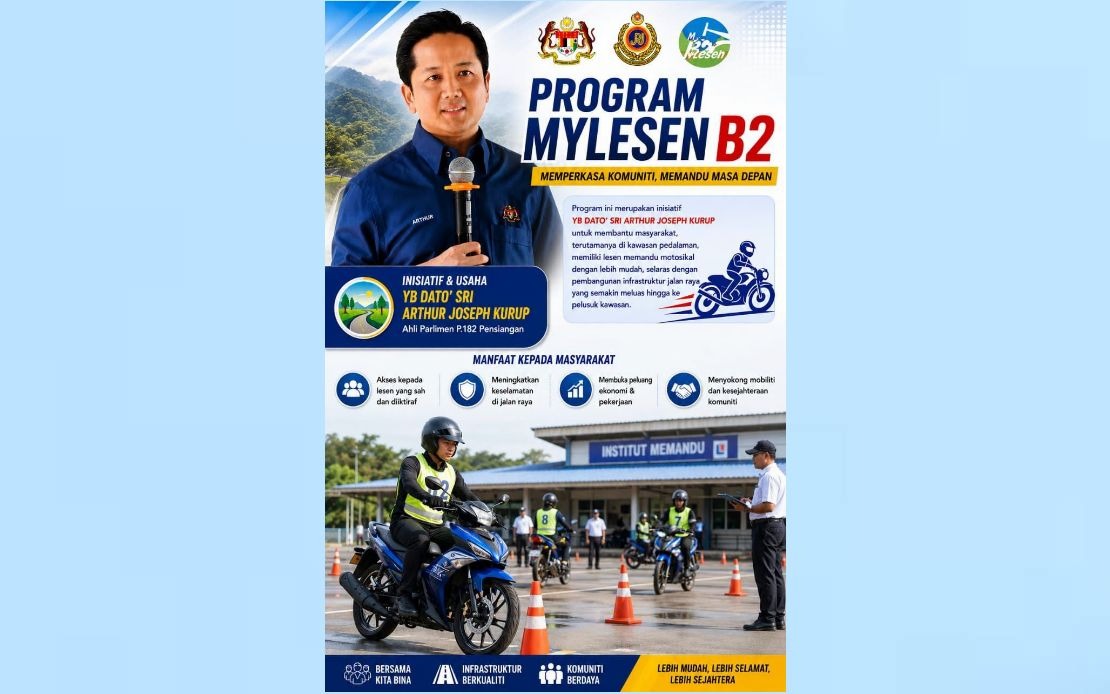
The MyLesen B2 mobile licensing scheme is once again operating in Pensiangan, Sabah, bringing standardised motorcycle licensing services directly to rural communities across the state. The programme addresses a persistent challenge for residents in remote districts: the burden of travelling considerable distances to urban driving schools simply to obtain and renew their riding credentials. This reinstatement represents a targeted effort to democratise access to legal documentation that has become essential for both personal mobility and economic participation in Malaysia's rural regions.
Pensiangan Member of Parliament Datuk Seri Arthur Joseph Kurup, who also serves as Minister of Natural Resources and Environmental Sustainability, emphasised that the initiative targets young adults and others who have never previously held a driving licence. Specifically, the programme welcomes applicants between 16 and 63 years of age, creating a pathway for entire age cohorts to formalise their riding status. By removing geographical barriers to licensing, the scheme recognises that rural youths often lack convenient access to the regulatory infrastructure available in towns and cities—a disparity that can inadvertently push residents toward unlicensed riding or legal non-compliance.
While MyLesen B2 brings services to people's doorsteps, the programme maintains rigorous standards. Participants must still complete mandatory training courses and pass prescribed examinations before receiving their licences. This dual approach—combining accessibility with accountability—ensures that the initiative does not compromise road safety standards in pursuit of convenience. Each rider completing the scheme emerges with validated competency in motorcycle operation and knowledge of traffic regulations specific to Malaysia's diverse road environments.
The broader implications for Sabah's rural economy should not be overlooked. A valid driving licence in Malaysia unlocks multiple opportunities beyond legal riding. Employment in logistics, transportation, delivery services, and rural commerce increasingly requires proof of licensure. Young people without licences face artificial barriers to entry-level positions that could anchor them to poverty. By removing this obstacle at the community level, MyLesen B2 potentially enables thousands of rural Sabahans to access jobs that provide stable income and pathways toward economic advancement.
Road safety emerges as a critical secondary benefit of the programme. Rural areas typically suffer disproportionately high rates of motorcycle accidents, often involving unlicensed or poorly trained riders unfamiliar with traffic laws. Enhanced awareness of road safety protocols and legal obligations—delivered through the MyLesen B2 curriculum—should translate into measurable reductions in accident rates. For Sabah, where rough terrain, unpredictable weather, and dispersed settlement patterns complicate traffic safety, improving rider competency across the population represents a public health intervention with substantial long-term value.
The permanence of the motorcycle licence once obtained—provided holders maintain compliance with ongoing regulations—adds another dimension of value. Unlike temporary or provisional documentation, a valid MyLesen B2 licence represents a durable credential that remains recognised throughout Malaysia's lifetime. This stability matters to rural residents planning their futures; a single qualification obtained today supports employment and legal mobility for decades to come.
Access to the programme has been democratised through multiple service points. Registration forms are available both at the Pensiangan Parliamentary Service Centre and the Sook State Assemblyman's Service Centre, ensuring that residents across the constituency can initiate their applications without extreme travel. This dual-location approach acknowledges the geographical spread of rural districts and demonstrates administrative responsiveness to logistical realities.
The initiative also carries symbolic weight within Malaysia's broader development agenda. Rural Sabah has historically experienced slower economic integration and more limited service delivery compared to peninsular urban centres. Programmes like MyLesen B2 signal commitment to narrowing this gap, treating rural communities not as peripheral afterthoughts but as constituencies deserving of proactive government service delivery. For young Sabahans watching whether opportunities will reach their hometowns, such initiatives provide tangible evidence that centralised resources are being deployed equitably.
Contextually, this programme arrives at a moment when Southeast Asia faces rising motorcycle usage in rural areas alongside insufficient licensing infrastructure. Neighbouring countries confront similar challenges: motorbikes dominate transportation in rural zones, yet licensing systems remain concentrated in urban hubs. Malaysia's MyLesen B2 model—bringing regulated licensing directly to dispersed populations—offers a replicable template for regional policymakers addressing rural mobility and safety simultaneously. The Pensiangan deployment effectively becomes a case study in decentralised governance that other Southeast Asian administrations might observe and adapt.
For participants, the pathway forward involves registering at one of the designated service centres, completing required coursework, and passing examinations that validate their riding competency. Successful completion transforms them from informal, potentially unlicensed riders into legal road users whose qualifications are recognised nationwide. This transition, though seemingly bureaucratic, represents genuine empowerment—enabling individuals to operate legally, access employment opportunities, and contribute to safer roads across Sabah.

