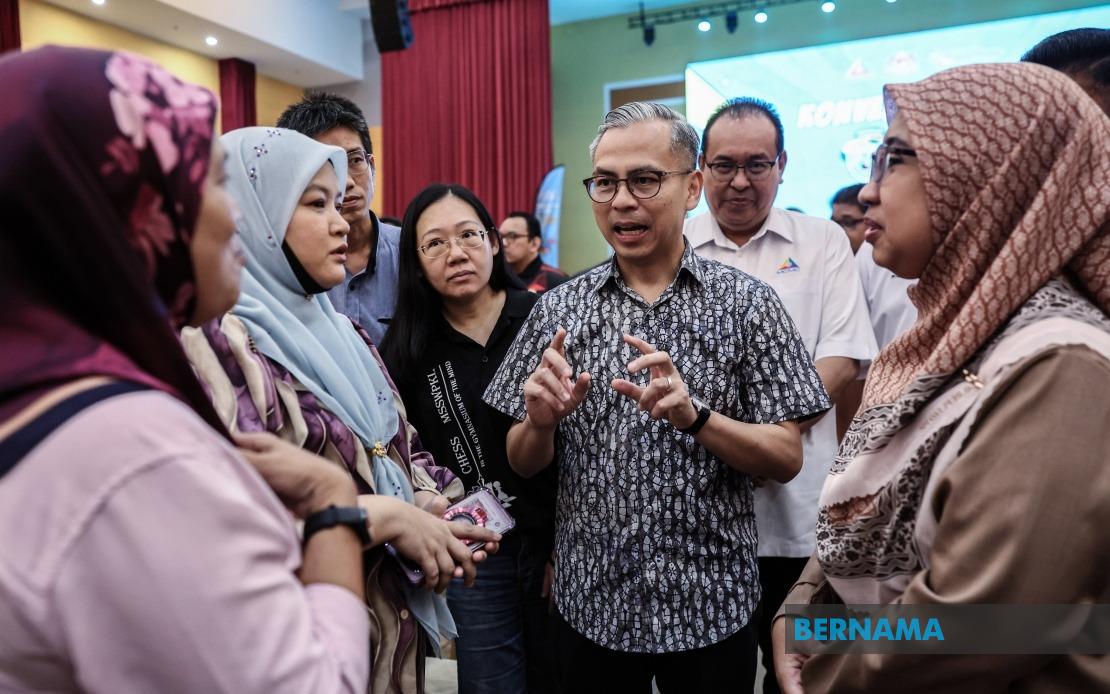
The Malaysian government has moved to clarify the nature and purpose of MyKhas, a special allocation programme that has drawn scrutiny regarding its distribution among parliamentary constituencies. Communications Minister Datuk Seri Fahmi Fadzil emphasised on Thursday that the fund represents a direct investment in the welfare of constituents rather than a personal benefit or discretionary allowance for elected representatives. The clarification comes as the MADANI administration continues to reshape public perception of how government resources are deployed across the country.
Fahmi, speaking at a press conference following his address at the 2026 Safe Internet PIBG Convention in Cheras, stressed that the MyKhas mechanism operates entirely under the Prime Minister's office and oversight. The fund has been formalised within Malaysia Plan and Budget documentation as a special provision under the Prime Minister's purview, giving the head of government full authority over its disbursement and allocation across different constituencies. This administrative structure ensures that allocation decisions remain centralised and aligned with broader government priorities rather than fragmented among individual MPs.
The PKR Information Chief reiterated that no Member of Parliament, regardless of party affiliation or seniority, can utilise MyKhas for personal or constituency-specific political purposes. Fahmi himself used his own position as an example, stating plainly that even he cannot access the fund for personal use. This principle underscores Prime Minister Datuk Seri Anwar Ibrahim's wider assertion that government allocations are fundamentally instruments for improving citizens' quality of life rather than political tools or perks tied to electoral success.
The Prime Minister had previously underscored this distinction by emphasising that parliamentary allocations serve to deliver tangible infrastructure and services to residents and voters. These projects span diverse areas including educational facilities, religious institutions such as mosques and Islamic schools, and essential public works like drainage systems and community infrastructure. By defining allocations through their end-use rather than their recipients, the government frames MyKhas as a mechanism for addressing genuine constituency needs rather than rewarding political success.
This clarification carries particular significance for opposition-held constituencies, where concerns have existed about whether allocation disparities might disadvantage areas governed by competing political forces. To address these concerns, Fahmi outlined a formal application process whereby constituents and community leaders in opposition-won areas can submit requests through the Implementation Coordination Unit operating under the Prime Minister's Department. This channel theoretically ensures that political geography does not determine access to development funding, though questions remain about whether application procedures are equally transparent and responsive across all constituencies.
The government's emphasis on centralised control over MyKhas reflects broader tensions within Malaysian politics regarding the balance between federal authority and parliamentary representation. By reserving all disbursement decisions for the Prime Minister's office, the administration maintains considerable influence over development priorities while potentially limiting the direct advocacy role that MPs might otherwise exercise on behalf of their constituents. This approach prioritises coordinated national planning over localised political responsiveness, a trade-off with significant implications for how constituency members interact with their elected representatives.
Fahmi's repeated insistence that MyKhas serves residents and voters, not MPs themselves, suggests the government recognises public sensitivity regarding allocation fairness and political patronage in constituency development. The clarification effort indicates awareness that citizens distinguish between genuine infrastructure investment and political favour, and that the government benefits from explicitly rejecting any suggestion that public funds become personal political assets. This messaging aligns with the MADANI coalition's broader reform rhetoric emphasising institutional integrity and public-interest governance.
The formalisation of MyKhas within official budget and Malaysia Plan documentation provides a degree of institutional permanence and transparency that might otherwise be absent from executive discretion. By embedding the fund in formal planning documents, the government creates a documented reference point and potentially subjects allocation decisions to scrutiny aligned with broader budgetary processes. However, the extent to which these safeguards actually constrain Prime Ministerial discretion or enhance public oversight remains an open question for observers of Malaysian public administration.
For Malaysian constituencies, the MyKhas clarification establishes a framework where development requests should flow through formal channels rather than through direct MP advocacy. This potentially shifts constituent-representative relationships by diminishing the MP's role as an intermediary securing local resources. Instead, the relationship becomes more transactional, with constituents applying directly to federal agencies. Such structural changes, though framed as anti-corruption measures, also reshape political accountability and the perceived value of constituency representation.
The government's positioning of MyKhas within the Prime Minister's authority rather than distributed among MPs also reflects broader patterns of executive centralisation observable across Southeast Asian democracies. While framed as ensuring fairness and preventing abuse, such centralisation concentrates resource allocation power within the executive branch, potentially altering the regional balance between executive and parliamentary authority. Malaysian observers tracking democratic governance practices will monitor whether this model enhances institutional fairness or simply displaces discretion to higher administrative levels.
Moving forward, the success of MyKhas in serving its stated purpose—directing resources equitably to constituency residents regardless of electoral outcomes—will depend significantly on implementation transparency and public confidence in the application process. The government's invitation for applications through the Implementation Coordination Unit provides a mechanism, but operational fairness ultimately determines whether the policy achieves its political and developmental objectives. How constituents in various political jurisdictions experience this process will shape perceptions of governmental even-handedness across Malaysia's diverse electoral landscape.

