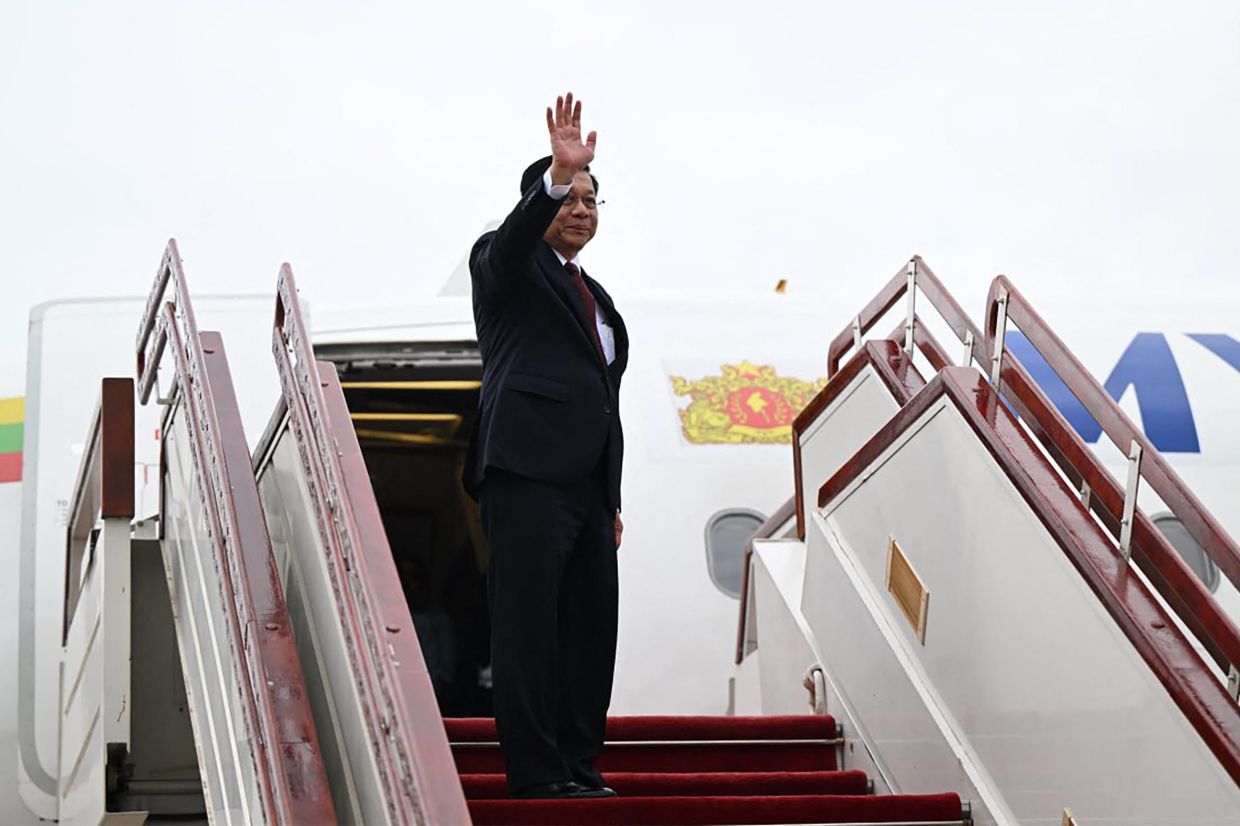
Myanmar's military-backed leader Min Aung Hlaing touched down in Moscow on Monday for high-level discussions with Russian President Vladimir Putin, representing his inaugural state visit to Russia since assuming the presidency. The Myanmar government confirmed the departure from the capital Naypyidaw, signalling a significant diplomatic engagement as the Southeast Asian nation continues to navigate isolation following its turbulent political transition.
Russia has positioned itself as one of the few major powers willing to maintain substantive relations with Naypyidaw in the aftermath of the February 2021 military coup that dismantled Myanmar's decade-long democratic experiment. When the junta overthrew elected civilian government leader Aung San Suu Kyi, triggering widespread international condemnation and economic sanctions, Moscow notably refrained from joining Western nations in imposing punitive measures. This contrarian stance has allowed Russia to deepen its foothold in Myanmar as Western influence receded, creating a strategic opening in a region where Beijing already maintains considerable leverage.
The human cost of Myanmar's internal conflict since the coup has been staggering. An estimated 100,000 people have perished in what has essentially become a nationwide civil war pitting government forces against an array of ethnic armed organisations and civilian resistance movements. The scale of casualties has drawn accusations of mass atrocities, with multiple international monitoring bodies documenting allegations of war crimes committed by Myanmar's military during operations against rebel factions and civilian populations. Despite these grave concerns, Russia's diplomatic relationship with Naypyidaw has strengthened rather than wavered.
Min Aung Hlaing's institutional position represents a carefully choreographed political fiction constructed by the military junta. The April presidential elections were orchestrated entirely within parameters controlled by the armed forces, and international observers including Western governments and independent democracy watchdogs universally dismissed the exercise as lacking any democratic legitimacy. The military council retained overwhelming control of both executive and legislative branches, rendering Min Aung Hlaing's civilian presidential title largely ceremonial rather than substantive.
The Moscow visit carries explicit strategic objectives centred on military and economic coordination. Myanmar's official statement emphasised strengthening the "longstanding friendly and close relations" while advancing "strategic cooperation" across security and commercial domains. These euphemistic formulations mask the practical reality: Myanmar's air force operates Russian-supplied fighter jets extensively throughout its conflict zones, relying on Moscow's military hardware to maintain aerial superiority against non-state armed groups. The February military cooperation agreement signed by both nations, though shrouded in minimal public disclosure, provided the institutional framework for this expanding defence relationship.
Accusations levelled against the Myanmar military regarding civilian targeting in its air operations have assumed particular significance in the context of Russian support. Conflict monitors documenting bombardment patterns argue that Myanmar's defence forces have systematically attacked civilian infrastructure, from residential neighbourhoods to healthcare facilities. These activities have prompted international humanitarian organisations to classify numerous incidents as potential violations of the laws of armed conflict. Russia's continued provision of military systems and training thus implicates Moscow indirectly in these contested operations, though Russian officials have consistently downplayed such concerns as exaggerated or politically motivated.
The bilateral five-year military pact signed in February established the skeleton for expanded defence partnership without revealing substantial operational details. The secrecy surrounding this agreement reflects both nations' desire to minimise Western scrutiny and domestic political pressure. For Myanmar, the agreement provides critical access to advanced weaponry and military expertise essential for suppressing internal dissent. For Russia, the arrangement represents a foothold in Southeast Asia and implicit acknowledgment of its continued relevance as a major power despite Western sanctions related to its Ukraine invasion.
Min Aung Hlaing's scheduled meetings during this visit encompass substantial governmental machinery beyond Putin himself. Conversations with Prime Minister Mikhail Mishustin, State Duma speaker Vyacheslav Volodin, and participation in a bilateral economic forum indicate comprehensive engagement across political, security, and commercial channels. This multi-layered diplomatic architecture signals both capitals' commitment to institutionalising their relationship against potential future shifts in Myanmar's domestic or regional circumstances.
The Myanmar leader's recent diplomatic itinerary reflects a broader strategy of international rehabilitation following the coup's immediate international ostracism. Since assuming office in April, he has visited China, India, and Thailand—navigating the delicate geopolitical landscape between Southeast Asian neighbours, major Asian powers, and isolated international pariah status. These carefully sequenced trips attempt to demonstrate continued Myanmar engagement with the world whilst avoiding the most hostile Western nations and their allies.
Myanmar's international position remains fundamentally unstable. The country confronts simultaneous challenges from multiple armed opposition groups controlling significant territory, humanitarian crisis affecting millions, and mounting pressure from ASEAN partners regarding implementation of the regional bloc's failed Five-Point Consensus designed to facilitate political dialogue. Russia's steadfast support provides diplomatic cover and essential military sustenance, yet cannot resolve Myanmar's underlying political fractures or restore the nation's international credibility.

