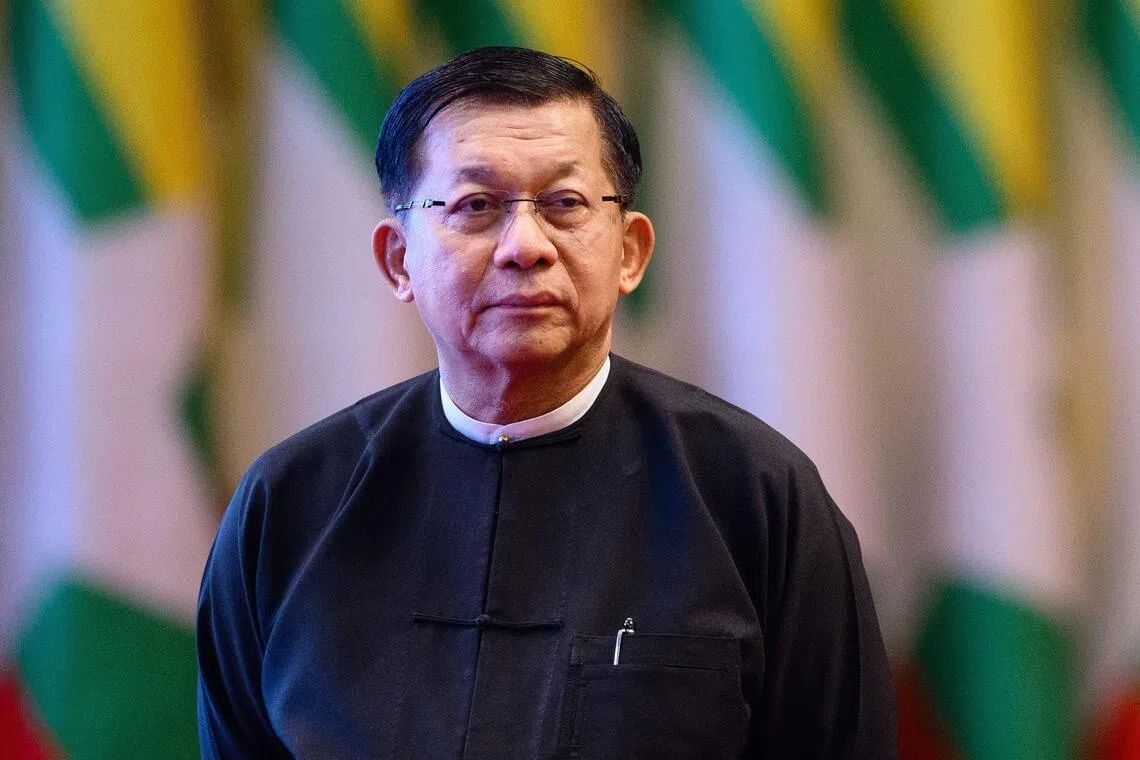
Myanmar's former military strongman Min Aung Hlaing arrived in Thailand on Thursday for what marks his first visit to the kingdom since rebranding himself as a civilian leader, underscoring his broader attempt to pull Myanmar back into the regional diplomatic mainstream after years of international isolation. The visit represents a significant shift in status for the man who orchestrated the 2021 military coup that deposed the democratically elected Aung San Suu Kyi and plunged the country into a devastating armed conflict that has claimed over 100,000 lives across all factions. By stepping onto Thai soil in civilian garb, the Myanmar leader is signalling his intention to reset relations with both Bangkok and the wider Southeast Asian community, despite the grave circumstances that brought him to power and the violence that continues to ravage his homeland.
Min Aung Hlaing's consolidation of civilian authority represents a carefully choreographed exercise in democratic theatre rather than genuine political transformation. Following stage-managed elections in April that international democracy monitors and Western governments dismissed as a sham designed to legitimise military rule under a civilian veneer, he assumed the title of Myanmar president. The elections themselves were widely regarded as an attempt to sanitise the junta's image and create the appearance of normalcy while fundamentally preserving the military's grip on power. This repackaging of authoritarian control has not fooled observers of Myanmar's political landscape, yet it has provided neighbouring governments with a technical rationale for engaging with Myanmar's leadership in ways that direct military rule made diplomatically awkward.
Thailand has positioned itself as the primary architect of Myanmar's diplomatic rehabilitation within Southeast Asia, pursuing a two-pronged strategy of bilateral engagement and regional inclusion through Asean mechanisms. Thailand's diplomatic initiative reflects its pragmatic calculation that Myanmar's instability creates direct security and humanitarian challenges that require active regional management rather than continued isolation. The kingdom faces mounting pressure from the spillover effects of Myanmar's internal conflict, including refugee flows, cross-border armed clashes, and criminal networks that exploit the chaos in Myanmar's borderlands. By welcoming Min Aung Hlaing to Bangkok and orchestrating high-profile meetings, Thailand is attempting to create channels through which it can address these pressing concerns through dialogue rather than passive observation of an increasingly unstable situation.
Regional responses to Myanmar's political status have begun to soften in recent months, though far from uniformly. Asean has maintained its ban on Myanmar's leadership attending high-level summit meetings since the coup, a symbolic but meaningful rebuke to military rule. However, there are signs of tactical loosening in this position, evident in the recent participation of Myanmar's foreign minister in an informal gathering of regional counterparts held in Thailand. This incremental thaw suggests that some Asean members, led by Thailand, see merit in gradual reintegration rather than indefinite exclusion. Min Aung Hlaing himself has embarked on a personal diplomatic tour designed to demonstrate his credentials as a statesman capable of engaging with major regional powers, having already visited India, China, and Laos in previous months. Each of these visits serves to chip away at the notion that Myanmar's leader remains a pariah figure unfit for international engagement.
Despite these apparent diplomatic overtures, a fundamental contradiction lies at the heart of Myanmar's regional positioning. The country's military leadership continues to categorically reject Asean's five-point consensus, a framework designed to facilitate dialogue between Myanmar's government and opposition forces as a path toward reducing violence and returning to democratic governance. This consensus, laboriously negotiated by Asean members, represents the bloc's core condition for normalising relations with Myanmar. By simultaneously seeking readmission to Asean mechanisms while refusing to genuinely engage with the consensus framework, Min Aung Hlaing is pursuing what analysts describe as a zero-sum strategy—attempting to gain the diplomatic legitimacy and international standing that comes with regional membership without making the substantive political concessions that Asean theoretically demands. This posture reveals the hollowness of the leadership's claim to civilian reform and raises questions about whether Thailand's diplomatic initiative is genuinely advancing peace or simply providing cover for renewed military consolidation of power.
Thailand's willingness to host Min Aung Hlaing at an official state dinner and formal government reception reflects Bangkok's calculation that pragmatic engagement serves its own national interests more effectively than continued isolation. The two nations are expected to sign a memorandum of understanding focused on labour cooperation, a relatively modest commitment that nonetheless carries symbolic significance in formalising renewed diplomatic ties. More substantively, Thai officials have indicated that bilateral security concerns will feature prominently in discussions with the Myanmar leader. Thailand's Foreign Minister Sihasak Phuangketkeow has specifically flagged the proliferation of cybercrime networks operating from Myanmar's borderland regions, an issue that Bangkok believes Min Aung Hlaing's government should be leveraging its authority to address. These criminal operations represent a transnational problem that affects Thailand's economic security and social stability, providing Bangkok with a concrete rationale for engagement that extends beyond mere diplomatic rehabilitation.
The humanitarian dimension of Myanmar's crisis also influences Thailand's diplomatic strategy. The kingdom currently hosts millions of refugees and internally displaced persons fleeing Myanmar's violence, creating enormous demands on Thai resources and infrastructure. Additionally, the porous border between the two nations means that armed conflicts in Myanmar's interior regularly spill across into Thai territory, occasionally resulting in casualties among Thai civilians and security forces. From Bangkok's perspective, a Myanmar leadership that can be engaged diplomatically may prove more responsive to Thai security concerns and more amenable to cooperation on border management issues than one that is completely ostracised. This pragmatic calculation, however, risks creating the perception that Thailand is willing to normalise relations with a leader who remains implicated in mass atrocities in exchange for incremental security improvements along the border.
The timing of Min Aung Hlaing's visit carries additional significance given recent developments regarding Aung San Suu Kyi's circumstances. The ousted democratic leader, who has spent the years since the coup under house arrest facing politically motivated legal cases, was permitted to meet with an International Committee of the Red Cross representative on Monday—her first publicised meeting with a foreign official since her removal from office. While this solitary meeting hardly represents a dramatic shift in Myanmar's governance, it does suggest that the military leadership may be moderating its approach to the former premier, potentially responding to international pressure or calculating that modest gestures might ease diplomatic reintegration. The coincidence of this development with Min Aung Hlaing's visit to Bangkok suggests a coordinated softening of Myanmar's posture on the international stage, designed to create the impression of movement toward normalcy even as fundamental power structures remain unchanged.
Criticism of Thailand's approach to Min Aung Hlaing has come from human rights advocates and civil society groups who view the diplomatic welcome as deeply problematic. The Myanmar leader faces international sanctions imposed by multiple Western nations and is actively wanted by the International Criminal Court on charges of crimes against humanity related to the military's conduct during the coup and subsequent conflict. Human rights campaigners argue that extending red-carpet treatment to someone accused of such grave offences sends a deeply troubling message about international accountability and the consequences for orchestrating political violence. Justice For Myanmar and similar advocacy organisations have publicly condemned Thailand's willingness to host the Myanmar leader, arguing that doing so grants false legitimacy to someone whose fundamental crime—the forcible overthrow of democratic governance—remains unaddressed and unaccounted for. From this perspective, Thailand's diplomatic engagement represents a capitulation to authoritarianism and a betrayal of the democratic values that Asean theoretically champions.
The broader implications of Myanmar's diplomatic rehabilitation extend beyond bilateral Thai-Myanmar relations or even regional Asean dynamics. Min Aung Hlaing's apparent success in repositioning himself as a civilian statesman worthy of international engagement, despite the violence associated with his rise to power, potentially sets a troubling precedent for how the international community responds to military coups and authoritarian consolidation of power. If a leader can engineer a coup, oversee a devastating civil war, and then simply rebrand himself in civilian dress and expect diplomatic normalisation, it suggests that military intervention in domestic politics carries manageable international consequences. This dynamic plays into the hands of military establishments across Southeast Asia and beyond, many of whom may view Myanmar's experience as a roadmap for how to achieve and retain power despite international opposition. The region must grapple with whether engagement with Min Aung Hlaing represents a pragmatic response to a difficult situation or a dangerous abdication of principles regarding democratic governance and accountability for state violence.

