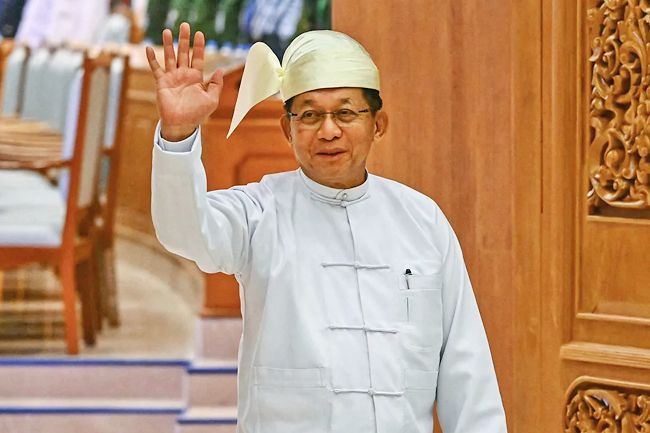
Myanmar's military leader Min Aung Hlaing is set to travel to Bangkok on August 6 and 7 for high-level talks with Thai Prime Minister Anutin Charnvirakul, Thailand's foreign minister confirmed this week. The visit marks a significant diplomatic engagement as Thailand continues its diplomatic outreach towards Myanmar, a strategy that has become increasingly contentious within ASEAN circles. Sihasak Phuangketkeow made the announcement after participating in wide-ranging consultations with fellow Southeast Asian foreign ministers in Manila, where the bloc grappled with the thorny question of how Myanmar might eventually rejoin mainstream ASEAN activities.
Although Myanmar retains its formal membership within the Association of Southeast Asian Nations, the country has been systematically barred from attending the bloc's principal gatherings since the military seized power in 2021, deposing democratically elected leader Aung San Suu Kyi. This exclusion represents an unprecedented rupture for the organisation, which traditionally prides itself on the principle of non-interference and consensus decision-making. The sanctions have been applied sporadically and with visible reluctance from several member states, creating persistent fault lines within the ten-nation grouping that complicate any unified response to the ongoing Myanmar crisis.
Thailand's aggressive pursuit of Myanmar's reintegration reflects its unique geographical and humanitarian circumstances. As a nation sharing an extensive border with the conflict-ravaged country and currently sheltering millions of Myanmar refugees, Bangkok faces immediate practical pressures that shape its diplomatic calculations. The refugee populations, many fleeing ongoing civil conflict and military violence, represent both a humanitarian concern and an economic burden for Thai border communities. This proximity to the crisis has pushed Thailand towards a more pragmatic stance than other ASEAN members, viewing engagement rather than isolation as a potential pathway to stability.
Sihasak characterised the proposed strategy as a "dual-track approach" that addresses immediate bilateral concerns while maintaining theoretical commitment to ASEAN's broader peace framework. The foreign minister highlighted transnational challenges requiring cooperation, including human trafficking, organised crime networks, and drug trafficking operations that flourish across porous borders. These issues represent genuine security threats to both nations and provide concrete grounds for diplomatic engagement beyond the abstract question of Myanmar's political future. By framing the dialogue in terms of shared security interests, Thailand has crafted a narrative that allows for enhanced bilateral relations without appearing to abandon ASEAN's stated principles.
However, cracks in ASEAN's unified position on Myanmar have widened considerably. Thailand's willingness to engage directly with the junta leadership contrasts sharply with the stance of other regional powers who view any such engagement as tacit acceptance of the coup. The bloc's established five-point peace plan, which calls for dialogue with all stakeholders and cessation of violence, has stalled dramatically, with little discernible progress on any metric. Sihasak acknowledged this impasse during recent meetings, suggesting that ASEAN members must develop more realistic benchmarks for measuring progress rather than waiting for wholesale transformation of Myanmar's political system.
The Thai foreign minister posed rhetorical questions about what constitutes meaningful progress in Myanmar's trajectory. Should ASEAN consider it a breakthrough if the military allows the bloc's special envoy access to detained former leader Aung San Suu Kyi, who remains imprisoned and largely isolated? Would a reduction in armed conflict along the Thai-Myanmar border qualify as progress worthy of diplomatic recognition? These questions reveal the profound ambiguity in ASEAN's approach, where members struggle to define the minimal conditions that would justify Myanmar's return to full participation. The absence of clear criteria has allowed interpretive flexibility that Thailand has leveraged to advance its engagement agenda.
Sihasak's comments underscore Thailand's conviction that incremental change, rather than transformative democratic reform, represents the realistic horizon for Myanmar in the medium term. This perspective stands in considerable tension with civil society organisations and several governments that view any engagement with the junta as morally compromised. The Thai position implicitly accepts that Myanmar's authoritarian trajectory is unlikely to reverse substantially, and that working within this constraint may yield better humanitarian outcomes than continued isolation. This pragmatism reflects Bangkok's assessment that the military regime will not be dislodged through international pressure alone.
One potentially significant development emerged from separate discussions between ASEAN and Myanmar's military-appointed foreign minister Tin Maung Swe in Bangkok. Thai officials indicated they had explored with ASEAN counterparts the possibility of establishing a permanent, long-term special envoy to Myanmar to replace the current system of annual rotation among member states. Philippine Foreign Minister Theresa Lazaro acknowledged that the existing rotating arrangement has demonstrated insufficient effectiveness in advancing dialogue or understanding. A dedicated envoy with extended tenure and accumulated expertise might provide greater continuity and pressure for progress than the current revolving-door approach.
The prospect of elections that installed Min Aung Hlaing as president offers, according to Sihasak, a potential opening for renewed dialogue between the junta and Myanmar's armed ethnic organisations along the Thai border. Thailand's vision involves leveraging its border position to facilitate conversations between the military government and these resistance movements, positioning itself as a venue for confidence-building discussions. Such mediation efforts would require delicate balance, as Thailand must maintain relationships with multiple parties while avoiding the appearance of enabling the junta or undermining opposition forces.
For Malaysian observers, the Thailand-Myanmar diplomatic engagement carries broader implications for ASEAN's coherence and future crisis response mechanisms. If Thailand's bilateral approach succeeds in gradually normalising relations with the junta while others maintain principled distance, the bloc risks further fragmentation on regional security matters. Conversely, if Myanmar's reintegration through incremental concessions proves unsuccessful, the failed experiment might strengthen arguments for more decisive collective action. Malaysia, as a significant ASEAN voice, will likely face pressure to position itself between these competing visions of how the bloc should respond to member-state crises in the future.

