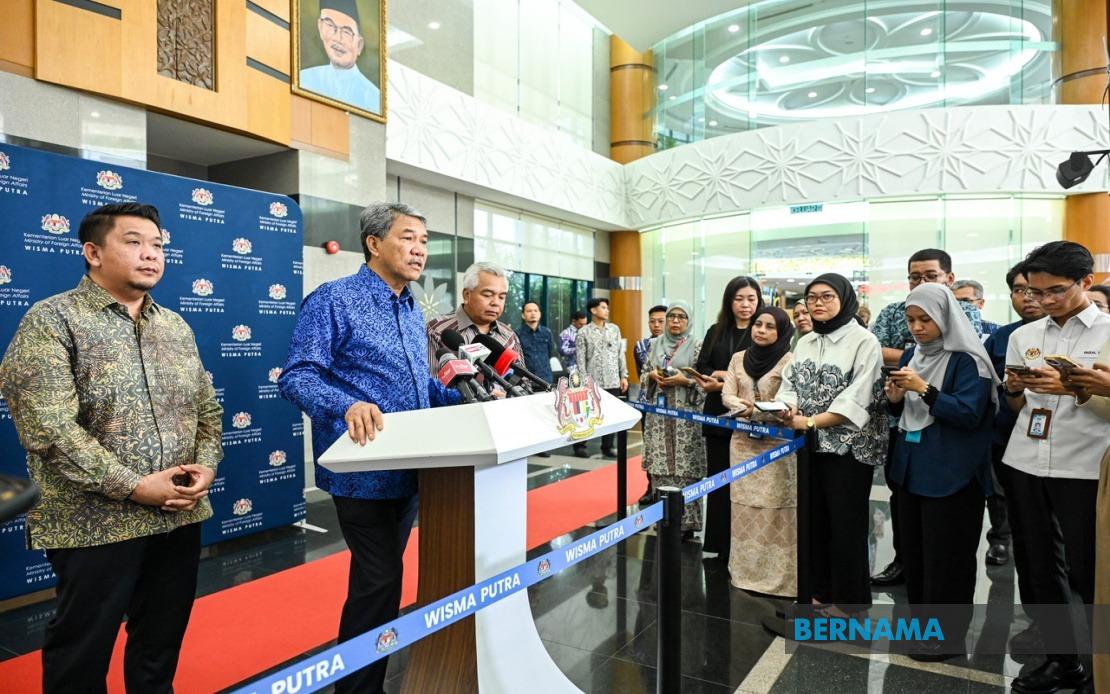
Myanmar's newly appointed Foreign Minister Tin Maung Swe has signalled the country's readiness to accept the return of 5,000 of its nationals currently sheltering in Malaysia, with maritime transport being proposed as the mechanism for their repatriation. The development emerged during bilateral discussions between the Myanmar envoy and Malaysia's Foreign Minister Datuk Seri Mohamad Hasan, who disclosed the undertaking at a press conference following Malaysia's observance of the 59th ASEAN Day celebration in Putrajaya on Monday.
While the commitment represents a potential breakthrough in addressing the mounting refugee challenge that has strained Malaysia's resources and humanitarian infrastructure, significant questions remain unresolved about the logistics and welfare safeguards inherent in such an operation. Mohamad Hasan emphasised that although Myanmar has demonstrated political willingness to facilitate the return journey, the paramount consideration must be ensuring the security and wellbeing of the individuals involved throughout their passage home. The careful framing of this caveat underscores Malaysia's insistence that any repatriation initiative cannot proceed at the expense of fundamental humanitarian principles.
Malaysia has completed the identification and documentation of all 5,000 individuals eligible for repatriation, substantially advancing the administrative groundwork necessary for such an undertaking. Despite this preparatory progress, negotiations have not yet crystallised a concrete timetable for commencing operations. Mohamad Hasan nevertheless called for acceleration of the repatriation timeline, signalling Malaysia's interest in resolving this longstanding displacement issue more swiftly. The absence of a fixed schedule suggests that critical details regarding vessel capacity, route planning, security arrangements, and post-arrival integration mechanisms remain subject to ongoing bilateral and multilateral consultation.
A notable dimension of the Malaysian government's approach involves broadening the lens beyond the internationally prominent Rohingya crisis to encompass the diverse refugee populations originating from Myanmar. Ethnic minorities including the Chin and Karen communities have fled Myanmar in substantial numbers, their plights often overshadowed by media concentration on the Rohingya exodus. By explicitly acknowledging these other communities' displacement, Mohamad Hasan has signalled that Malaysia views the Myanmar refugee question as a complex humanitarian challenge rooted in broader systemic instability rather than a singular ethnic or religious dimension. This framing carries implications for how international responses are calibrated and resources allocated across different refugee cohorts.
ASEAN's collective engagement with the Myanmar situation remains anchored to the Five-Point Consensus, a foundational framework agreed upon by all ten member states including Myanmar's military leadership at the time of adoption. Mohamad Hasan reiterated that this consensus should continue serving as the organisational bedrock for the regional bloc's Myanmar strategy, underscoring that any substantive modifications to the framework must be negotiated and authorised by ASEAN leaders themselves rather than unilaterally implemented. This position reflects Malaysia's commitment to maintaining multilateral coherence on the issue and preventing individual states from pursuing divergent trajectories that could fracture ASEAN's already delicate unity on this contentious matter.
The Malaysian Foreign Minister's assertion that ASEAN members must address the Myanmar refugee challenge collectively reflects acknowledgment that displacement stemming from Myanmar constitutes a burden-sharing imperative rather than a bilateral problem. Malaysia has borne disproportionate responsibility in hosting refugee populations, with Rohingya and other Myanmar nationals comprising significant proportions of irregular migrants and undocumented persons within its borders. By invoking collective ASEAN responsibility, Mohamad Hasan has implicitly called for other member states to contribute more substantively to solutions, whether through burden-sharing arrangements, financial contributions, or diplomatic pressure on Myanmar to create conditions enabling voluntary return.
The safety considerations flagged by the Malaysian Foreign Minister acquire particular resonance given historical instances of maritime incidents involving refugee populations and the inherent vulnerabilities of sea-based transit for displaced persons. Questions regarding vessel standards, medical facilities, crew competency, and contingency planning for emergencies would require meticulous negotiation before any operation commences. Furthermore, the capacity of Myanmar to adequately receive and integrate 5,000 returned nationals—given its own internal conflicts and limited state capacity—poses secondary welfare concerns that extend beyond the voyage itself to encompass post-arrival circumstances.
The involvement of Myanmar's new Foreign Minister signals potential policy flexibility from Naypyidaw, possibly reflecting international pressure or a recalibration of the military regime's position on refugee returns. However, expressions of willingness at the ministerial level do not automatically translate into operational reality, as implementation involves numerous government agencies, logistical complexities, and verification procedures. Malaysia's experience with previous repatriation initiatives involving other nationalities illustrates the gap between diplomatic agreements and ground-level execution.
For Malaysia, facilitating the return of even a subset of Myanmar's refugee population would alleviate considerable pressure on its healthcare, education, and social welfare systems. However, the repatriation of 5,000 individuals represents only a fraction of the estimated hundreds of thousands of Myanmar nationals residing in Malaysia, both registered and undocumented. This initial cohort may function as a pilot programme whose success or complications will shape subsequent phases of larger-scale repatriation. The strategic importance of ensuring a credible, humane process cannot be overstated, as any perception of failed or unsafe returns would severely discourage future voluntary participation and complicate diplomatic negotiations.
The timeframe for advancing from diplomatic agreement to operational commencement remains uncertain, though Mohamad Hasan's call for expediency suggests Malaysia views prompt action as essential. ASEAN's upcoming meetings and bilateral Myanmar engagement opportunities will likely serve as venues where Malaysia continues advocating for concrete progress. The success of this repatriation initiative could establish precedents for addressing other aspects of the broader Myanmar crisis and might influence how other ASEAN members calibrate their own policies toward Myanmar nationals seeking refuge or temporary residence.

