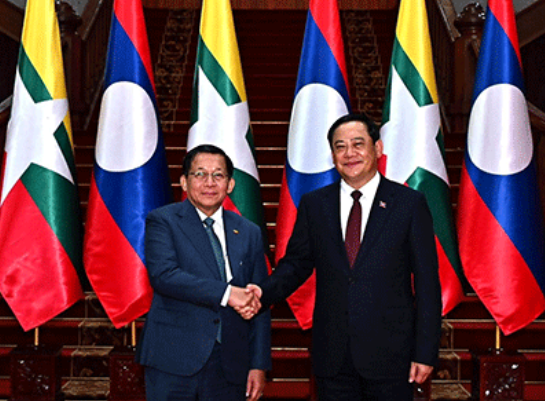
Myanmar's President Min Aung Hlaing arrived in Vientiane on July 3 for a three-day state visit that underscores the enduring strategic partnership between two neighbouring Southeast Asian nations. The trip, which concluded on July 5, carried particular significance as it marked the 70th anniversary of formal diplomatic relations between Laos and Myanmar, a milestone that both countries used as an opportunity to reaffirm their commitment to deepening engagement across political, economic, and security dimensions.
The visit represented Myanmar's first major international engagement following President Min Aung Hlaing's recent assumption of office, with Laos notably chosen as the inaugural destination for official foreign visits. This selection itself carries diplomatic weight, reflecting the strategic importance Naypyidaw places on its relationships within the Association of Southeast Asian Nations and particularly with its immediate neighbours. President Thongloun Sisoulith hosted the Myanmar delegation with full ceremonial honours at the Presidential Palace, where the two leaders were joined by their spouses and supporting delegations for formal state protocols that underscored the gravity both nations assign to bilateral ties.
During comprehensive official talks, the two presidents reviewed the trajectory of their bilateral cooperation and identified new areas for coordinated action. Their discussions ranged beyond conventional diplomatic pleasantries to encompass substantive reviews of existing arrangements and strategic planning for future collaboration. President Thongloun extended formal congratulations to Myanmar on its recent general election and government formation, expressing confidence in the new administration's capacity to guide the nation toward continued development and prosperity. This acknowledgement of Myanmar's domestic political transition implicitly signals Laos's support for the country's governance direction and underscores regional acceptance of its current leadership.
The two leaders highlighted their satisfaction with existing momentum in bilateral relations, pointing specifically to regular high-level visits, consistent political dialogue, and the mutual trust that characterises their engagement. They identified defence and security cooperation as a particularly promising avenue for expansion, alongside established collaboration in foreign affairs coordination, trade and investment promotion, transport infrastructure development, energy projects, labour mobility, and educational exchange programmes. The breadth of these cooperation areas reflects how comprehensively the two nations have woven their interests together across government and society.
Border security and information-sharing mechanisms emerged as priority concerns requiring enhanced coordination between relevant agencies. Both nations recognised the value of closer cooperation through multilateral frameworks including Asean, the United Nations, and the Mekong-Lancang Cooperation initiative, which has become increasingly influential in shaping regional development trajectories. By emphasising their commitment to these platforms, Laos and Myanmar signalled their intent to coordinate positions on regional matters and leverage collective mechanisms for addressing transnational challenges affecting their populations.
Prime Minister Sonexay Siphandone met separately with President Min Aung Hlaing at the Prime Minister's Office to discuss concrete mechanisms for advancing bilateral cooperation. Sonexay welcomed the productive outcomes of the presidential-level discussions and the signing of cooperation agreements concluded during the state visit. The Prime Minister characterised the visit as instrumental for consolidating the historical friendship between the two peoples and deepening institutional relationships that have weathered decades of regional transformation. His involvement at this level reflected the comprehensive nature of the bilateral agenda, which transcends presidential-level diplomacy to encompass government-wide coordination.
Laos's National Assembly President Xaysomphone Phomvihane also received President Min Aung Hlaing, highlighting the legislative dimension of bilateral relations. The two parliamentary leaders pledged to strengthen cooperation between their respective chambers and committed to supporting effective implementation of bilateral agreements through legislative oversight and monitoring. Xaysomphone specifically emphasised that parliamentary coordination would ensure that memorandums of understanding and other accords delivered tangible benefits to both populations. This parliamentary engagement reflects growing recognition that sustainable bilateral relationships require buy-in and active participation from legislative bodies, not merely executive-level endorsement.
The two sides formalised their expanded cooperation through the signing of two significant documents. A Memorandum of Understanding on tourism cooperation linked the Lao Ministry of Culture and Tourism with Myanmar's Ministry of Hotels, Tourism and Culture, recognising the mutual benefits of promoting people-to-people exchanges and cultural tourism. Simultaneously, Vientiane and Naypyidaw established formal friendship city relations, a gesture designed to facilitate direct municipal-level cooperation and cultural exchange. Additionally, Myanmar provided snake antivenom serum to Laos's Ministry of Health, addressing a practical public health need while demonstrating concrete commitment to regional welfare.
The cultural and ceremonial components of the visit reinforced the historical and emotional dimensions of Myanmar-Laos relations. President Min Aung Hlaing participated in formal commemorative activities including laying a wreath at Vientiane's Unknown Soldier Monument, honouring Lao revolutionary soldiers who sacrificed their lives during the nation's struggles. He attended a traditional Baci blessing ceremony and an official state banquet hosted by President Thongloun and his wife, Naly Sisoulith, immersing the Myanmar delegation in Lao cultural practices and reinforcing bonds of friendship between the peoples.
The visitor's itinerary extended beyond the capital to encompass Luang Prabang, the ancient royal city designated as a Unesco World Heritage site. The Myanmar delegation's planned exploration of temples, cultural landmarks, and historical attractions served multiple purposes: demonstrating respect for Lao civilisation and heritage, facilitating cultural education for the visiting entourage, and promoting tourism understanding that could translate into increased people-to-people exchanges. This cultural dimension transforms the visit from a purely diplomatic exercise into an opportunity for deeper mutual understanding and appreciation.
From a Southeast Asian perspective, this state visit illustrates the continuing importance of bilateral relations between smaller Asean members as foundations for regional stability and cooperation. Myanmar and Laos, despite their individual challenges and international scrutiny, have maintained consistent diplomatic engagement and recognised mutual interests in border security, trade facilitation, and coordinated regional positioning. Their emphasis on Mekong-Lancang cooperation and Asean channels reflects broader efforts to embed bilateral relations within multilateral frameworks that promote stability across the region. For Malaysian observers, the visit demonstrates how neighbouring states navigate complex domestic circumstances while maintaining constructive international engagement, a lesson potentially relevant as the region addresses various transnational challenges requiring coordinated responses.

