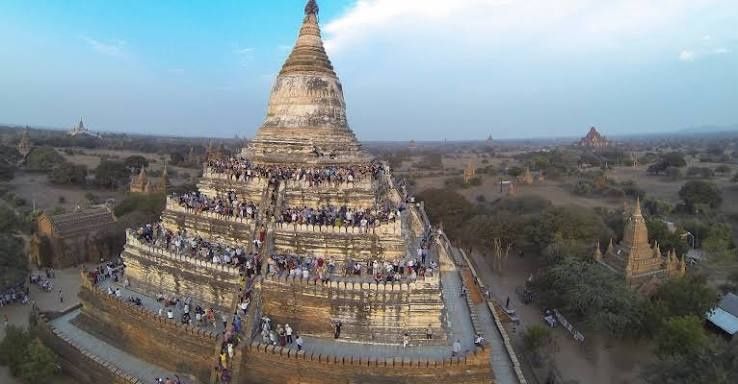
Myanmar's military-backed administration is placing significant hopes on reviving its tourism sector as a cornerstone of post-election economic recovery, with the country aiming to welcome 1.8 million foreign visitors this year through streamlined visa procedures and targeted marketing campaigns. The ambitious target reflects government confidence that key attractions—the ornate temples of Bagan, the spiritual draws of the Golden Rock Pagoda and Inle Lake, and the colonial heritage of Yangon and Mandalay—can once again become major revenue generators despite years of civil conflict and international isolation since the February 2021 military coup.
The tourism recovery initiative carries particular significance as Myanmar seeks to demonstrate to international audiences that portions of the country are stabilising and safe for investment and travel. Officials are banking on neighbouring China and Thailand as primary drivers of visitor growth, recognising these markets' proximity and existing travel infrastructure. Maung Maung Kyaw, permanent secretary at the Ministry of Hotels, Tourism and Culture, emphasised this regional focus when discussing growth projections, highlighting the strategic importance of neighbouring nations in achieving visitor targets during what remains a delicate period of international re-engagement.
Current performance metrics, however, suggest the government faces a substantial challenge in reaching its goals. Through May 2025, Myanmar had received 448,205 international arrivals, representing modest growth of approximately five percent compared to the same period last year. The country welcomed 973,263 visitors across the entirety of 2024, meaning officials must engineer significantly accelerated arrivals during the second half of 2025 to hit their ambitious benchmark. This trajectory raises questions about whether the eased visa policies and marketing efforts will generate sufficient momentum within the remaining months.
The raw numbers also underline how profoundly Myanmar's tourism industry has contracted since the military coup. Pre-coup Myanmar attracted approximately 4.7 million visitors in 2015, when the country was experiencing a tourism boom following decades of isolation. That figure stands roughly two-and-a-half times higher than the government's current target, illustrating the scale of recovery work ahead. The disparity becomes even starker when compared to Thailand, which received approximately 33 million tourists last year and maintains similar targets for 2025—a sobering reminder of the competitive disadvantage Myanmar faces in Southeast Asian tourism markets.
China and Thailand currently dominate visitor flows, with Chinese travellers representing the largest source of international arrivals, followed by Thais and South Koreans. Statistics from the first five months of 2025 reveal encouraging signs within this mix: Chinese arrivals climbed twelve percent year-on-year, while Thai visitors increased by seven percent. These incremental gains suggest that diplomatic outreach and promotional efforts targeting immediate neighbours are gaining traction, though the pace of growth remains insufficient to close the gap between current numbers and official targets.
A notable complication underlying official tourism statistics involves the distinction between legitimate travel and human trafficking operations. Myanmar's figures capture only legal border crossings and exclude individuals trafficked into online scam compounds, a phenomenon that has prompted intense regional law enforcement activities. These criminal operations, which have resulted in the repatriation of thousands of Chinese nationals, cast a shadow over the country's tourism narrative and underscore security and governance concerns that continue to complicate international perceptions of travel safety.
To facilitate visitor growth, Myanmar has expanded its visa-on-arrival programme to include travellers from China, India, Japan and South Korea, complementing existing visa-free entry for Russian citizens and most Southeast Asian nationals. Government officials indicated that further visa liberalisation measures will emerge based on demand patterns from specific markets, suggesting a calibrated approach that balances openness with security considerations. This graduated strategy reflects awareness that blanket policy changes could invite unwanted international attention given the country's fraught geopolitical position.
Aung Aye Han, director general of the Directorate of Hotels and Tourism, characterised Myanmar's approach as prioritising "trust-building," acknowledging the patience required to rebuild confidence among international travellers and investors. His remarks implicitly recognise that Myanmar cannot rely solely on promotional campaigns to overcome the substantial reputational damage inflicted by years of civil conflict, military rule and international sanctions. The focus on cultural and spiritual destinations—Bagan's temple complexes, Inle Lake's water villages, the iconic Golden Rock Pagoda—reflects a deliberate strategy to market Myanmar as a repository of ancient Buddhist heritage rather than a contemporary tourist economy.
Recent diplomatic activities suggest the government is pursuing a broader regional normalisation strategy of which tourism plays a supporting role. President Min Aung Hlaing's April inauguration was followed by state visits to China and India, signalling an attempt to recalibrate Myanmar's international relationships. Thailand, one of Myanmar's most significant economic partners, has begun re-engaging: Thai Foreign Minister Sihasak Phuangketkeow visited in April, and prominent Thai travel influencers including Farose and Go Went Go's Bas have recently filmed in Yangon, exposing the city to regional audiences after years of reduced visibility on Southeast Asian travel platforms.
Hospitality sector responses suggest cautious optimism among industry insiders. Occupancy rates at luxury hotels in Yangon have risen approximately ten percent since the recent election, according to May Myat Mon Win, general manager of Chatrium Hotel Royal Lake and adviser to the Myanmar Tourism Federation. Importantly, the emerging guest composition has shifted: rather than traditional leisure travellers, hotels are now hosting business delegations, religious pilgrimage groups and individuals exploring investment prospects. This transition signals that Myanmar is attracting purpose-driven visitors willing to navigate security concerns, rather than tourists motivated purely by leisure and relaxation.
International travel warnings, particularly the United States State Department's "Do Not Travel" advisory citing armed conflict and civil unrest, continue to complicate Myanmar's tourism revival efforts. Yet paradoxically, official arrival figures show American visitors increased seventeen percent through May 2025 despite these cautions. Individual travellers like Liam Martinez, a 34-year-old from Texas, report being persuaded by YouTube content to visit despite negative news coverage, suggesting that user-generated travel content and personal testimonies may be gradually offsetting government travel warnings among certain demographics.
Longer-term tourism recovery will likely depend on Myanmar's ability to demonstrate genuine stabilisation and security improvements to international audiences. Tour operators report rising inquiry volumes from Europe, the United States and India despite limited international flight connectivity, suggesting latent global interest in Myanmar's cultural attractions. However, converting inquiries into confirmed bookings requires sustained confidence in physical safety and political stability—conditions that remain uncertain given ongoing internal conflicts and governance challenges. The government's tourism gambit thus represents not merely an economic strategy but a statement about Myanmar's trajectory and its confidence in its ability to manage internal security while welcoming the outside world.

