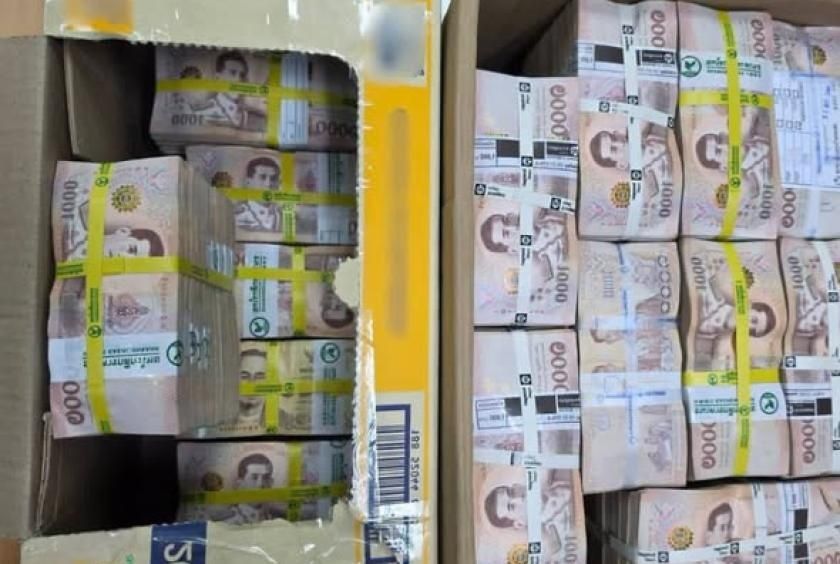
A Myanmar national faces serious charges after Thai customs officers at the Mae Sai border checkpoint intercepted an attempted large-scale cash smuggling operation on the Thai-Myanmar Friendship Bridge. The 31-year-old driver was detained while piloting a vehicle bearing Myanmar licence plates through the crossing point, where routine inspections by authorities led to the discovery of more than 23 million baht in Thai currency concealed within innocuous food packaging.
The sophistication of the concealment method highlights a common tactic employed by organised smuggling networks operating across Southeast Asian borders. Customs officials found approximately 17 million baht in the opening of the first carton, which appeared to contain dried fish, while inspectors located an additional 6.023 million baht in a second carton ostensibly filled with potatoes. The Thai banknotes, predominantly in 1,000-baht denominations, had been methodically packed into plastic bags before being inserted into the food containers, a practice designed to evade detection at standard inspection points.
The Mae Sai crossing represents one of Thailand's busiest international checkpoints, processing significant daily traffic between the two nations. The border region has long served as a nexus for illicit financial flows, and this seizure underscores the persistent challenges that Thai authorities face in combating currency smuggling operations that may be connected to broader networks involving money laundering, sanctions evasion, or financing of illegal activities. The amount seized—equivalent to approximately US$689,077—suggests coordination at a level beyond opportunistic individual action.
Thailand's stringent foreign exchange control regulations explicitly prohibit the unauthorised movement of large sums of currency across international borders, a framework designed to prevent capital flight, combat organised crime, and maintain monetary stability. The alleged breach of both the Customs Act and foreign exchange legislation carries substantial legal consequences in Thailand, where violations can result in significant penalties and imprisonment. Authorities have pursued formal charges against the driver, who remains in custody at Mae Sai Police Station pending further judicial proceedings.
Investigators are now pursuing leads to identify potential accomplices and the broader network that may have orchestrated this smuggling attempt. The detention of a single driver typically signals the tip of a more extensive operation, and Thai law enforcement agencies are likely examining financial records, communication patterns, and supply chain documentation to trace the cash's origin and intended destination. Such investigations often reveal connections to multiple entities across both Thailand and Myanmar, potentially implicating individuals in positions of influence or business authority.
For Malaysian observers, this incident reflects the pervasive transnational nature of organised financial crime throughout Southeast Asia. Malaysia's own significant cross-border trade with both Thailand and Myanmar means that similar smuggling methodologies may be employed regionally, and Malaysian customs and financial intelligence units coordinate with Thai authorities on shared security concerns. The scale of detected operations typically represents only a fraction of successful smuggling attempts, suggesting that substantially larger volumes of currency move illicitly across Southeast Asian borders annually without detection.
The use of food commodities as cover for contraband highlights vulnerabilities in customs inspection regimes despite technological advances and training improvements. Mae Sai handles thousands of vehicles daily, and resource constraints mean that not every shipment receives thorough examination. This seizure demonstrates both that vigilance can yield results and that determined smugglers continuously adapt their methods to circumvent detection—a perpetual enforcement challenge.
The broader context suggests that currency smuggling operations often connect to deeper financial crimes. Large quantities of Thai baht leaving the country through informal channels may fund overseas operations, purchase assets beyond financial regulators' oversight, or represent proceeds from illicit activities being relocated for reinvestment or concealment. The driver's nationality and the direction of currency flow warrant examination of whether this constitutes capital flight from Myanmar or represents Thai currency being extracted for specific purposes abroad.
Thailand's government has intensified efforts to combat currency smuggling as part of broader anti-money laundering and financial crime initiatives, recognising that effective border security requires not merely physical inspection but also intelligence-led enforcement targeting organised networks. The cooperation between customs officials, police, and financial intelligence units at Mae Sai reflects this coordinated approach, though the volume of trade moving through the checkpoint perpetually challenges capacity and effectiveness.
Looking forward, this arrest may prompt enhanced scrutiny of food commodity exports and imports through Mae Sai, potentially affecting legitimate trade flows in the short term. Regional traders and logistics operators should anticipate stricter inspection protocols that, while necessary for enforcement, may increase processing times and costs at this critical trade gateway. The case also reinforces broader lessons about the need for multi-agency cooperation, intelligence sharing, and public-private partnership to counter sophisticated smuggling networks that continuously evolve their operational methods to circumvent enforcement.

