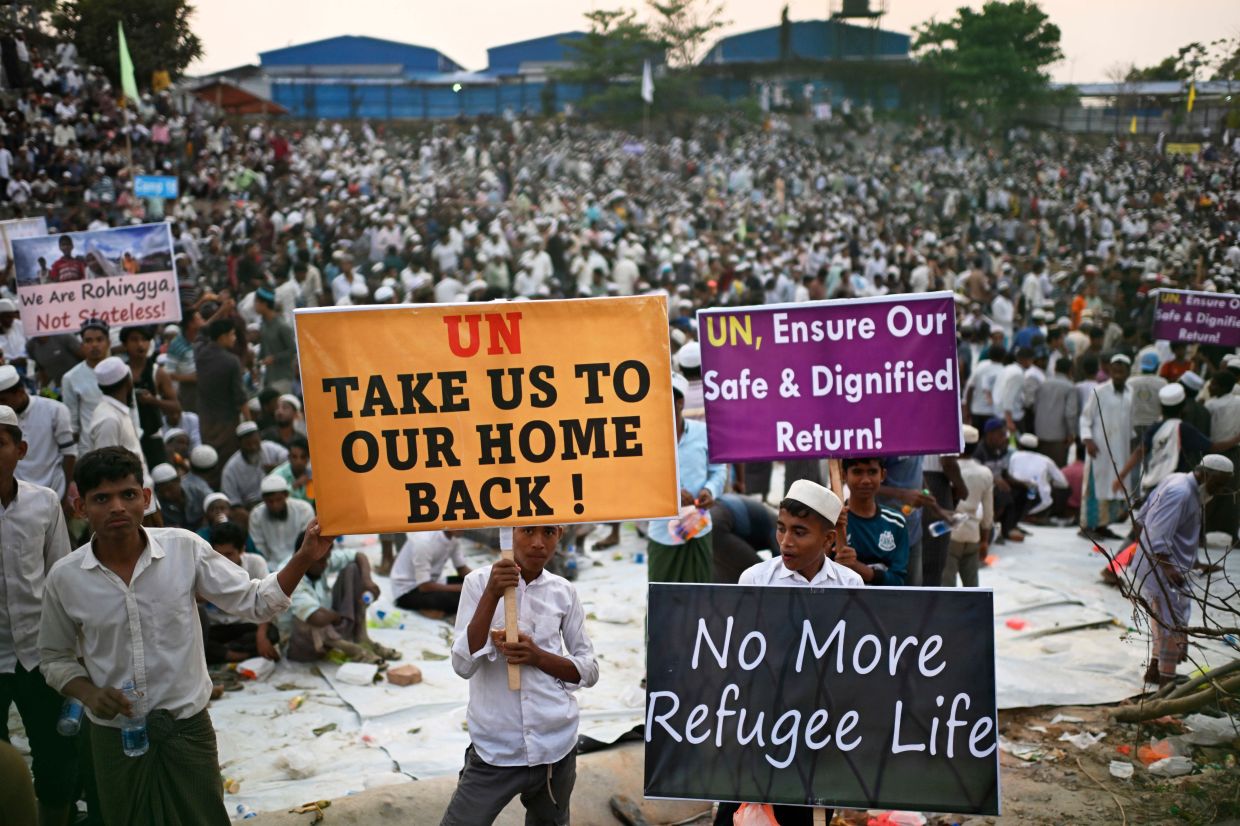
Myanmar's military-controlled government announced Saturday that it has verified more than 300,000 Rohingya refugees sheltering in camps across Bangladesh, designating them as former residents of western Rakhine state who may eventually be permitted to return home. The Foreign Affairs Ministry statement arrives as the humanitarian crisis marking the Rohingya displacement approaches its ninth anniversary, with hundreds of thousands remaining confined to sprawling camps in Bangladesh after fleeing Myanmar in August 2017 during a military offensive that followed insurgent attacks on security installations in Rakhine.
The 2017 military campaign proved catastrophic in scale and consequences. More than 700,000 Rohingya were driven across the border into Bangladesh within months, compounding an already substantial displaced population that had accumulated over decades through successive waves of communal violence and military-orchestrated persecution. The sudden mass displacement, coupled with credible accounts of widespread killings, sexual violence, and systematic destruction of villages, drew international condemnation. The United Nations and numerous human rights organizations characterized the operation as ethnic cleansing and genocide, assessments Myanmar's government has consistently rejected.
According to Myanmar's verification figures released through late July, authorities assessed 426,545 individuals from a list of 828,824 refugees provided by Bangladesh. Of those examined, 308,797 were determined to have originated from Rakhine state and therefore qualified under the framework for potential repatriation. The government stated that 113,507 people on the refugee list could not be verified through available documentation, while a further 4,241 individuals were identified as having participated in what Myanmar characterized as terrorist activities—likely references to the Arakan Rohingya Salvation Army (ARSA), the insurgent group that precipitated the 2017 crackdown.
Myanma's categorical refusal to recognize Rohingya as an ethnic minority remains fundamental to understanding the impasse. The government officially denies citizenship rights to the group, instead labelling them "Bengalis" to delegitimize their presence and suggest they are illegal migrants from Bangladesh. This nomenclature, deeply rooted in Myanmar's ethno-nationalist ideology, obscures a more complex historical reality of generations-long habitation and establishes a legal framework making repatriation politically unpalatable for military hardliners who view the Rohingya as demographic threats to Buddhist-majority Rakhine.
The government's statement regarding repatriation included a crucial conditional clause: Myanmar would accept verified former Rakhine residents only once security conditions stabilized sufficiently. This stipulation reflects genuine deterioration in Rakhine's security environment beyond the original 2017 conflict. Since the military coup in February 2021 that ousted Aung San Suu Kyi's elected government, Myanmar has descended into nationwide armed conflict between junta forces and diverse resistance movements. Rakhine experienced particularly acute violence beginning in 2023 when the Arakan Army, a powerful ethnic insurgent organization based in the region, launched major offensives against military positions, capturing substantial territory and further destabilizing the state where repatriation would occur.
A bilateral repatriation agreement signed between Myanmar and Bangladesh in 2018 envisioned a two-year process for orderly refugee return. The arrangement collapsed almost immediately given deteriorating security circumstances and Myanmar's apparent lack of political commitment. Successive diplomatic efforts have yielded minimal concrete progress. The Arakan Army now controls much of central and southern Rakhine, having systematically wrested territory from military control through sustained armed campaigns. With such fluid conflict conditions and no functioning local governance structures, prospects for safely receiving hundreds of thousands of returnees remain distant.
Disputes over repatriation figures themselves reveal the competing narratives surrounding the crisis. Myanmar's Foreign Affairs Ministry rejected international estimates suggesting over 1 million people were displaced, instead asserting that approximately 540,000 crossed into Bangladesh following the 2017 violence while over 200,000 remained in northern Rakhine state. These divergent numbers reflect fundamental disagreement about the original scale of persecution and continued population distribution—disagreements unlikely to be resolved given Myanmar's complete control of access to affected areas and international investigators' exclusion from the country.
Refugee camp conditions in Cox's Bazar, Bangladesh, have deteriorated markedly in recent years. International humanitarian funding has declined significantly as donor attention shifted toward other global emergencies. Unemployment remains endemic, education opportunities limited, and basic services chronically underfunded. These compounding hardships have driven thousands of Rohingya, increasingly desperate and lacking any foreseeable pathway to dignified resettlement, toward perilous maritime routes targeting Malaysia and Indonesia. Overcrowded fishing boats and jury-rigged vessels regularly depart from Cox's Bazar carrying refugee families, resulting in periodic drownings, capsizings, and human trafficking incidents that periodically surface in regional news cycles.
Malaysia has emerged as an unintended destination for these maritime crossings despite lacking formal refugee status protections. Malaysian Prime Minister Anwar Ibrahim stated in late July that Myanmar had committed to receiving 5,000 Rohingya currently residing in Malaysian detention facilities, framing the arrangement as part of a broader repatriation initiative. However, contradictory statements from Myanmar officials immediately complicated this narrative. Han Win Aung, a Foreign Ministry representative, told international media that Myanmar's repatriation program specifically targeted verified Myanmar nationals held in Malaysian detention centers and explicitly rejected broader acceptance of Rohingya populations. This contradiction between Malaysian government messaging and Myanmar's own clarifications underscored the fundamental disagreement about repatriation scope and conditions.
For Southeast Asian nations, the Rohingya crisis presents an evolving regional challenge. Malaysia and Indonesia have borne disproportionate humanitarian burdens absorbing maritime arrivals, yet lack the international resources or diplomatic leverage to pressure Myanmar toward genuine repatriation. Thailand, sharing a border with Myanmar, navigates complicated relations with the military junta while managing its own displaced populations. Vietnam and other ASEAN members have maintained relative silence, viewing the situation as Myanmar's internal matter despite humanitarian dimensions. ASEAN's consensus-based diplomacy has proven ineffective in addressing Myanmar's most acute human rights crises, including the Rohingya displacement.
The verification announcement, while appearing procedurally significant, likely represents minimal progress toward actual refugee return. Myanmar's government has demonstrated no genuine commitment to repatriate Rohingya despite international pressure and bilateral agreements. Military authorities view any large-scale Rohingya return as potentially destabilizing to Buddhist-majority Rakhine demographics and undermining the ethno-nationalist ideology underpinning junta rule. Unless Myanmar's security situation stabilizes dramatically—an unlikely prospect given ongoing Arakan Army advances and broader civil conflict—verification statistics will remain largely academic exercises rather than gateways to meaningful repatriation.
The ninth year of displacement finds Rohingya communities trapped in indefinite limbo. Bangladesh struggles under the humanitarian burden of hosting nearly 1 million displaced people in sprawling camps. Malaysia and Indonesia contend with maritime arrivals despite lacking burden-sharing mechanisms. Myanmar's government offers only rhetorical commitments contingent on improvements in security that appear increasingly distant. Regional diplomacy has yielded minimal progress. Without fundamental shifts in Myanmar's political trajectory or ASEAN's collective diplomatic posture, the Rohingya crisis will likely persist as one of the region's defining humanitarian failures, a testament to the limits of international humanitarian intervention in contested spaces where national sovereignty claims override obligations toward displaced populations.

