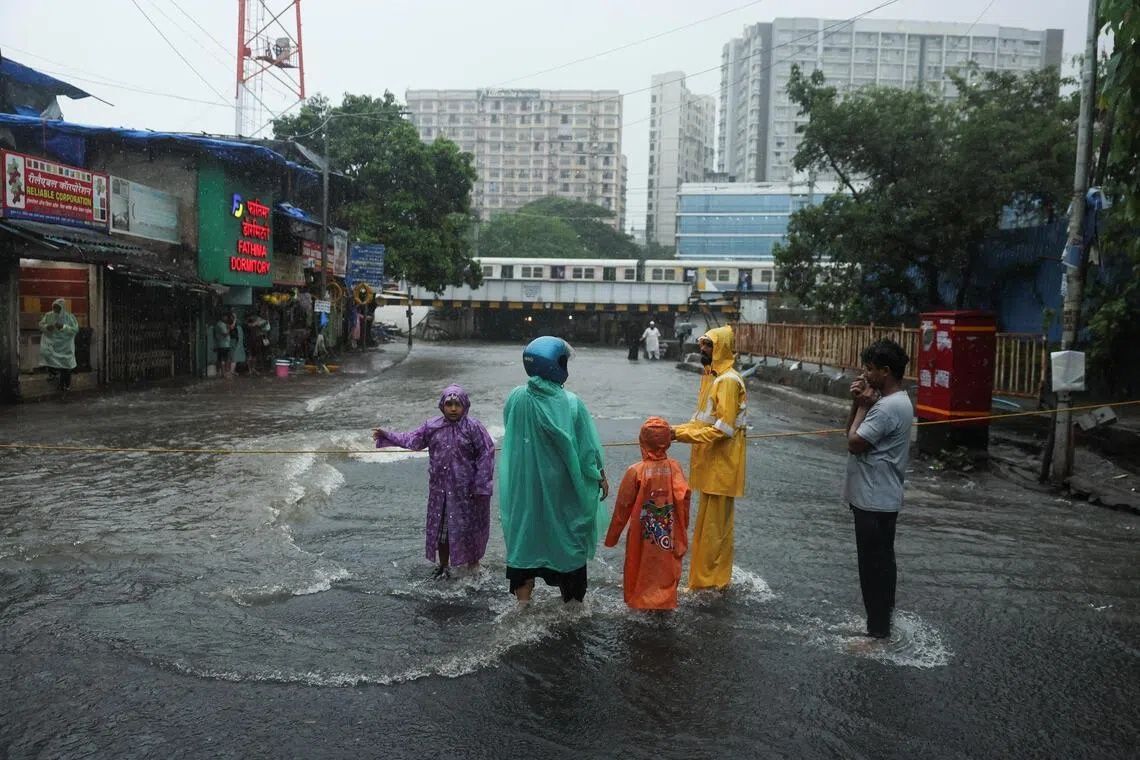
Mumbai's monsoon season has turned deadly, with two fatalities exposing significant vulnerabilities in the city's civic infrastructure and emergency response systems. An 11-year-old boy died after a tree uprooted by strong winds struck a school bus in Chembur, while a 60-year-old man fell into an inadequately secured manhole during heavy rainfall, triggering fierce political demands for systemic accountability rather than scapegoating lower-ranking officials. The India Meteorological Department's orange alert for July 3 signals that the city faces continued danger as heavy downpours persist across the metropolitan region.
The school bus incident on June 30 represents the type of preventable tragedy that haunts monsoon season in India's financial hub. The large tree crashed onto the vehicle carrying students from Universal High School and Tilak Nagar School, trapping multiple children inside. Emergency responders with specialised cutting equipment worked to extricate the victims, but despite their efforts, Vihan Shrivastav succumbed to injuries sustained in the collision. Other students were transported to Zen Hospital and Jain Hospital, underscoring how such incidents cascade through families and entire school communities. The tragedy immediately raised questions about whether pre-monsoon tree-trimming and hazard mitigation exercises conducted by municipal authorities had been adequate or merely performed as rubber-stamp formalities.
Government responses were swift but highlighted the political sensitivity surrounding such incidents. Maharashtra minister Ashish Shelar acknowledged the tragedy as unfortunate and stated that both the state government and the Brihanmumbai Municipal Corporation bore responsibility for supporting the bereaved family. However, his framing of action being taken against responsible officers suggested a tendency toward administrative reshuffling rather than structural reform. The minister's statement, whilst expressing sympathy, embodied the pattern many Indian municipalities follow—acknowledging responsibility whilst simultaneously deflecting deeper questions about systemic neglect.
MLA Rohit Pawar went further, meeting with the victim's family and emphasizing that accountability must extend beyond junior staff. He articulated a crucial distinction: punishing frontline workers while allowing senior officials who oversee policy and resource allocation to escape consequences perpetuates cycles of preventable tragedies. Pawar's insistence that senior officials face punishment reflected growing frustration among elected representatives that monsoon season deaths recur because underlying governance failures remain unaddressed. His critique of pre-monsoon inspections of roads, drains, and manholes highlighted a persistent pattern where such inspections appear conducted perfunctorily rather than rigorously, potentially creating a false sense of security.
The second fatality, occurring the next day in Sakinaka, exemplified another recurring danger. Aslam Isak Shaikh, aged 60, fell into an open manhole whose drainage cover had been removed for maintenance work. Despite the obvious hazard, authorities failed to implement adequate barricading around the opening. When Shaikh, distracted by a mobile phone conversation, encountered the uncovered manhole, rainwater flowing rapidly through the drainage system swept him away. Recovery of his body required a three-hour search operation, transforming a maintenance lapse into a tragedy affecting his entire family and the broader community. The incident invokes memories of similar preventable deaths that have occurred repeatedly across Indian cities during monsoon seasons.
MLA Vijay Wadettiwar responded by demanding criminal action against officials responsible for the maintenance failure, pointedly questioning whose responsibility it was to ensure proper barricading. His call for filing a First Information Report reflected frustration that civil negligence resulting in death often escapes criminal prosecution. When infrastructure failures cost lives, victims' families are typically offered nominal compensation whilst structural accountability remains elusive. Wadettiwar's demand represented a shift toward insisting that administrative lapses causing fatalities should trigger criminal investigation, not merely internal inquiries.
Mumbai's political establishment struggled to demonstrate that systemic change would follow these tragedies. Speaker Rahul Narwekar stated that the matter had been discussed in the Maharashtra Legislative Assembly and promised a detailed report, language that suggests bureaucratic motion rather than transformative action. Mumbai Mayor Ritu Tawde characterised the manhole incident as an administrative mistake—a euphemism that minimises the severity of supervision failures that cost a human life—and announced 10 lakh rupees in compensation for Shaikh's family. Whilst compensation provides some material relief, the amounts offered typically reflect how undervalued preventable deaths from infrastructure negligence remain in India's governance calculus.
Beyond the two deaths, the monsoon spell has created cascading disruptions across Mumbai's transport and commerce systems. Submerged roads have paralysed traffic across multiple neighbourhoods, and a truck overturning near the Kharghar Toll Plaza on the Sion-Panvel Highway created major congestion by blocking multiple lanes. Waterlogging in areas such as Dadra East and Sion Gandhi Market left commuters stranded in protracted traffic jams. These disruptions reveal how monsoons overwhelm civic infrastructure designed for drier conditions, suggesting that Mumbai's development has outpaced its drainage and flood management capacity.
The India Meteorological Department's orange alert indicated that heavy rainfall would continue for the next 24 hours, prompting authorities to advise residents to avoid unnecessary travel. Emergency teams worked to clear flooded roads and remove fallen trees and debris, activities that consume resources and manpower but remain fundamentally reactive rather than preventive. This reactive posture—deploying teams to clear debris after disasters rather than implementing comprehensive pre-monsoon maintenance—characterises urban disaster management across India.
For Malaysian and Southeast Asian observers, Mumbai's monsoon crisis illustrates risks that cities across the region face as urbanisation accelerates. Kuala Lumpur, Bangkok, and other regional metropolises experience their own seasonal inundation challenges, raising questions about whether their civic infrastructure will prove more resilient than Mumbai's when climate patterns intensify rainfall. The political dynamics in Mumbai—where responsibility is acknowledged but systemic accountability remains elusive, and compensation substitutes for structural reform—resonate across the region. These incidents underscore that merely issuing weather alerts and advising residents to avoid travel does not constitute adequate disaster preparedness; cities must invest in drainage systems, tree maintenance, and infrastructure oversight designed to prevent preventable deaths.
The pressures building across Mumbai's political establishment suggest that such incidents, when repeated often enough, eventually catalyse structural change. However, the trajectory from tragedy to systemic reform typically unfolds slowly and unevenly, with short-term political memory fading before genuine transformation occurs. For residents enduring monsoons across Asia's sprawling cities, the pattern remains depressingly consistent: tragedies occur, investigations commence, compensation is offered, promises of action multiply, and the underlying infrastructure deficits persist until the next monsoon season brings fresh casualties. Mumbai's current crisis illustrates both the urgency of reform and the structural obstacles that prevent rapid implementation of solutions.

