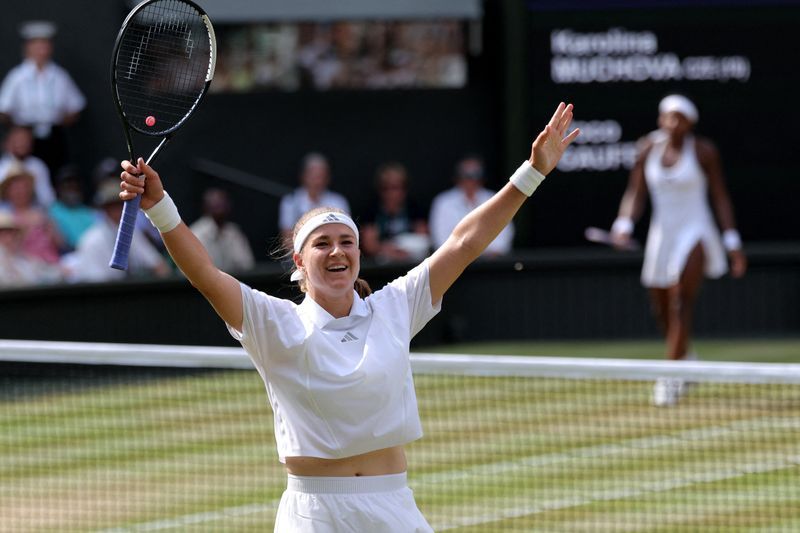
Karolina Muchova of the Czech Republic etched her name into Grand Slam history on Wednesday, dispatching American seventh seed Coco Gauff 6-2 1-6 7-6 (12-10) in a pulsating semi-final encounter at the All England Club. The victory marks Muchova's maiden appearance in a Grand Slam championship final, achieved through extraordinary mental fortitude as she clawed back from the brink of defeat by saving a match point during a marathon deciding set tiebreak that lasted well over two hours.
Muchova's breakthrough comes at a remarkable moment for Czech tennis, particularly on the women's side of the sport. Should her compatriot Linda Noskova overcome Ukrainian Marta Kostyuk in Thursday's second semi-final, the Wimbledon championship could be contested entirely between players from the Czech Republic—a scenario that would mark the first all-Czech women's final at any Grand Slam tournament. The achievement would further cement the nation's resurgence as a tennis powerhouse, following Marketa Vondrousova's triumph at the championships in 2023 and Barbora Krejcikova's dominant 2024 campaign.
Surprisingly, Muchova's passage through to Saturday's final represents a considerable personal conquest given her acknowledged difficulty adapting to grass court conditions. The Czech player has previously disclosed that competing on the surface requires intensive medical intervention, relying on a substantial pharmaceutical arsenal including numerous pills, sprays, and specialised eyedrops simply to function competitively on Wimbledon's hallowed turf. This vulnerability makes her performance against Gauff all the more impressive, demonstrating exceptional technical and tactical mastery despite the environmental challenges posed by both the surface itself and Thursday's stifling heat conditions on Centre Court.
The opening set showcased Muchova's superior court positioning and variety during the blistering afternoon. Breaking Gauff's serve twice—in the third and fifth games—she quickly established dominance, with the American's frustration evident when a wayward forehand crashed into the back hoardings. Muchova's aggressive serving prowled throughout the set, culminating in an impressive 111 mph ace that secured the opener at 6-2 and suggested this would be a comfortable victory.
Gauff, however, demonstrated the resilience that has become her defining characteristic throughout this tournament. The American's journey to the semi-finals had already been extraordinary, requiring her to navigate four consecutive three-set matches to reach this stage—a gruelling physical and mental ordeal that would have destroyed lesser competitors. Rather than capitulate when Muchova seized control, Gauff regrouped completely, reversing her fortunes by breaking serve on her ninth attempt after squandering her initial eight opportunities. This breakthrough proved transformative, enabling her to construct a commanding 5-1 advantage that ultimately produced a second set rout at 6-1, with her mother erupting in celebration from the player's box as the momentum shifted decisively.
The third set developed into a masterclass of aggressive baseline tennis from both competitors. With one-sided sets behind them, Muchova and Gauff engaged in a captivating display of modern women's tennis, exchanging ferocious forehands and exquisitely constructed backhands in a sustained rally that mesmerised spectators. The set remained tightly contested, with neither player able to establish the separation required for a decisive breakthrough, ultimately forcing a tiebreak that would determine the championship.
The decisive tiebreak itself became the defining moment of the match and arguably of Muchova's career to date. Gauff engineered two break point opportunities that would have positioned her at 5-4 with significant momentum, yet Muchova produced an extraordinary escape, refusing to be denied. The Czech player unleashed an outrageous diving volley winner and followed with a perfectly executed lob to create her own match point at 10-9. When that opening evaporated, she demonstrated ice-cold composure, converting her second match point when Gauff's forehand drifted into the net, concluding the two-hour 35-minute contest with arms aloft in triumph.
For Malaysian and Southeast Asian tennis enthusiasts, Muchova's achievement represents an instructive study in tournament resilience and grasscourt adaptation. Her ability to overcome both physiological challenges and the devastating momentum shifts generated by Gauff's second-set comeback offers valuable lessons for aspiring players in the region working to develop consistency across different surfaces. The performance equally highlights the unpredictability of Grand Slam tournaments, where seeding and expectations frequently collapse against superior will and tactical intelligence. Muchova's path to the final, though unconventional and hard-fought, demonstrates that Grand Slam finals are ultimately claimed through earned, not inherited, victories.
The result also carries broader implications for tennis parity. Gauff, seeded seventh, entered Wimbledon as a genuine championship contender with recent form and trajectory suggesting she might finally convert her obvious talent into major silverware. That she fell short against an unseeded Czech player who essentially required pharmaceutical intervention to survive on grass speaks to the tournament's inherent unpredictability and the considerable depth of talent now competing at the sport's highest echelon. For Asian players aspiring to reach similar heights, the lesson remains clear: Grand Slam success demands not merely talent but also tactical sophistication, mental resilience through adversity, and the willingness to battle through seemingly insurmountable obstacles across multiple rounds and surfaces.

