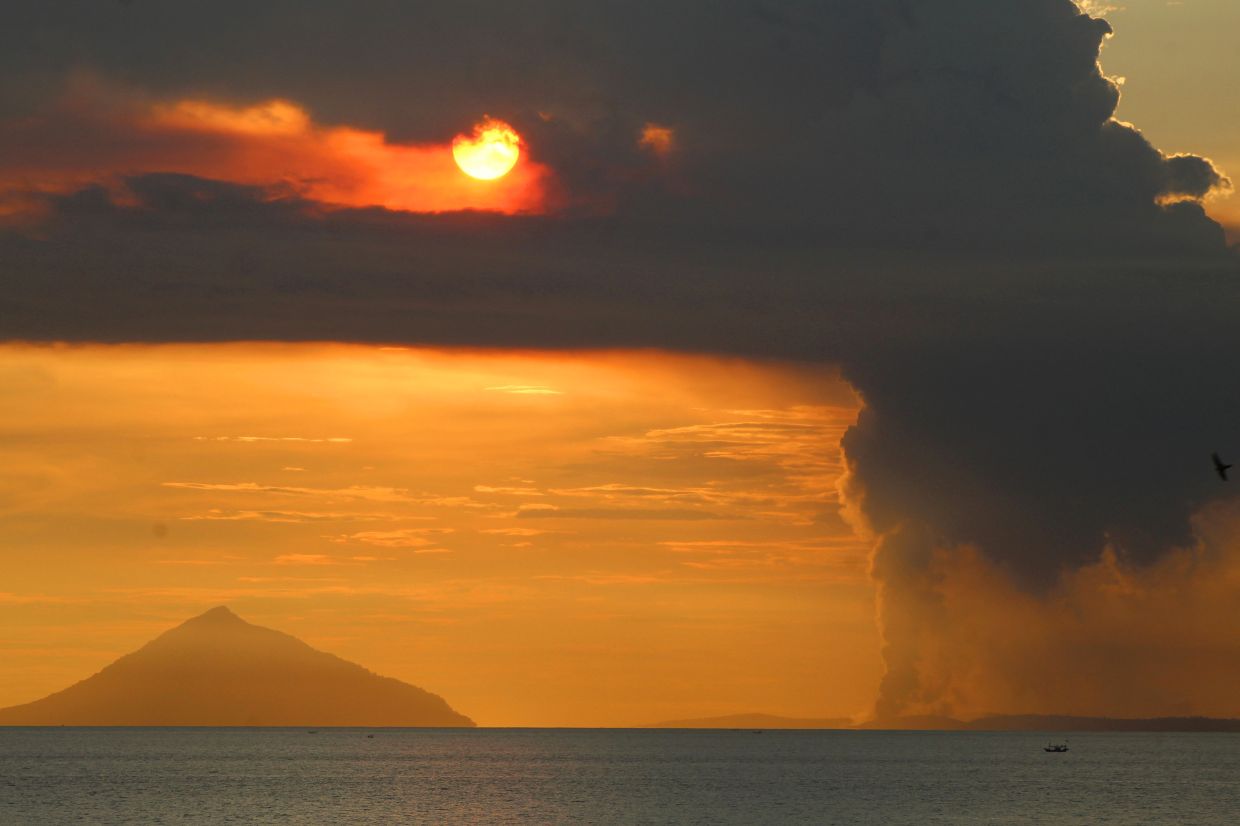
Mount Anak Krakatau, the volcanic island sitting in Indonesia's strategically important Sunda Strait, erupted on Tuesday morning, demonstrating the continued instability that has characterised the volcano since early June. The eruption at 8:21 a.m. sent a dense column of gray ash soaring 100 metres into the sky, with seismic monitors recording a maximum amplitude of 11 millimetres during the 15-second event. The ash plume drifted north-westward from the crater, visible across the surrounding waters and islands that form one of Southeast Asia's busiest maritime corridors.
Indonesia's Geological Agency of the Energy and Mineral Resources has been tracking the volcano's behaviour with increasing concern. What began as isolated tremors in mid-June has escalated dramatically into a pattern of sustained eruptive activity. Between June 18 and 19, monitoring stations recorded more than 50 seismic events daily, a figure that nearly doubled to an average of 97 events per day during the period from June 16 to July 2. This marked acceleration prompted officials to escalate their response, with the first eruption of this current eruptive phase occurring on Thursday, to be followed by four additional eruptions in quick succession.
Reacting to the worsening volcanic indicators, Indonesia's Geological Agency elevated Mount Anak Krakatau's status from Level II (Alert) to Level III (Watch) on Friday, positioning the volcano at the second-highest tier of the country's four-level volcanic alert classification system. Andi Suwardi, head of the Mount Anak Krakatau Observation Post based in South Lampung, emphasised that despite the rising alert level, the volcano's status remained static in terms of immediate threat designation. However, he stressed that round-the-clock surveillance teams at the observation post continue monitoring critical parameters including ash plume altitude and seismic activity to detect any further deterioration.
The government has implemented a three-kilometre exclusion zone encompassing the volcano's crater area, effectively closing the immediate vicinity to all civilian activity. This precautionary measure reflects lessons learned from the volcano's catastrophic 2018 eruption, when a sudden flank collapse triggered a devastating tsunami that claimed at least 429 lives and injured more than 7,200 people across southern Sumatra and western Banten. Yet enforcement remains challenging in these economically vital waters, where fishermen and tourism operators continue venturing into restricted areas in pursuit of livelihoods, attempting to evade monitoring authorities.
The economic dimensions of the exclusion order present a genuine hardship for Indonesia's maritime communities. South Lampung Regent Radityo Egi Pratama acknowledged the genuine difficulties facing fishing communities and tourism operators whose incomes depend entirely on access to the waters surrounding Mount Anak Krakatau. Nevertheless, he reinforced government messaging that temporary economic sacrifice remains preferable to the catastrophic human and material costs that could accompany an unexpected major eruption. His appeals attempted to balance compassion for struggling communities with the non-negotiable requirement of public safety, though the competing pressures highlight tensions between disaster preparedness and economic survival in volcanic regions.
Understanding the current volcanic context requires grasping Mount Anak Krakatau's extraordinary history. The island itself emerged from the ocean in 1927, rising from the caldera left behind by the monumentally destructive eruption of Mount Krakatau in 1883. That eruption ranks among the most catastrophic natural disasters ever recorded, with the explosion and subsequent tsunamis killing approximately 36,000 people across the broader region. The 1883 cataclysm ejected such enormous quantities of volcanic material into the atmosphere that it measurably disrupted global weather patterns and climate conditions for years afterward, darkening skies across multiple continents.
The emergence of Anak Krakatau, literally the "Child of Krakatau," represents nature's remarkable capacity for regeneration within zones of extreme geological danger. Over the past century, the volcano has grown substantially, building itself higher and wider through successive eruptive phases. Yet this growth trajectory remains interrupted by extended periods of dormancy, making the volcano's awakening cycles difficult to predict with precision. The transition from relative quiescence since the last major activity to the current heightened phase illustrates how volcanic systems can rapidly shift from stable to unstable configurations, sometimes with limited warning.
For Malaysian and broader Southeast Asian observers, Mount Anak Krakatau's behaviour merits attention on multiple grounds. The Sunda Strait represents a crucial maritime chokepoint through which enormous volumes of regional and global commerce flow daily. Any major volcanic event capable of generating tsunamis or substantially disrupting air quality could have immediate ripple effects throughout the region. The 2018 tsunami demonstrated that Mount Anak Krakatau retains genuine capacity for sudden, large-scale violence despite its relatively modest size compared to other Indonesian volcanoes. Regional maritime authorities maintain coordination protocols to manage such contingencies, yet preparedness remains an ongoing challenge.
The volcano's present behaviour also underscores the limitations of scientific forecasting regarding volcanic systems. Monitoring teams employ sophisticated instrumentation to detect shifts in seismic activity, gas emissions, and ground deformation, yet predicting precisely when or whether escalating activity will culminate in dangerous eruptions remains fundamentally uncertain. The distinction between elevated volcanic activity and imminent catastrophic eruption often becomes clear only retrospectively. This scientific uncertainty translates into operational difficulty for authorities attempting to calibrate responses that protect public safety without imposing excessive restrictions on communities whose survival depends on resource extraction and tourism.
Movement toward higher alert levels typically prompts increased monitoring intensity and expanded exclusion zones, yet enforcement against economically desperate populations presents genuine challenges. The observation post's 24-hour surveillance teams represent a vital early warning capability, but monitoring capacity ultimately depends on public compliance with safety directives. When volcanic exclusion zones persist across extended timeframes without major incidents, the psychological and economic pressure to gradually resume normal activities intensifies among affected communities. This dynamic has played out repeatedly at volcanic sites worldwide, creating persistent tensions between geological hazard management and human economic necessity.
Looking forward, Indonesia's volcanological community faces the familiar challenge of maintaining heightened alert status and exclusion enforcement even as days pass without dramatic new eruptions. Public attention typically wanes when crises appear to stabilise, yet volcanic systems operate on timescales and logic fundamentally disconnected from human economic cycles. The Geological Agency must balance transparent communication about actual risks against creating alarm fatigue that could reduce public compliance with crucial safety measures. For Indonesian authorities and the communities residing near volcanic zones, the coming weeks represent a critical period for observing whether Mount Anak Krakatau's current eruptive phase continues escalating or gradually subsides into renewed dormancy.

