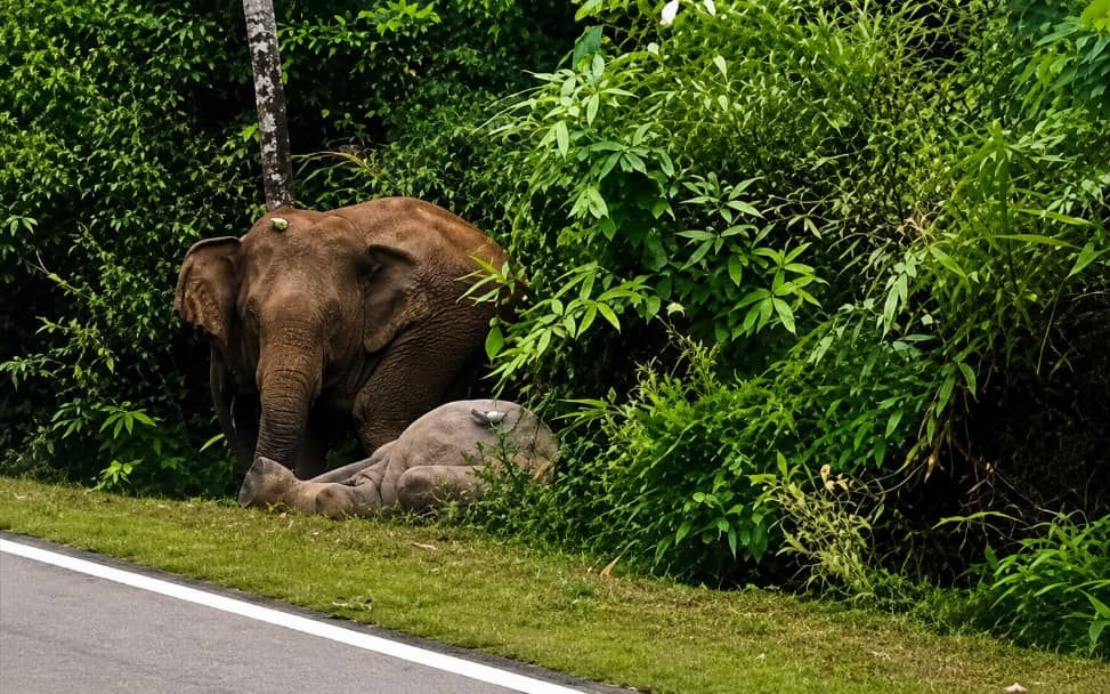
A tragic incident in Johor's Mersing district has reignited concerns about human-elephant conflict in Malaysia, as a grief-stricken mother elephant stood guard over her dead calf for seven hours after the young animal was fatally struck by a vehicle in the early hours of July 1. The emotional scene, captured in videos that swiftly circulated across social media platforms, drew haunting parallels to the widely-publicised Gerik incident from Mother's Day last year, which had similarly moved Malaysians and sparked discussions about wildlife safety and motorist responsibility in elephant corridors.
The collision occurred at approximately 2.28 am along Jalan Felda Nitar, when a Perodua Bezza struck the young elephant. Johor's Department of Wildlife and National Parks, known locally as Perhilitan, received notification of the tragedy at around 8.30 am and promptly deployed a team of four personnel to investigate the scene. Upon arrival, officers confirmed that the deceased calf was a female elephant, approximately five years old, measuring roughly 150 centimetres in body length. The animal bore characteristic measurements including front footprint width of 11 inches and rear footprint width of 14 centimetres, with no visible tusks. The identity of the bereaved mother was established through her connection to the Jamaluang-Mersing population grouping.
The mother's unwillingness to abandon her offspring reflected the deeply social nature of elephant herds and their maternal bonds, a behaviour that has long fascinated wildlife researchers and has underscored the emotional complexity of these intelligent creatures. Rather than fleeing to safety, the adult elephant remained steadfastly at the carcass, a poignant display of maternal attachment that resonated with observers familiar with similar documented incidents across Asian elephant populations. The extended seven-hour vigil highlighted the psychological impact such traumatic events have on elephant families, and the challenges these impacts create for both the animals and wildlife management authorities.
The accident's human cost extended beyond the loss of wildlife. The driver, a 31-year-old man, found himself in a life-threatening situation when his vehicle careened after impact and plummeted into a five-metre-deep ravine. He sustained significant leg injuries and required rescue by the Fire and Rescue Department. The incident thus exemplified the hazardous nature of night-time travel through wildlife corridors, where reduced visibility compounds the inherent dangers to human motorists who may have limited time to react to large animals crossing roadways unexpectedly.
Perhilitan's response included mobilising the Elephant Capture Unit from the Johor Elephant Sanctuary to facilitate the mother's safe return to the forest. After careful management of the situation, officers successfully guided the grieving elephant away from the accident scene and back towards natural habitat. The calf's remains were subsequently interred in the vicinity, allowing for a respectful disposal of the carcass while minimising further disturbance to the bereaved mother. The department committed to intensified patrols throughout the night and the following day to monitor the mother elephant's welfare and discourage her from returning to the traumatic location.
The recurrence of this tragedy underscores the ongoing tension between Malaysia's expanding road infrastructure and the conservation of elephant populations that depend on traditional migration routes. Despite prior installation of warning signage indicating elephant crossings in the area, the incident occurred during darkness when visibility is severely compromised. Perhilitan's advisory to motorists emphasised the critical need for heightened caution in these zones, particularly during nocturnal hours when elephants are more likely to be active on the move.
The comparison to the Gerik incident of May 11 last year inevitably invites reflection on progress—or lack thereof—in mitigating human-elephant conflict. In that earlier tragedy, a young elephant became trapped beneath a container lorry after being struck, while its mother was observed attempting to push the vehicle, seemingly in a desperate bid to free her offspring. That incident captured international media attention and mobilised widespread public empathy, yet elephant mortalities from vehicle strikes have continued at a troubling pace. The Gerik incident became a watershed moment in Malaysian consciousness regarding wildlife protection, yet fundamental safeguards remain inadequate.
For Malaysia and the Southeast Asian region more broadly, these recurring tragedies highlight the inadequacy of current mitigation strategies. While warning signs exist, they provide only passive notification to drivers already approaching hazardous zones at night. More robust solutions—including wildlife underpasses and overpasses that enable safe corridor passage, coupled with reduced speed limits and increased enforcement through elephant crossing zones—remain underdeveloped in most Malaysian locations where human infrastructure intersects with elephant habitat. The cost-benefit analysis of comprehensive wildlife infrastructure investment appears increasingly justified when measured against the emotional and ecological toll of preventable fatalities.
The plight of the mother elephant in Mersing also raises questions about the broader ecosystem implications of targeting individual tragedies without addressing systemic vulnerabilities. Each killed calf represents not merely an emotional tragedy but a demographic loss for elephant populations already under considerable pressure from habitat loss and fragmentation. The Jamaluang-Mersing group, to which both animals belonged, constitutes a vulnerable population unit whose viability depends on reproduction rates that these fatal incidents directly compromise.
Authorities and conservation advocates face mounting pressure to move beyond reactive incident management towards proactive redesign of high-risk corridors. The mother elephant's seven-hour vigil, preserved in video and shared across networks, serves as a powerful reminder to policymakers and the general public alike that the cost of inaction extends beyond statistics and ecosystem services into the realm of observable animal suffering. For Malaysian drivers and residents in elephant habitat regions, the incident reinforces the urgency of treating wildlife crossing zones with the seriousness they demand—not merely as occasional hazards to navigate, but as critical thresholds where human alertness and restraint directly determine whether wild families survive their necessary journeys.

