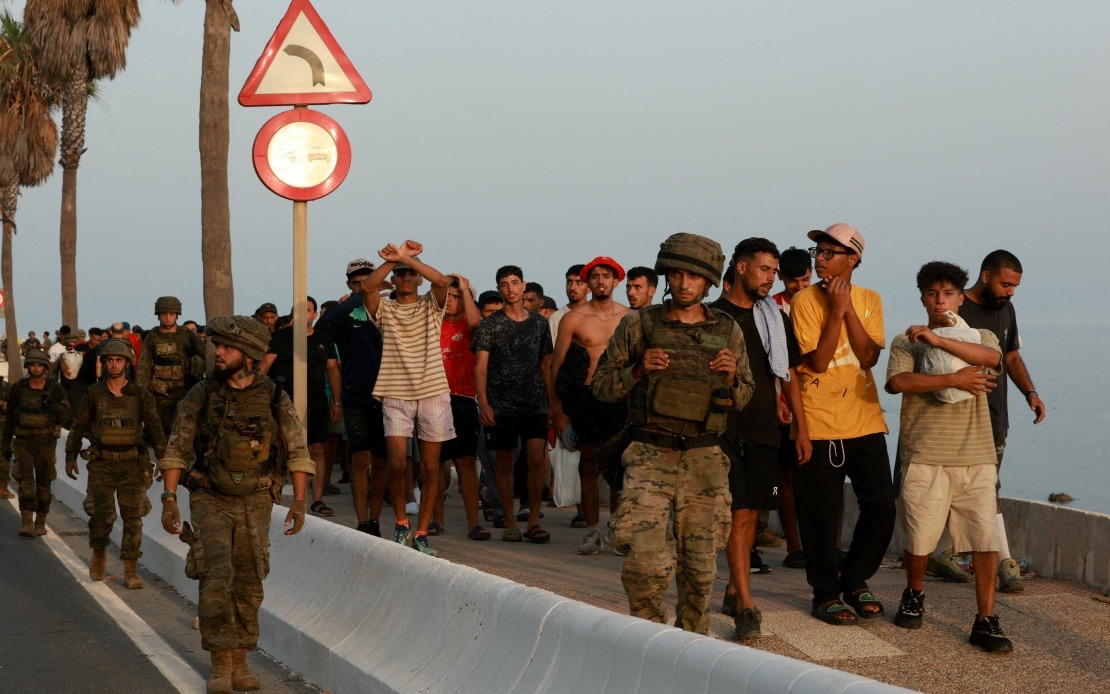
Morocco's government has pinpointed social media misinformation and organised human trafficking as the principal drivers behind tens of thousands of migrants attempting entry into the Spanish enclave of Ceuta in recent days, according to statements from the country's Interior Ministry reported by the German Press Agency. Officials indicated that false narratives circulating online, combined with systematic smuggling operations, created conditions for the unprecedented surge in crossing attempts that overwhelmed authorities on both sides of the border.
The Interior Ministry elaborated that migrants were operating under a fundamental misunderstanding rooted in how they had interpreted a ruling from Spanish courts. This legal decision, according to Moroccan officials, had been widely misrepresented across social platforms to suggest that individuals could enter European territory without facing immediate deportation or detention. Such misreporting appears to have emboldened groups to attempt crossing despite the substantial risks involved and historical patterns of enforcement.
The scale of the crossing attempt was staggering relative to the size of Ceuta itself. Spanish estimates placed the total number of migrants who successfully entered Ceuta between late July and early August at somewhere between 50,000 and 60,000 individuals, arriving within only a handful of days into a territory with a total population of approximately 85,000 residents. The sudden demographic shock posed logistical and administrative challenges for local authorities tasked with processing, housing, and determining the status of such numbers.
Moroccan authorities offered a somewhat lower accounting, claiming approximately 40,000 migrants had entered Ceuta specifically, while an additional 1,135 had attempted entry into the neighbouring Spanish enclave of Melilla. Moroccan officials asserted that all migrants reaching Melilla were promptly returned, suggesting a more effective containment operation at that location compared to the situation in Ceuta.
The humanitarian cost of the crossing attempts created a stark point of contention between Rabat and Madrid. Morocco's official death toll stood at 11 individuals who perished during the attempted crossings, yet Spanish authorities reported a significantly higher figure of at least 72 deaths. This discrepancy of more than six-fold raised questions about transparency, verification procedures, and the actual scope of casualties in the sea crossing or at border points.
Moroccan authorities indicated they were engaged in ongoing coordination with Spain to clarify the full extent of deaths and injuries connected to the incident. The ministry stated it was working to verify additional fatality reports and to establish the identities and nationalities of deceased individuals, a process complicated by the chaotic nature of the mass crossing and the involvement of multiple nationalities among the migrant populations.
The incident underscores the persistent tensions between Morocco and Spain over migration management, a perennial flashpoint in the broader Mediterranean migration crisis affecting Europe. Ceuta and Melilla, as Spanish territories on the African mainland, serve as pressure points where African aspirations to reach European employment and opportunities collide with European border enforcement policies. The reliance on social media to coordinate crossing attempts and the apparent effectiveness of online misinformation in generating false expectations represents a modern dimension of migration pressure that authorities have struggled to counter effectively.
For Malaysia and other Southeast Asian nations observing these dynamics, the situation in Ceuta illustrates how migration pressures, often rooted in economic disparity and limited opportunity in origin countries, can be amplified and weaponised through digital channels. The role of human trafficking networks in exploiting migrant desperation remains a concern that transcends geographic boundaries, as demonstrated by ongoing smuggling operations in the Straits of Malacca and Bay of Bengal.
The competing casualty figures between Moroccan and Spanish authorities suggest that establishing accurate information during migration crises remains challenging, with potential implications for humanitarian response and future policy formulation. The incident also demonstrates how court rulings, when misinterpreted or weaponised through social media, can create widespread behavioural changes among vulnerable populations seeking to improve their circumstances through irregular migration.

