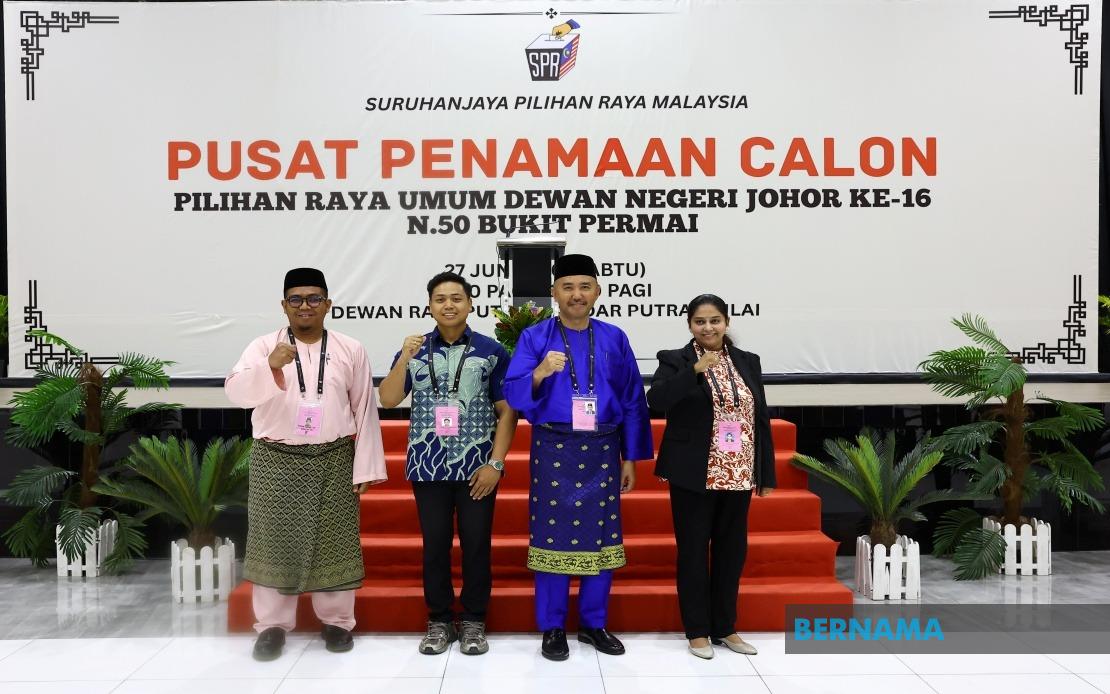
The 16th Johor state election is shaping up to deliver a competitive battleground in Bukit Permai, where sitting assemblyman Datuk Mohd Jafni Md Shukor of Barisan Nasional must fend off opposition from three rival camps seeking to claim the constituency. The nomination process concluded on June 27 at the Dewan Raya Putra nomination centre in Bandar Putra, Batu Pahat, with returning officer Afzan Azhari confirming the full slate of candidates contesting the seat.
Mohd Jafni's challengers reflect the increasingly fragmented Malaysian political landscape. Mohamad Shafwan Ani represents Pakatan Harapan's bid to reclaim ground in this Johor stronghold, while M. Lina Manoh carries the Perikatan Nasional banner in a contest that demonstrates PN's determination to expand its footprint beyond its traditional bases. Muhammad Aidil Riduan Mohd Yusof completes the field as Parti Bersama Malaysia's standard-bearer, adding another layer of complexity to voter choices in the constituency. The presence of four candidates underscores how Malaysia's fractured opposition landscape has created openings even in seats where a single dominant party once held sway.
Pakatan Harapan's campaign received a notable show of support when Johor DAP chairman Teo Nie Ching arrived at the nomination centre early on June 27 to accompany Mohamad Shafwan. The gesture highlighted PH's commitment to contesting the seat with resources and visibility, suggesting the coalition views Bukit Permai as winnable territory in what remains a traditionally Barisan-leaning state. Such high-profile endorsements carry symbolic weight in Malaysian electoral contests, signalling to grassroots supporters that party leadership considers a particular seat strategically important.
The incumbent's track record provides him with a tangible foundation for re-election. In the 2022 state election, Mohd Jafni secured victory with a majority of 4,755 votes in what was also a four-cornered contest. That result demonstrates both his personal appeal to constituents and BN's residual strength in Bukit Permai, though a margin of roughly 4,700 votes is hardly commanding in contemporary Malaysian politics where voter sentiment can shift appreciably between election cycles. The fact that he faced a similar multi-candidate scenario two years ago and prevailed suggests familiarity with the dynamics required to win when the opposition vote fragments across multiple contenders.
However, political analysts must account for shifting dynamics since 2022. The Malaysian political environment has grown increasingly volatile, with voter behaviour proving unpredictable as party allegiances continue to erode in favour of personality-driven choices and local grievances. Additionally, the emergence of new political vehicles like Bersama represents an attempt to appeal to voters fatigued by the traditional coalition structure, potentially cannibalising support from established opposition parties. The trajectory of such newer entrants remains uncertain, but their mere presence complicates predictive modelling for contests like Bukit Permai.
The Election Commission's timeline for the Johor polls offers candidates limited opportunity to campaign. Early voting is scheduled for July 7, with election day itself arriving on July 11. This compressed calendar means political machinery must mobilise rapidly and efficiently to reach voters, placing a premium on ground-level organisation and existing party networks. For the incumbent, these constraints may offer a modest advantage, as Barisan Nasional typically commands more developed electoral infrastructure compared to newer political entities, though Pakatan Harapan's experience in recent electoral cycles means it is unlikely to be outmanoeuvred organisationally.
Bukit Permai's demographic and socioeconomic composition will likely prove decisive in determining the outcome. The constituency's voter profile will determine which candidate's messaging and policy platform resonate most effectively. Whether bread-and-butter economic concerns dominate voter thinking, or whether national political narratives drive decision-making, remains an open question with major implications for all four candidates. Local issues particular to the Bandar Putra and surrounding areas—infrastructure needs, service delivery, community development—may ultimately prove more influential than national party dynamics in determining voter preference.
For Barisan Nasional, retaining Bukit Permai carries strategic significance beyond the single seat. Johor has remained a BN stronghold, yet successive elections have demonstrated that even traditional support bases cannot be taken for granted. The state's political trajectory directly influences national calculations about government stability and coalition mathematics at the federal level. A loss in Bukit Permai, whilst not catastrophic, would reinforce perceptions that BN's electoral reach continues to contract, potentially emboldening opposition parties and complicating the party's broader strategic positioning ahead of future general elections.
For Pakatan Harapan, victory in Bukit Permai would represent meaningful progress in Johor, a state where the coalition has struggled to achieve significant breakthroughs despite its federal-level influence. The appointment of senior party figures like Teo Nie Ching to accompany their candidate indicates PH believes the seat offers genuine competitive potential. A successful outcome would demonstrate that PH's opposition credentials continue to resonate with voters seeking alternatives to BN dominance, particularly important given the coalition's mixed electoral fortunes since the 2022 general election.
Perikatan Nasional's presence in Bukit Permai forms part of a broader strategy to position itself as a third force in Malaysian politics. PN's performance across the Johor elections will substantially influence its trajectory as a national political entity. While the coalition's core support remains concentrated in certain states and demographics, results in constituencies like Bukit Permai provide evidence of whether PN can expand beyond its traditional bases and establish itself as a credible alternative to BN and PH dominance.
Parti Bersama Malaysia's participation, though it enters the contest as a genuine outsider, nonetheless reflects Malaysian voters' receptiveness to new political options. The party's performance across multiple constituencies in the Johor election will indicate whether it can establish viable footholds in particular areas, potentially positioning itself for greater prominence in future electoral contests. The presence of such new entrants, even when they finish poorly, testifies to the underlying dynamism and fluidity of Malaysian electoral politics.
The four-way contest in Bukit Permai epitomises contemporary Malaysian state election dynamics—no single dominant force, multiple credible challengers, and genuine uncertainty about outcomes. Voters will make their choice on July 11, deciding whether continuity under the incumbent or change represented by one of three alternatives best serves their interests and reflects their political preferences.

