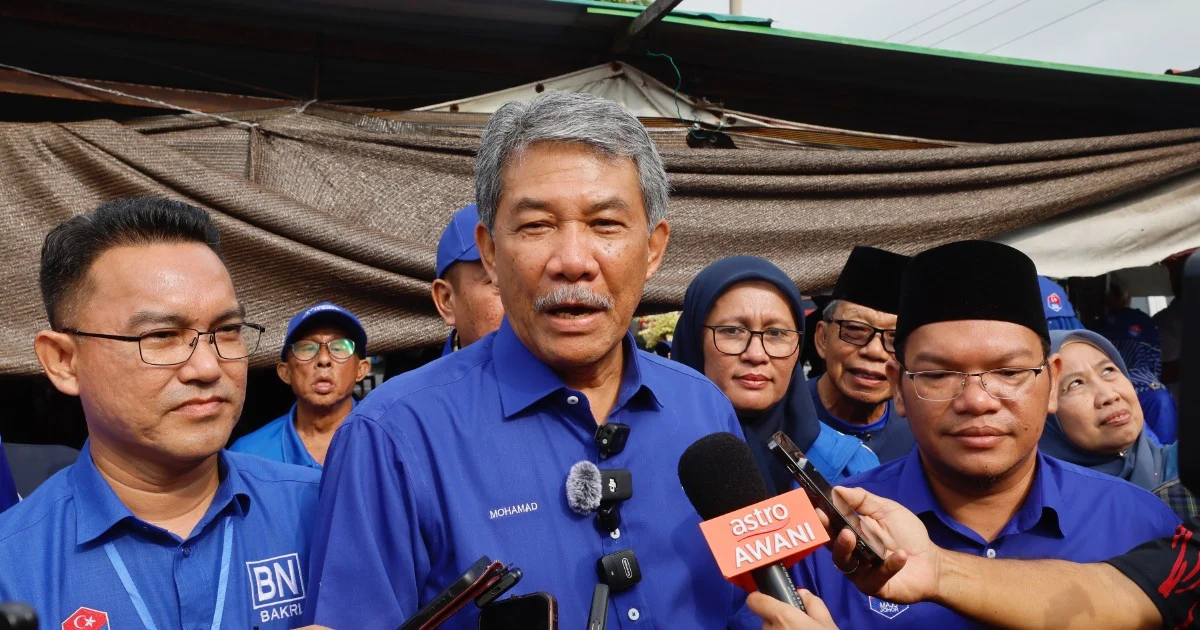
The political temperature between Malaysia's ruling coalition and opposition escalated sharply when Barisan Nasional deputy chairman Datuk Seri Mohamad Hasan delivered a sharp rebuke to Democratic Action Party secretary-general Nga Kor Ming, essentially calling for his resignation in response to statements made about the Johor election. Speaking in Muar, a stronghold where BN maintains considerable influence, Tok Mat—as Mohamad Hasan is commonly known—took direct aim at the DAP leader's credibility and fitness for office, framing the disagreement as a matter of principle rather than mere partisan scoring.
The confrontation underscores mounting frictions within Malaysia's coalition government, which was painstakingly assembled after the 2022 general election to provide political stability following months of uncertainty. Though DAP is technically a component of the Pakatan Harapan (PH) coalition that forms the federal government, its partnership with BN remains fragile and subject to regular strain when policy differences or public statements create ripples. Nga's remarks on Johor—a state where BN retains dominant influence—evidently struck a nerve with coalition partners sensitive to any perception of undermining their territorial strongholds.
Mohamad Hasan's aggressive intervention reflects broader anxieties within the BN machinery about maintaining cohesion and messaging discipline at a time when the coalition faces pressure from both resurgent opposition forces and internal competition for dominance. As deputy chairman of the entire Barisan apparatus, Tok Mat carries considerable weight in shaping party narratives and defending coalition interests. His call for Nga's resignation was not merely a rhetorical flourish but a calculated political statement designed to demonstrate that BN will not tolerate what it perceives as DAP overreach or interference in states where BN enjoys electoral hegemony.
The Johor context matters significantly in Malaysian politics. The state has been a BN bastion for decades, and any challenge to BN's political standing there carries national implications. Opposition parties attempting to gain traction in the state face an uphill struggle against entrenched BN machinery and traditional voting patterns that have favoured the coalition across multiple election cycles. When DAP leaders, even those serving in federal government capacity, make public comments about Johor politics, they risk being perceived as attempting to build a bridgehead into territory BN considers its preserve.
Nga Kor Ming's position as DAP secretary-general carries particular sensitivity given his party's unique standing within the federal government coalition. Unlike component parties of BN—which have long operated within a settled hierarchy and understood protocol—DAP's participation in government remains relatively recent and subject to lingering suspicion within conservative political circles. Any statement by the DAP leadership that appears to question BN's governance or electoral legitimacy in its strongholds can trigger defensive reactions from coalition partners keen to establish clear boundaries around acceptable political discourse.
The escalation also reflects deeper questions about the functioning of Malaysia's multi-ethnic coalition politics. While the federal government officially operates as a unity arrangement between BN and PH, the reality involves constant calibration of interests, positioning for advantage, and management of competing territorial claims. States controlled by BN view themselves as having legitimate prerogatives that should not be challenged by federal coalition partners, yet DAP, as a significant political force with parliamentary representation, maintains its own interests and organizational autonomy that cannot be entirely subordinated to BN preferences.
Mohamad Hasan's ultimatum carries implicit threats about BN's willingness to continue collaboration if DAP does not exercise restraint in public commentary about BN-ruled states. Such standoffs have become recurring features of Malaysia's coalition government, periodically generating headlines and requiring behind-the-scenes negotiation to defuse tensions before they metastasize into broader coalition dysfunction. The frequency of these incidents suggests fundamental structural challenges in maintaining unity across politically diverse partners with competing visions and territorial interests.
For Malaysian observers, the Mohamad Hasan-Nga confrontation illustrates the precarious nature of consensus-based governance when partners fundamentally distrust one another's long-term intentions. BN worries that DAP will use federal government participation to build alternative power bases in traditionally non-Malay opposition constituencies, while DAP frustrates at what it perceives as BN's resistance to reform and attempts to restrict its political space. These competing anxieties regularly boil over into public exchanges that test coalition durability.
The demand for resignation also signals how Malaysian political discourse increasingly weaponizes calls for leaders' stepping down as routine pressure tactics rather than serious proposals. Mohamad Hasan's intervention was calculated to demonstrate BN's unwillingness to accept challenges to its authority in states where it governs, establishing a marker for what Tok Mat and BN leadership consider acceptable boundaries in coalition discourse. Whether Nga will respond, how senior DAP leadership will manage the situation, and whether this becomes a momentary spat or accelerates broader coalition recalibration remains to be seen, but the incident reinforces how fragile consensual politics in Malaysia remains when territorial interests collide.

