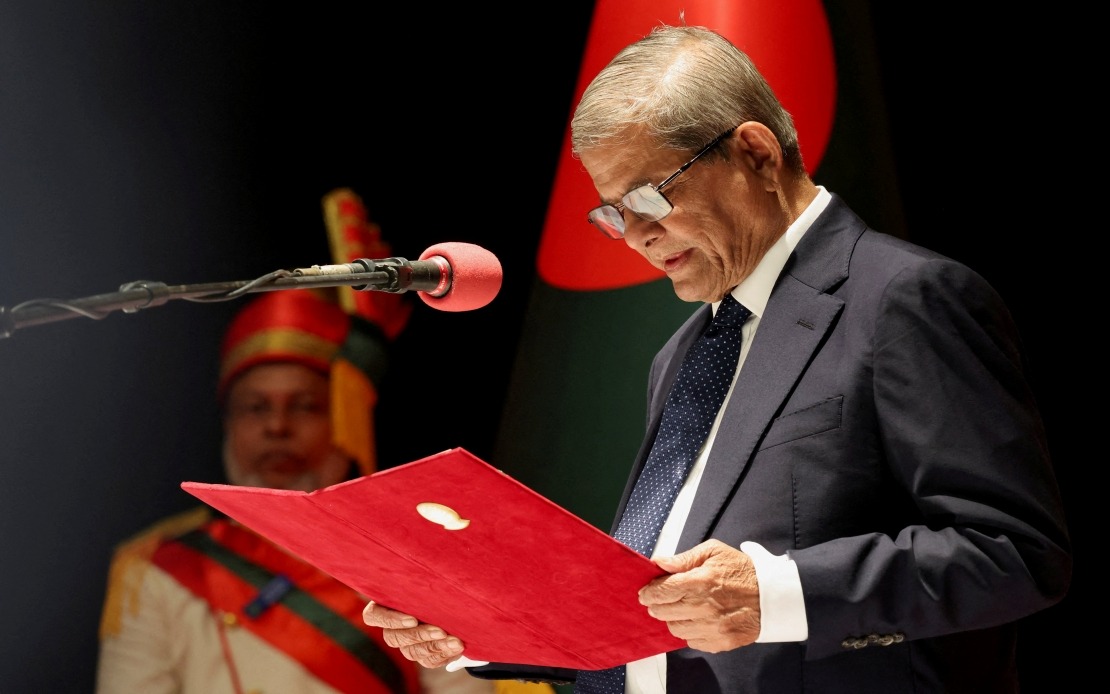
Mirza Fakhrul Islam Alamgir was sworn in as Bangladesh's 23rd President on Friday evening in a ceremonial gathering held at Bangabhaban, the official residence of the nation's head of state. The oath-taking took place at the Darbar Hall at 7.30 pm local time, marking a significant transition in the country's political leadership during a period of considerable constitutional flux.
Barrister Kayser Kamal, serving as Acting Speaker, administered the oath to the newly elected president. The formal proceedings followed constitutional protocols, with Fakhrul first receiving a welcome from senior officials upon arrival at the presidential compound before being formally received by Acting President Hafiz Uddin Ahmad Bir Bikram. This ceremonial reception underscored the institutional continuity expected to govern the transition of executive authority in the nation's highest office.
The ceremony drew an extensive gathering of Bangladesh's political and administrative elite. Prime Minister Tarique Rahman attended alongside members of the Cabinet, the chief justice, and parliamentary representatives. The presence of senior civil and military officials, combined with foreign diplomatic delegations, reflected the significance of the moment for both Bangladesh's domestic political framework and its international standing. Such comprehensive attendance at presidential inaugurations typically indicates the political importance of the transition and the need to signal stability to domestic and international audiences.
The constitutional parliament had elected Fakhrul in accordance with Bangladesh's constitutional provisions governing presidential selection. His background as a prominent opposition political figure and former secretary-general of the Bangladesh Nationalist Party positioned him as a significant player in the country's political landscape prior to his elevation to the ceremonial presidency. His appointment represents continuity with established political structures within Bangladesh's power configuration.
The ceremony incorporated traditional symbolic elements designed to convey the formal transfer of authority. Following the administration of the oath, the newly inaugurated president and the outgoing acting president exchanged their respective seating positions, a ritual gesture intended to represent the complete handover of presidential responsibilities and legitimacy. This symbolic moment, repeated across many constitutional democracies, serves to reinforce the peaceful nature of the transition and the continuity of state institutions despite changes in personnel.
Fakhrul completed the formal requirements by executing his oath of office and oath of secrecy, binding him legally and constitutionally to the obligations and confidentiality requirements inherent in the presidency. The inclusion of the oath of secrecy underscores the sensitive nature of information and decision-making that characterises high office, particularly during politically sensitive periods. These dual commitments form the foundation of the president's constitutional role and public responsibility.
The proceedings concluded with the performance of Bangladesh's national anthem, a customary finale to state ceremonies that reaffirms national identity and institutional continuity. The use of patriotic symbols at such events serves multiple purposes: it reinforces the connection between leadership transition and national unity, provides a moment of collective national reflection, and marks the official conclusion of the inaugural ceremony.
For regional observers in Southeast Asia, Fakhrul's inauguration occurs against the backdrop of Bangladesh's recent political turbulence and constitutional evolution. His appointment as president represents a particular configuration of political forces within the country and reflects decisions made during a period of institutional restructuring. The presidency in Bangladesh, while constitutionally significant, functions primarily as a ceremonial office with the Prime Minister holding executive authority, yet the symbolic weight of the position remains considerable for national political narrative and international representation.
The transition to Fakhrul's presidency signals continuity with established political institutions even as Bangladesh navigates contemporary constitutional challenges. His extensive experience within Bangladesh's political framework, combined with his background as a senior party functionary, suggests an understanding of the nuances and sensitivities required in representing the nation during a complex period. Regional dynamics, including Bangladesh's relations with neighbouring countries and its role within broader South Asian geopolitical configurations, may be influenced by symbolic positioning and diplomatic messaging emanating from the presidency.

