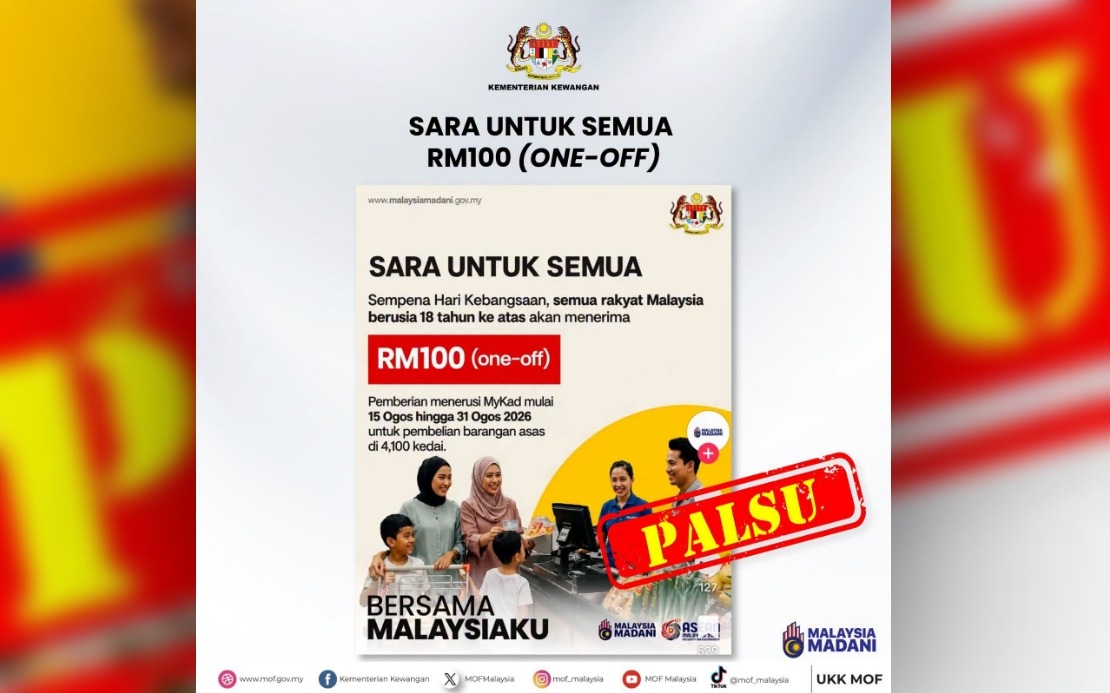
The Ministry of Finance moved swiftly on Tuesday to extinguish speculation surrounding a purported cash handout, declaring that no such distribution of Sumbangan Asas Rahmah funds would occur in connection with Malaysia's National Day celebrations. Through its social media channels, the ministry categorically labelled the circulating poster as fabricated, signalling growing concern about misinformation spreading across digital platforms during a period typically marked by heightened national sentiment and commemorative announcements.
The timing of this viral claim underscores a persistent vulnerability in Malaysia's information ecosystem. As National Day approaches, Malaysians frequently anticipate government largesse in the form of temporary relief payments or special allowances. This expectation, rooted in previous fiscal stimulus measures and assistance programmes, creates fertile ground for false claims to gain traction. The RM100 figure carries particular resonance in a country where such sums hold meaningful purchasing power for lower-income households, lending credibility to claims that might otherwise seem implausible.
The Ministry of Finance's response reflected frustration with the circulation of unverified claims, emphasising that the poster contradicted all official communication released through legitimate governmental channels. The ministry reiterated that any announcement concerning SARA payments or related disbursements would come through authenticated sources, not third-party social media accounts or forwarded graphics. This distinction between official and unauthorised information has become increasingly critical as digital communication accelerates the speed at which false claims propagate.
The incident highlights broader challenges facing Malaysian authorities in combating disinformation ahead of major national events. With millions of Malaysians active on social media platforms during celebrations, unverified claims about government benefits can achieve exponential reach within hours. The psychological appeal of such rumours—a sudden, unexpected monetary gift—makes them particularly sticky in people's minds and likely to be shared across family groups and community networks before verification occurs.
Background context reveals that Malaysia's Sumbangan Asas Rahmah programme has been a recurring feature of recent government assistance efforts, particularly during periods of economic uncertainty or cost-of-living pressures. Previous iterations of SARA payments have supported citizens facing inflationary pressures and reduced purchasing power. Consequently, public familiarity with the programme's existence made this particular falsehood more plausible to many recipients, who might reasonably assume that a National Day variant could form part of government celebrations.
The ministry's advisory to the public carries implications extending beyond this single incident. By explicitly urging Malaysians to rely exclusively on official channels for verified information, the Finance Ministry acknowledges that disinformation poses a genuine threat to public confidence in genuine government announcements. When people become accustomed to dismissing claims as potentially false, even legitimate government communications may face heightened scepticism. This erosion of trust in official sources ultimately weakens governmental ability to communicate with citizens during genuine crises or important policy announcements.
For Malaysian policymakers, this episode demonstrates the necessity of proactive communication strategies surrounding anticipated assistance programmes. When government payments or subsidies are under consideration or announcement, clear and timely official communication can forestall the emergence of false claims in information vacuums. The longer a period extends without official confirmation, the greater the opportunity for speculation and fabrication to flourish. Enhanced media literacy campaigns might also help the public develop greater discriminatory capability when evaluating claims about government benefits.
The broader Southeast Asian context reveals that Malaysia is far from alone in confronting systematic disinformation regarding government largesse. Similar false claims circulate regularly across the region, reflecting patterns of exploitation by bad actors seeking to sow confusion or undermine institutional credibility. Some instances reflect coordinated campaigns of political manipulation, while others emerge from simpler motivations such as seeking attention or creating viral content for engagement metrics. Distinguishing between these different origins remains challenging for both authorities and platforms.
Regional implications also deserve consideration. As Malaysian institutions work to improve information verification and combat disinformation, their experiences and response mechanisms gain relevance for other Southeast Asian democracies facing analogous challenges. Frameworks developed for identifying and countering false claims about government payments could potentially inform broader regional approaches to combating electoral misinformation or other forms of disinformation with serious governance consequences.
Looking forward, this incident suggests that Malaysian government agencies would benefit from establishing more sophisticated early-warning systems for detecting and responding to widespread false claims. Rapid response protocols, clear communication hierarchies, and pre-authorised messaging frameworks could enable faster intervention before misinformation achieves critical mass. Simultaneously, partnerships between government, technology platforms, and civil society organisations working on media literacy could create multiple reinforcing layers of defence against false claims gaining traction.
The episode concludes with a fundamental reminder about digital citizenship. Each Malaysian who encounters unverified claims about government payments carries personal responsibility for verifying information before amplifying it through sharing. By exercising critical evaluation of claims, particularly those promising unexpected financial benefits, citizens collectively raise the bar for disinformation success. This individual agency, multiplied across millions of users, ultimately constitutes the most effective long-term defence against misinformation ecosystems.

